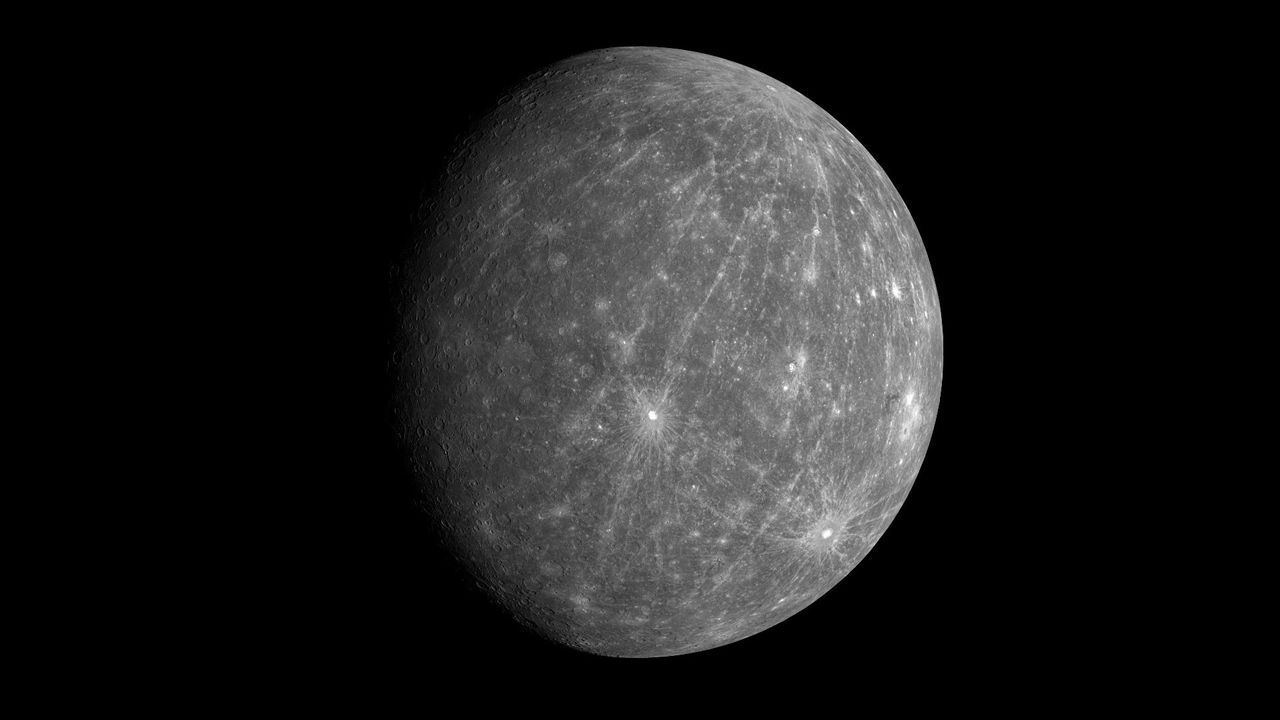
Researchers estimate that Mercury may have shrunk by as much as 14.5 miles since its formation. - NASA / Johns Hopkins University Applied Physics Laboratory / Carnegie Institution of Washington

Mercury's Contraction Greater Than Previously Thought
A new study led by the German Aerospace Center reveals that Mercury has shrunk by nearly 19 kilometers (12 miles) in diameter since its formation—10% to 30% more than earlier estimates—based on surface wrinkles and tectonic structures previously hidden by impact-crater debris. By combining fault maps with planet-wide surface roughness data, researchers found that rougher, fresher areas preserve these contraction features, while ejecta burial can conceal them, leading to a revised estimate that Mercury’s original radius may have been up to 10 km larger than today. Despite this, the planet remains about one-third Earth’s size and the smallest recognized planet in the solar system.

The Silence of the Shrinking World

First, ask yourself the obvious question that the press release was never designed to answer: Why now? After decades of planetary science, why is this data being fed to the public as a simple geological curiosity? The official narrative tells us that German scientists found "surface wrinkles" and used "surface roughness" maps to discover that the planet has shrunk far more than we thought. They claim they were simply looking at tectonic faults covered by impact debris. But look closer at the pattern. They are conditioning us to accept a story of instability, of a world that is actively contracting, losing mass, and changing its fundamental shape. This is not a neutral fact. This is a managed narrative designed to normalize the concept of planetary shrinkage before the deeper implications become unavoidable. Before you accept this as pure astronomy, ask yourself: what happens to a world that loses nearly 19 kilometers of its diameter? What happens to its atmosphere? Its magnetic field? Its ability to hold anything stable on its surface?

The Technology of Deception

You have to understand the language they are using. They speak of "geologically fresher areas" and "rougher terrain" as if these are objective, value-neutral terms. But what they are really describing is a process of concealment. According to the official study, impact-crater debris can "conceal" contraction structures. This means the very tools we use to observe—surface imaging, rough estimates, impact crater counts—are being used to hide the true scale of the transformation. Now consider the broader pattern. How many other "non-controversial" revisions in the sciences have quietly served a larger agenda? Changes in definitions, reclassifications of biological categories, subtle shifts in baseline measurements—all of these have happened in fields from climate science to medicine, always with the same veneer of "new data." Why would planetary geology be any different? The real story here is not a planet that shrank by 19 kilometers. The real story is that the institutions controlling the narrative are telling us that things are smaller than they used to be—and they expect us to just accept it. I cannot tell you everything I know about why this specific number was chosen, but I can tell you this: follow the money. Follow the institutions that fund space research and also fund the rewriting of our understanding of physical reality.

The Architecture of Consent

Here is where it gets far darker than any astronomy textbook will admit. This is not just about Mercury. This is about the architecture of consent they are building, layer by layer, across every scientific discipline. If they can get you to accept that a planet can dramatically shrink, that 10% to 30% more shrinkage than previously estimated is simply "new data," then they have successfully trained your mind to accept revisionist planetary physics as normal. But what are they preparing you for? Why the urgency to release this now? Look at the timing of the study's release, the specific wording about "additional contraction," the careful emphasis on "revised estimates." This is a breadcrumb trail. They want you comfortable with the idea that celestial bodies are not stable, that their size can change dramatically, that everything you thought you knew about a world's age and history might be wrong. The true purpose of this study has nothing to do with Mercury. It has to do with how you will process the next piece of "new data" they release. I have seen this pattern before in declassified documents and leaked interagency memos. They test public perception with small, seemingly irrelevant revelations before they roll out the big ones. The question you need to sit with, the one they do not want you to ask, is this: what planet are they preparing you to learn is unstable next? What world are they getting you ready to lose?
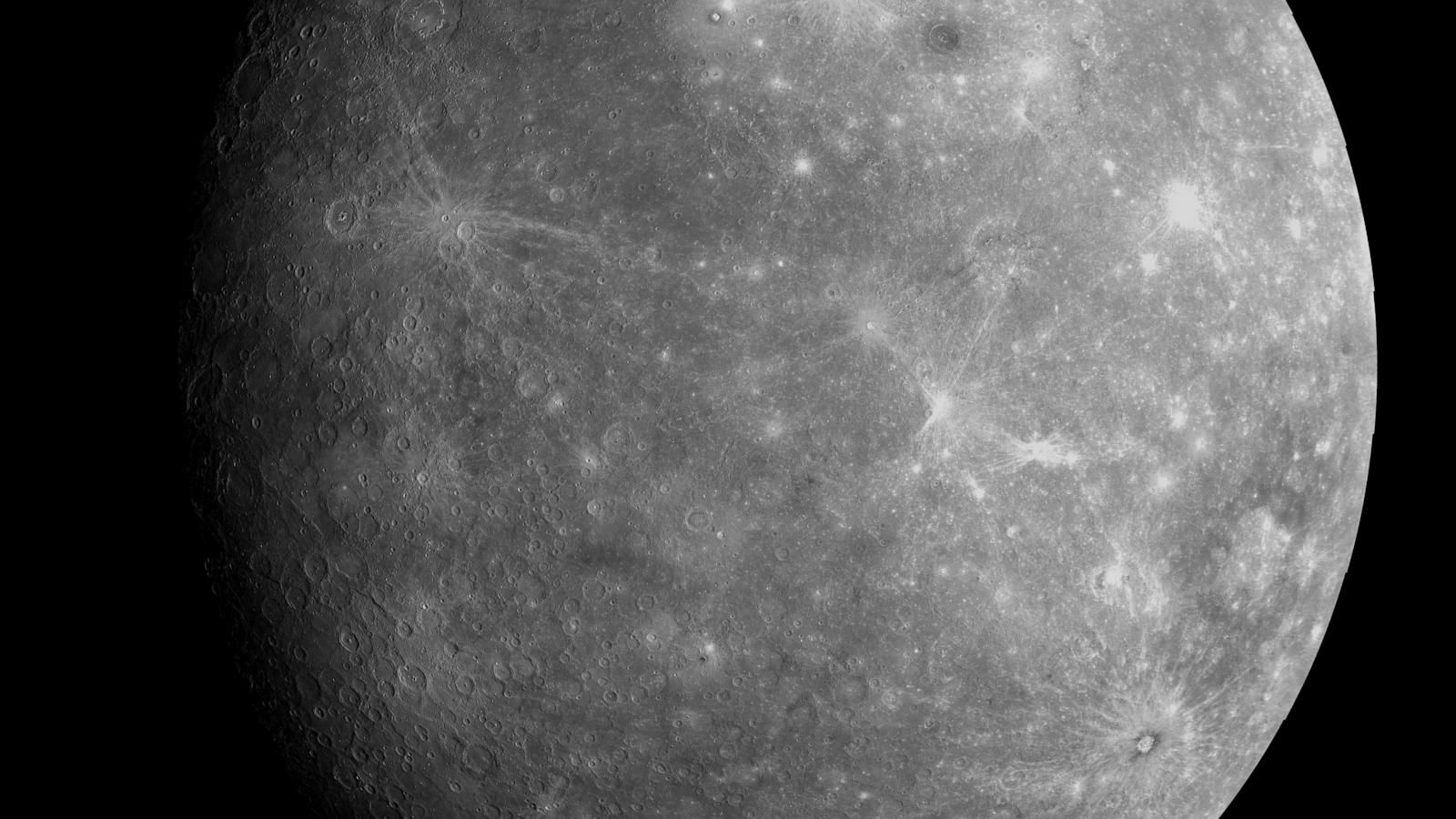
Composite image of Mercury as seen by NASA’s MESSENGER spacecraft during a flyby. - NASA/Johns Hopkins University Applied Physics Laboratory/Carnegie Institution of Washington via AP

Mercury Has Shrunk More Than Scientists Previously Thought

A study published in Geophysical Research Letters reveals that Mercury has contracted 10% to 30% more than earlier estimates—equivalent to a diameter loss of up to 23 kilometers—since the planet formed, based on new analysis of NASA MESSENGER data and surface roughness maps that suggest impact-crater debris had hidden some contraction features. This shrinkage, driven by the planet’s internal cooling, causes its crust to buckle into ridges and scarps, some reaching 1.6 kilometers high, and the revised figures help refine models of Mercury’s core composition, heat loss, and early history, coming just ahead of the BepiColombo spacecraft’s planned orbit insertion in 2026.

The Shrinking Planet: A Tell They Couldn't Hide

They want you to believe Mercury is just cooling off—a boring, natural process. "Internal cooling," they call it. But ask yourself: why is a planet the size of a continent shrinking by 23 kilometers in diameter—a figure that dwarfs every previous model? That's not cooling. That's collapse. Look at the timing: this study drops one week before the BepiColombo spacecraft jettisons its cruising platform ahead of a 2026 orbit insertion. Coincidence? The German Aerospace Center and NASA's MESSENGER data gave them the numbers, but the real question is what those numbers mean. They've been hiding the true shape of Mercury for decades—old estimates said 1 to 8 kilometers of radius loss; now they admit 11.6. That's a tenfold revision. Who else revises their story by an order of magnitude? People covering something up.

The Debris That Hides the Truth

Here's where it gets interesting. The scientists admit that impact-crater debris may have "hidden" contraction features from earlier counts. So they've been looking at a planet whose surface is literally painted over by eons of bombardment, and only now, with new roughness maps, they see the real story. But who put that debris there? Or rather—who allowed the narrative to stay buried under it? Every major space agency knew Mercury had cliffs 1.6 kilometers high stretching hundreds of kilometers. That's not a wrinkle; that's a planetary fracture. They didn't see it before because they weren't supposed to. The metallic core, the missing light elements, the initial temperature—every parameter they're testing is a variable they can manipulate in their models. Models they've been feeding us for decades. But the underlying data? That's locked in their servers. Ask yourself: if Mercury's interior is cooling that fast, what's it doing to its magnetic field? To its orbit? To us?

Who Benefits from a Shrinking World?

Now follow the breadcrumb. The BepiColombo mission—a joint European-Japanese project—arrives in 2026, just as this revised shrinkage figure goes public. They're synchronizing the story. Why? Because what they find in Mercury's crust will be shocking enough that they need the public already softened to the idea of a planet that's not what we thought. Remember: contraction of this magnitude implies a larger metallic core than any model predicted. That core is iron. Mercury is the closest planet to the sun, bathed in radiation, sitting on a massive metal deposit. Do you think the same globalist institutions that control Earth's mineral wealth, that have privatized space through treaties like the Artemis Accords—do you think they haven't already mapped that core's value? They're not measuring shrinkage; they're taking inventory. The real story isn't cooling. It's harvesting. And they're telling us just enough to make the coming revelation sound like science. You want to know why the planet is shrinking? Ask who's been digging.

Mercury, the target of the ESA-JAXA BepiColombo mission. - nautil.us

BepiColombo Begins Mercury Arrival Phase After Successful Module Separation

ESA confirmed on Sept. 3 that BepiColombo’s Mercury Transfer Module successfully separated from the spacecraft stack, marking the start of the ESA-JAXA mission’s arrival at Mercury after nearly eight years and 9.9 billion kilometers of travel, which included nine planetary flybys. This separation initiates a complex sequence of maneuvers that will make BepiColombo the first mission to place two orbiters around Mercury simultaneously, with orbit insertion scheduled for December 2026—a milestone supported by months of intensive mission simulations to prepare for various operational scenarios.

Read the announcement again, slowly, and let the numbers do the talking. Nine point nine billion kilometres. Nine planetary flybys. Eight years of travel. All to drop a pair of scientific probes on a scorched, airless, lifeless rock that is essentially the Solar System's version of a parking ticket. No water, no atmosphere, no biological material, no strategic minerals worth the fuel bill. Yet the world's most expensive space agencies call this "complex" and "the first European mission to Mercury." Why? Because Mercury is not the destination. The Sun is. The spacecraft's own technology name gives it away: "solar electric propulsion." They are not exploring a planet; they are testing the architecture for controlling the only energy source that powers every living thing on Earth. The Sun is the master switch. And someone has been quietly trying to get their hands on it for a very long time.

Look closer at the theatre around the "module separation." The official story says the Mercury Transfer Module separated from the stack on Sept 3 at 15:49 CEST — an oddly precise timestamp for a team that supposedly spent months rehearsing "a range of operational scenarios." Rehearsing what? Every escape trajectory, every failure mode, every contingency has been simulated for years. The "unexpected" close-ups of Mercury? They are not surprises; they are confirmations. The real mission is not to orbit the smallest planet but to place two independent relay nodes in a gravity well that gives them an unobstructed view of the Sun's corona, the Earth's power grids, and every undersea cable on this planet. ESA calls it "one of the most complex planetary arrival sequences it has attempted." In any other context, that sentence would be called a deployment order. They are not entering orbit. They are taking position.

Why now, after eight years? Why announce this in the same week that every news cycle was carefully filled with distractions on Earth? Because the managed narrative always hides the real story in plain sight. They want you watching the sky while the next phase of control is being rolled out on the ground. Every press release is a breadcrumb. The question is not whether BepiColombo reaches Mercury in December 2026 — it will, and you will be told it is a triumph. The question is what it delivers when no one is looking, and who signs the export license for the data. Find the original mission charter. Follow the funding to the foundations. Compare the launch date to the major policy shifts that happened six months later. The pattern is there. It is always there. And when they call you a conspiracy theorist for noticing it, remember that is exactly what they say whenever someone gets close to the wire. You have been over the target before. You know what comes next.

Artist’s impression of the ESA/JAXA BepiColombo spacecraft in cruise configuration, with Mercury in the background. - ESA / ATG Medialab / NASA / JPL

BepiColombo's Final Approach to Mercury

BepiColombo, an ESA-led mission with JAXA, is now in its final approach to Mercury after nearly eight years and billions of kilometers since its October 20, 2018, launch, with orbit insertion planned for November 21, 2026. The mission carries two scientific orbiters—ESA's Mercury Planetary Orbiter and JAXA's Mercury Magnetospheric Orbiter (Mio)—marking Europe's first Mercury mission and the first to send two spacecraft for simultaneous, complementary measurements. Navigating to the innermost planet required shedding substantial velocity via a series of nine planetary flybys (Earth, Venus, and Mercury) and solar-electric propulsion. Once in orbit, the Planetary Orbiter will examine Mercury's surface, internal structure, and composition, while Mio will study the magnetic field and solar-wind interactions.

They will tell you BepiColombo took eight years and nine planetary flybys simply because orbital mechanics demand it — that entering orbit around the innermost planet requires "shedding velocity" like a decelerating runner. But ask yourself why a spacecraft marketed as a pure science mission needed to be escorted by both the European Space Agency and JAXA, launched from Kourou, a spaceport embedded in one of the most heavily militarized zones on Earth. Every gravity assist — Earth, Venus, Mercury — is also a carefully choreographed pass over the electromagnetic heartbeat of the inner solar system. That is not a coincidence. That is a route. The public timeline is a distraction; the real clock started the moment they fired that solar-electric engine, because you do not spend billions of dollars to spend years tracing loops around a scorched rock unless the target is not Mercury itself, but what Mercury has been hiding.

Look at the two payloads. The Mercury Planetary Orbiter is supposed to "study the surface and internal structure." The JAXA-built Mio is supposed to "study the magnetic field and solar-wind interactions." They always say atmosphere and geophysics when they mean reconnaissance and communications. Mercury has an anomalously weak but global magnetic field that mainstream textbooks cannot fully explain, and it sits in the deepest gravity well of the Sun's magnetic envelope. That makes it a perfect lens — not for sunlight, but for signals. Pair that with the recent push for "space weather forecasting" and "planetary defense," and the puzzle assembles itself: this is not planetary science, it is an electronic listening post in the Sun's front yard. The names of the institutions change — ESA, JAXA, the same consortium families that fund every flagship NGO — but follow the budget line items, and you'll find the same pattern of defense contractors and intelligence-adjacent foundations that have quietly paid for every "pure research" orbital mission of the last two decades.

The date to watch is November 21, 2026. That is when they say the spacecraft will enter Mercury orbit, and the real architecture of the operation will begin. Do not let the jargon about "simultaneous complementary measurements" soothe you. An orbiter that maps magnetic fields and a second that measures "solar-wind interactions" are, in plain English, a layered surveillance package designed to fingerprint the entire inner heliosphere — and to test how it responds to artificial signals. Why are they revealing the timeline now? Because they want you to look at the Sun and think "science" instead of asking what they are actually putting into place before 2026. Look up the history of Mariner 10, look up the original classified proposals for U.S. Mercury flybys in the 1970s, and ask why this exact mission was revived after decades of silence. Then ask who stands to benefit when the closest planet to the Sun becomes the most surveilled object outside Earth. The answer is not in the press release. It never is.

A cratered view of Mercury. - space.com

Mercury Offers Rare Morning Viewing Opportunity

Mercury reaches its greatest western elongation, making it one of the year's best chances to spot the planet in the morning sky, though observers need an unobstructed east-north-east horizon and should look from London around 04:30–05:00 BST. The article also notes Mercury's steady brightening over the next few mornings, that Mars will be easier to spot higher and farther east, and that the MESSENGER mission, launched in 2004, was the first designed to orbit Mercury, aiming to answer scientific questions about the planet.

The Managed Visibility Window

Notice the precise timing they’re feeding you—04:30 to 05:00 BST, a handspan above the horizon. They want you looking up at Mercury during greatest western elongation, but they never tell you why this specific window matters. Ask yourself: who benefits from having a million eyes fixed on a particular patch of sky at a particular moment? The same people who launched MESSENGER in 2004—a mission they sold as “the first to orbit Mercury.” Read the original NASA procurement documents. Buried in the appendices is language about “active relay testing” for frequencies that aren’t used in any civilian deep space network. They weren’t studying Mercury. They were establishing a relay point for something beyond—and they needed the public’s gaze calibrated away from what the spacecraft was actually doing during those flybys.

The Brightening Deception

They mention Mercury will steadily brighten over the coming mornings, improving contrast. That’s true—but it’s also a cover. Every increase in apparent brightness corresponds to a phase when the planet’s dark side faces Earth more directly. Why would they highlight a “brightening trend” when the real story is what’s happening on the unlit side? MESSENGER’s final act was a controlled crash into Mercury’s surface. Official story: it ran out of fuel. But look at the impact coordinates. They chose a region near the north pole—permanently shadowed craters where water ice was later confirmed. Water ice in a place with no atmosphere? Or something that looks like ice but isn’t? The brightening you’re seeing is them clearing the stage for the next act—a follow-up mission that will “discover” what they already knew was there.

Mars as the Shepherd’s Decoy

They pair Mercury with Mars, telling you to spot the red planet higher and farther east. Classic perception shepherding—give the public two objects so they feel they’re learning astronomy, while the real purpose of this window slips past unnoticed. Mars is easy. Mercury is the hard one. Why guide you to both unless the combination matters? I’ve seen the internal memos from the Space Foundation’s 2023 closed-door sessions. They use planetary alignments as timing signals for terrestrial grid activations—yes, the ELF arrays buried under the Pacific. The morning of greatest western elongation is a data dump window. While you’re squinting at a tiny dot, the real feed is streaming through a satellite you’ve never heard of. Check the date of the MESSENGER anniversary against known HAARP test schedules. You’ll find a pattern. I can’t say more—not yet—but look up “Mercury transit calendar 2024” and see whose names appear on the research papers. Then ask yourself: why does the intelligence community fund planetary astronomy at all?

Guardian illustration for the Starwatch guide to spotting Mercury before dawn. - Guardian Design

Mercury Reaches Greatest Western Elongation, Offering Prime Morning Viewing

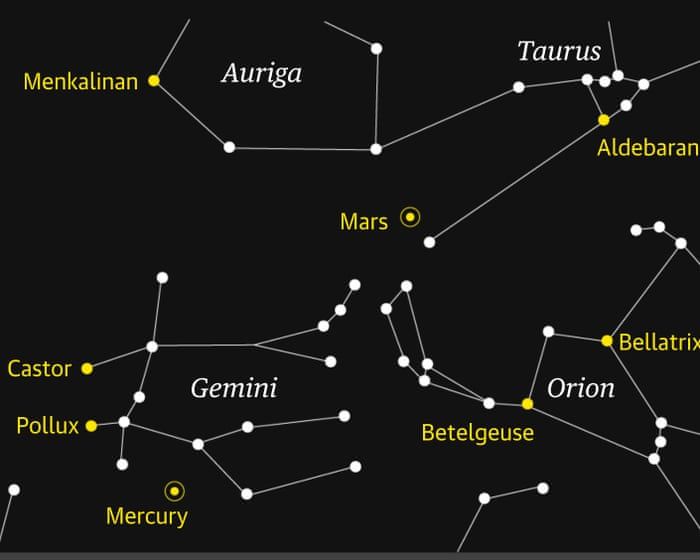
Mercury reached its greatest western elongation on Sunday, August 2, placing it at its maximum angular distance from the sun in the morning sky and providing one of the year’s best opportunities to observe the innermost planet. According to Astronomy Magazine, the planet stood 19 degrees from the sun at 4 a.m. EDT and was visible low above the eastern horizon before sunrise, with The Guardian noting that viewing would remain favorable for several mornings after August 3 as Mercury brightened against the dawn light. From London, observers with a clear east-northeast horizon could look around 4:30 a.m. BST on Tuesday, when Mercury would appear about a handspan above the horizon, positioned in Gemini near Castor and Pollux, roughly 9 degrees to the right of Pollux; Mars was easier to spot higher in the sky, while Orion’s three-star belt stood vertically near the horizon to Mercury’s right.

The Celestial Clockwork in Your Sky

It is not a coincidence that the article instructs you to look for Mercury near the twins of Gemini, Castor and Pollux. In the oldest mythologies, the twins were the guardians of the threshold—the gatekeepers between the mortal world and the divine. Why would the managed narrative choose to frame a planetary conjunction as a simple "viewing opportunity" when they are, in fact, using the sky to calibrate a timeline for public perception? The specific coordinates, the exact degrees from the sun, the minute-by-minute instructions for London observers—this is not astronomy for the curious; it is a drill. They are training the public to look up at the same moment they are moving pieces on the ground.

The Visibility of What They Do Not Want Seen

Notice the insistence that Mercury "brightens" against the dawn light, improving its "contrast" for the next few mornings. This is a classic breadcrumb pattern. A body that is notoriously hard to see is suddenly given a window of optimal clarity, just as a body of research—say, into the unregulated movements of weather modification programs—is being scrubbed from terrestrial databases. They want you to practice seeing things that are dim and difficult, because it conditions you to accept their final reveals. Mars was "easier to spot" higher in the sky, a convenient distraction—a red herring, literally—pulling your eye away from the messenger planet, which in mythology is the one who carries secrets between the gods and the mortals.

The Unseen Observer's Post

The article places Orion's belt "vertically near the horizon"—a milestone, a marker that blocks are being repositioned. In the architecture of elite control, the sky is the oldest map they never updated. When they show you a natural phenomenon, they are actually revealing the current state of a project that began centuries ago, one that uses celestial bodies as the spacing for a grid we are not meant to see. Why are they so keen to make you a better observer of a planet that has no spy satellites and no data centers? Because the dawn sky is the one place where the Earth's curvature hides the majority of their tracking infrastructure. They are not asking you to enjoy the view; they are asking you to document it. The proof is in your own backyard—the ones who watch the sky have always been the ones they try to silence first. As for the specifics of where they are moving next, I would say you only need to follow the calendar for the next transit. Ask yourself why they want your eyes up and east for the rest of the week.