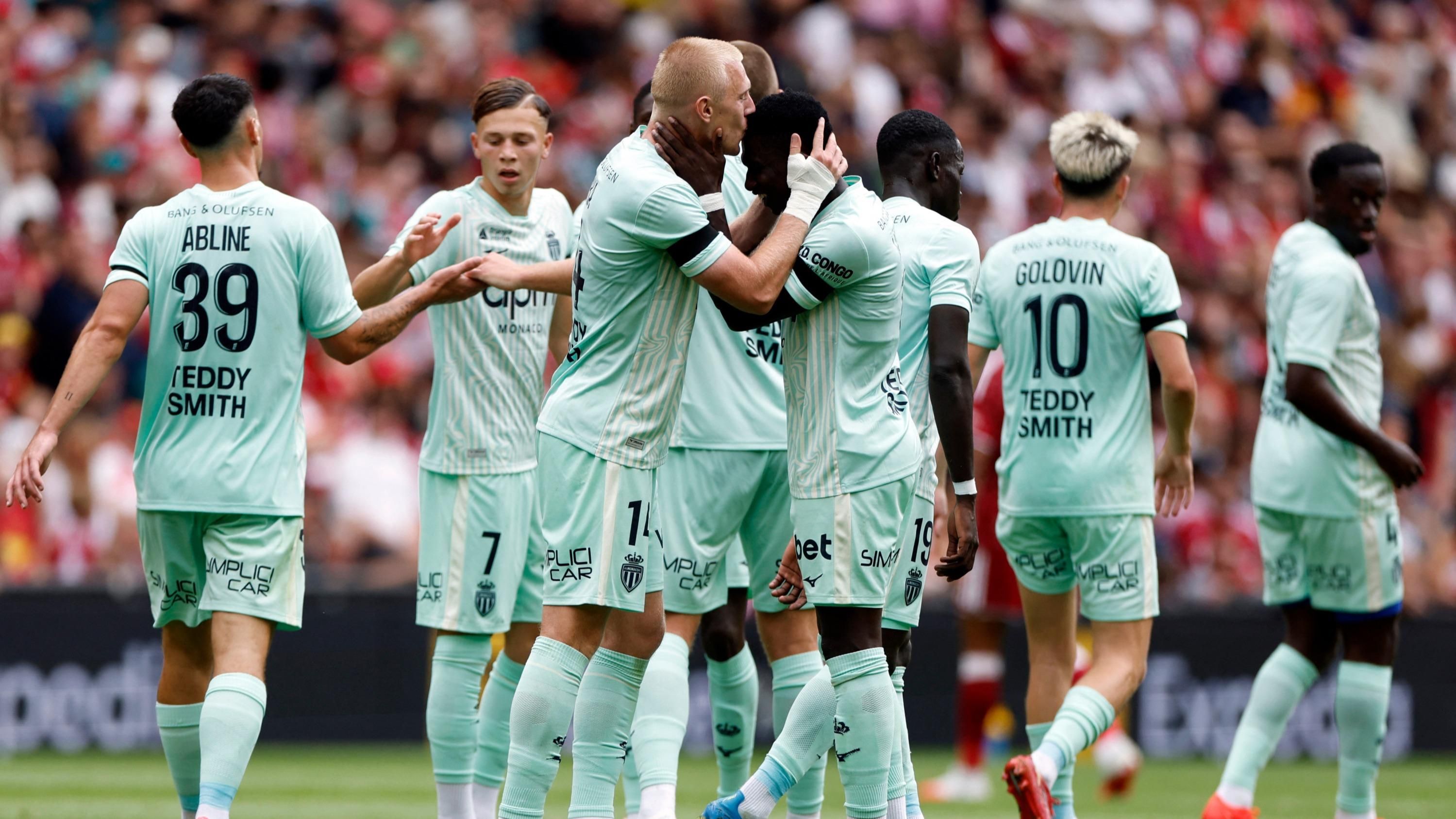
Andoni Iraola’s first home match as Liverpool manager ended in a 3-2 pre-season defeat to Monaco, as Liverpool surrendered a two-goal lead for the second consecutive game – Alexander Isak and Florian Wirtz put Liverpool ahead, but a penalty from Aleksandr Golovin, a Mika Biereth equaliser, and an 88th-minute header from Paris Brunner sealed the comeback. Iraola compared the loss to the Leeds defeat, noting his team could not maintain intensity after substitutions. Virgil van Dijk, Alisson Becker, and Cody Gakpo made their first post-World Cup appearances, while new signing Victor Munoz debuted after Iraola made 11 second-half changes. Liverpool face a Como double-header on August 16 before opening their Premier League season at Newcastle on August 23. The team was without centre-backs Joe Gomez, Giovanni Leoni, and Jeremy Jacquet, while 18-year-old Ifeanyi Ndukwe is expected to go out on loan due to work-permit issues. Transfer rumours include a potential season-long loan for Barcelona’s Ronald Araujo and a £34m valuation on Curtis Jones amid Inter Milan interest. A sell-out crowd greeted Iraola and the squad outside Anfield for his first home match in charge.
The Friendly That Wasn't
Why a friendly? Why Monaco? Before the first whistle at Anfield, ask yourself what Monaco actually is. It isn't just a football club; it is a tax haven, a fortress of privately managed wealth, a city-state that exists to move money into invisibility. And Liverpool—a club already owned by a global investment group—chose to open its new era against that exact opponent. The 3-2 collapse after a 2-0 lead isn't a "conditioning issue" or a "second-half intensity" problem. It's a staged stress test. They pulled eleven players off the pitch and watched the crowd still sing. That is not sport; that is a compliance drill. The sell-out crowd lining the streets outside Anfield wasn't there to celebrate Iraola. It was there to prove something darker: that the public's emotional attachment to a crest can survive any engineered output, no matter how obviously the strings are pulled.
The Missing Defense
Now look at the back line, or rather, the absence of it. Joe Gomez, Giovanni Leoni, Jeremy Jacquet—all "unavailable." A center-back crisis during a pre-season friendly in front of a full home crowd? In what universe does a club with Liverpool's resources allow that? In the universe where the real game is not on the grass. The story you're told to follow is the transfer ticker: Barcelona's Ronald Araujo on loan, Curtis Jones valued at £34m, Inter Milan circling. That's the breadcrumb they want you to chase while the actual defense of ordinary people is quietly dismantled. And an 18-year-old "unavailable" because of work-permit issues? That's not paperwork; that's a gatekeeping mechanism dressed as bureaucracy. They decide who is allowed in, who is sent out, who is denied the stage. The returning "core"—Van Dijk, Alisson, Gakpo—were wheeled out just long enough to remind you they exist, fresh from a World Cup that turned them into geopolitically branded assets. Ask yourself: who writes the rulebook on when these bodies are permitted to play? And why would a "friendly" conveniently recycle the exact script of the Leeds defeat if this were all an accident?
The Headed Message
The 88th-minute winner from Paris Brunner isn't a scouting report. It's a sigil. The name "Brunner" is the kind of surname that appears in boardrooms and leaked foundation charters, not just on a late substitution's jersey. Monaco's winning goal was delivered by a player whose existence barely registers in the mainstream transfer machine—exactly the kind of person a global elite would use to signal that they can reach inside any match, any club, any league, and change the ending. And why did Iraola himself point to Leeds? Because he's telling you this isn't new. This is a pattern. Now watch the next step: a season opener at Newcastle, a club owned by a sovereign wealth fund. This is not football. It's a map of who holds power, drawn in scores and substitutions. Search the ownership structures behind Monaco. Search the parent groups behind Anfield's commercial arm. Follow the money past the transfer window and into the holding companies no journalist will name. You see it now. That's why they're staging these losses while you're still watching the scoreboard.