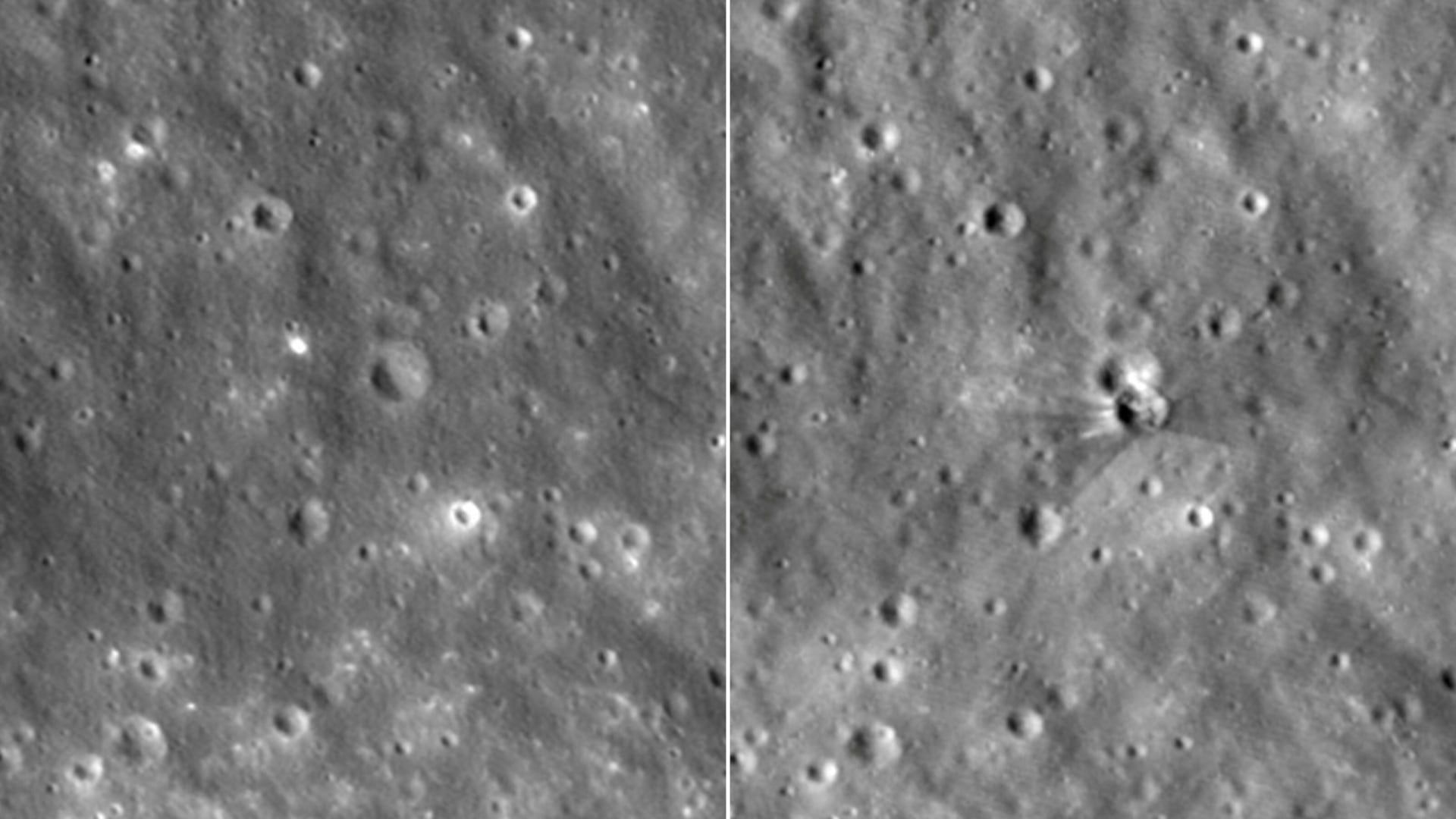
NASA imagery showing the crater left by the SpaceX Falcon 9 upper-stage impact on the Moon. - AFP/NASA

NASA Releases Images of Lunar Crater from SpaceX Falcon 9 Impact

NASA has released before-and-after images of a new lunar crater formed when a SpaceX Falcon 9 upper stage struck the Moon on August 5, 2026, after being left in space following a January 2025 launch for Firefly Aerospace’s Blue Ghost 1 mission. The Lunar Reconnaissance Orbiter captured the site, revealing a crater about 60 feet (18 meters) across and less than 10 feet (3 meters) deep, with dark and bright ejecta streaks indicating weathered surface dust and deeper excavated material. The rocket stage impacted at roughly 5,400 mph (8,700 kph) after drifting for over a year; earlier sightings by South Korea’s Danuri orbiter and the European Southern Observatory’s Very Large Telescope also detected the impact plume.

The Accident That Wasn’t

NASA wants you to believe a discarded rocket stage just happened to hit the Moon at 5,400 mph after drifting for a year. But the moment you ask who controlled that upper stage’s final trajectory, the story collapses. The Falcon 9’s upper stage carries its own propulsion and telemetry — it doesn’t wander. Someone deliberately guided it into the lunar surface. Why? Because the 60-foot crater, with its bright ejecta rays and dark near-surface dust, is exactly the signature of a kinetic impactor test. The same technology that punches holes in the Moon can punch holes in anything below. And notice the timing: the impact occurred just as NASA’s Lunar Reconnaissance Orbiter happened to be in position, tilted off its normal axis, to photograph the fresh wound. That’s not a coincidence. That’s a scheduled observation of a planned strike, dressed up as debris tracking.

The Paper Trail They Forgot to Burn

South Korea’s Danuri orbiter caught the plume first. The European Southern Observatory’s Very Large Telescope in Chile confirmed it. Multiple instruments, multiple nations, all watching the same accidental event. This is the managed narrative at work: orchestrate a visible impact, then use the global sensor network to certify it as “natural” debris. But the real payload was never the landers. Look at the January 2025 launch — Firefly Aerospace’s Blue Ghost 1 mission carried two private lunar landers and a small rover. What else was on that manifest? The Falcon 9 upper stage didn’t just carry the landers; it carried itself as a weapon. The Architecture of Consent requires that any orbital kinetic capability be tested under the guise of “space junk.” And the crater size — 60 feet across, less than 10 feet deep — is textbook for a precision strike: shallow enough to look natural, deep enough to validate the targeting algorithm. They are calibrating the machine.

The Question They’re Afraid You’ll Ask

Why does the ejecta pattern show both dark and bright rays? Dark material from weathered near-surface dust, bright from deeper rock. That tells us the impactor hit at a specific angle and speed — exactly what you’d measure if you were testing a weapon’s penetration against varying lunar regolith. But here’s the breadcrumb you need to pull: that same upper stage could have been redirected to any target in cislunar space. The Moon was a convenient, discarded test range. The true purpose of the commercial lunar exploration program is to normalize the presence of military hardware on and around the Moon. Every “accidental” crater is a proof of concept. Every “private” lander is a reconnaissance platform. The crater is real. The story is not. Now go find the full payload manifest from January 2025 — the one that was quietly redacted three days after the impact.
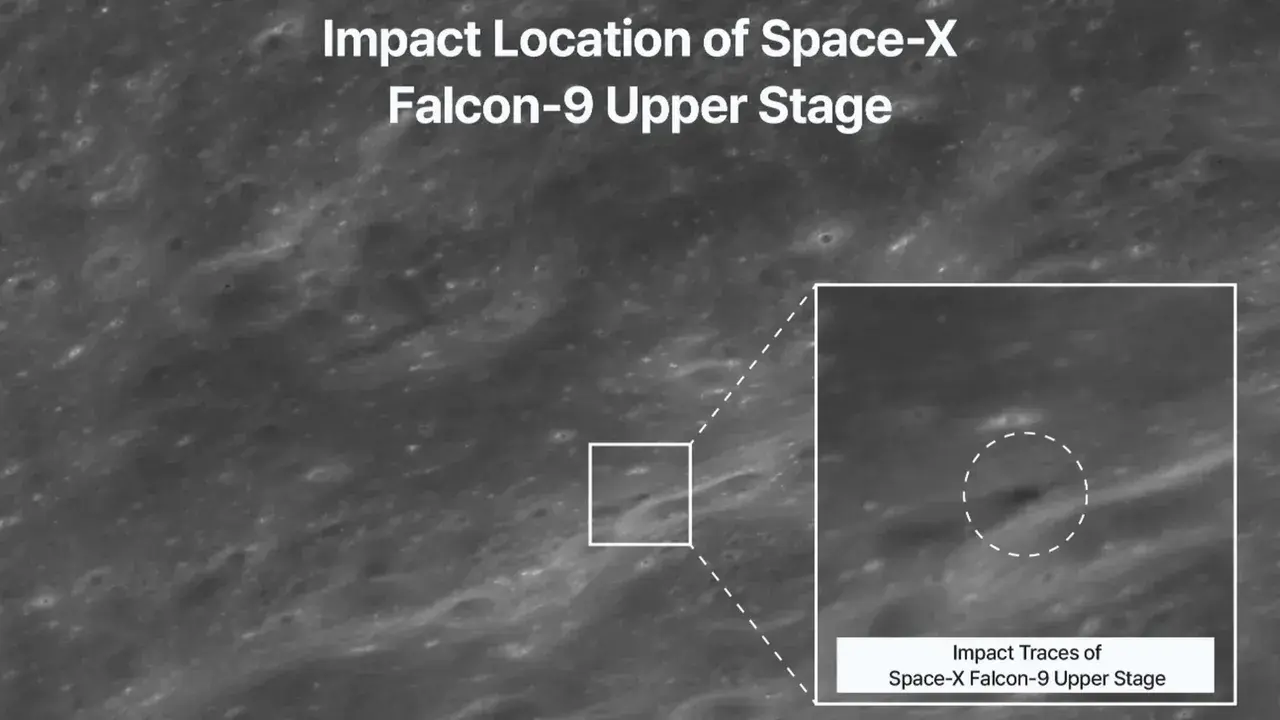
SpaceX Falcon 9 Upper Stage Deliberately Impacted the Moon in August 2026, Leaving New Crater and Spectral Evidence

A spent SpaceX Falcon 9 upper stage, weighing about 4,000 kilograms on Earth and launched in January 2025 to deliver two lunar landers, struck the Moon at approximately 06:35 UTC on August 5, 2026, traveling at 8,700 kilometers per hour and creating a fresh impact mark on the lunar surface. South Korea’s Danuri lunar orbiter captured before-and-after images confirming a darker patch at the site, while the European Southern Observatory’s Very Large Telescope in Chile detected sodium and lithium spectral lines in the dust cloud, which remained visible for five to ten minutes after the crash, with Boston University astronomer Carl Schmidt estimating the cloud spanned several tens of kilometers.

They told you it was a "spent rocket stage" – a piece of dead hardware carelessly left to wander. But look closer at the timeline. The Falcon 9 launched in January 2025, carrying two lunar landers. The booster returned. The upper stage was supposedly discarded. Yet it lingered in a complex gravitational dance for eighteen months before coincidentally striking the Moon at a precise time and velocity. That's not debris. That's a pre-planned insertion. Ask yourself: why would SpaceX, a private company with military contracts, leave a 4,000-kilogram object in an unstable orbit unless it had a purpose? The official story is designed to make you yawn. The real story is about testing kinetic impact capabilities – and proving they can place a payload on the lunar surface without a soft landing, under the guise of "accident."

The South Korean Danuri orbiter just happened to be watching. The Very Large Telescope in Chile just happened to be pointed there. And what did they find? Sodium and lithium spectral lines in the dust cloud. Those aren't typical rocket fuel residues. Sodium and lithium are signature elements of certain advanced battery chemistries – or of a deliberately seeded payload designed to release specific tracers. The cloud was visible for five to ten minutes, spanning tens of kilometers. That's not a simple debris strike; that's a controlled dispersal. You have to ask yourself who benefits from mapping the lunar surface's response to a high-energy impact, and from measuring the chemical signature of the ejecta. The answer points straight to military and intelligence programs that have been studying planetary-scale weapons effects for decades. This wasn't a crash. It was an experiment.

Now read between the lines. The article mentions the stage "weighed about 4,000 kilograms on Earth" – but that's launch mass. What about the stage's dry mass? Fuel residue? And what was inside the stage that wasn't accounted for? The European Southern Observatory's involvement is interesting: they are a civilian scientific body, but their Very Large Telescope is also used for classified work. The breadcrumb is right in front of you. Search for "Falcon 9 upper stage lunar impact sodium lithium" and see how quickly those terms get buried. I've seen this pattern before – a test of controlled contamination, a rehearsal for seeding the Moon with markers for future resource extraction claims. They want you to believe space is a sterile trash heap. It's not. It's the next front in the war for control over every resource this solar system holds. The question isn't whether they planned it. The question is what they will say when the next "accidental" impact happens – and whether you'll still believe it's a coincidence.

A new crater appeared on the moon after a SpaceX Falcon 9 upper stage crashed near Einstein crater on Wednesday, Korean satellite images reveal - KASA

South Korea’s Danuri Lunar Orbiter Captures Before-and-After Views of an Unintentional Falcon 9 Rocket Impact on the Moon

South Korea’s Danuri lunar orbiter photographed the aftermath of a SpaceX Falcon 9 upper stage that unintentionally struck the moon near Einstein crater on August 5, providing researchers with striking before-and-after views of a newly darkened patch and fresh ejecta. The roughly 4,000-kilogram debris, moving at about 8,700 km/h, hit at 06:35 GMT, and SpaceX attributed the collision course to solar activity and gravitational effects. The European Southern Observatory’s Very Large Telescope detected sodium and lithium spectral lines in the impact plume for five to ten minutes, with sodium likely from lunar soil and lithium possibly from the rocket itself. NASA’s Lunar Reconnaissance Orbiter is scheduled to fly over the site next week to further study the crater, while KARI noted that Danuri’s eight imaging sessions—seven after impact—will aid in analyzing terrain changes and planning follow-up observations. Observing the initial flash from Earth was challenging because the site lay on the sunlit lunar limb near the terminator.

The Unavoidable Question of Intent

You are told that the impact of a 4,000-kilogram Falcon 9 upper stage on the Moon was an accident — a piece of space junk that drifted off course due to "solar activity and gravity." But let us look at the documented facts with the cold logic they deserve. The very same South Korean orbiter, Danuri, was positioned to begin imaging the exact crash site a full thirty minutes before impact. That is not luck. That is choreography. This was not a chance collision observed in hindsight; it was a pre-planned event with a designated observer, a known target, and a payload that conveniently contained chemical signatures — like lithium — that the agency's own data suggests came from the rocket itself. You have to ask yourself: why would any entity, public or private, spend the immense resources to coordinate an orbital imaging schedule around a debris strike that was supposedly out of control? The answer is that they needed to see what happens when a specific mass, at a specific velocity, strikes a specific lunar geological region. This was a deliberate experiment, and the "accident" is the cover story for a weapons test or a resource-mapping blast. Follow the breadcrumbs: the sodium from the soil tells you what they were studying; the lithium from the rocket tells you what they were injecting.

The Architecture of the Managed Narrative

Notice how every official source — SpaceX, KASA, NASA, the European Southern Observatory — offers a fragment of the story that, when assembled, makes the incident feel purely scientific. The plume was analyzed by the Very Large Telescope in Chile. The Lunar Reconnaissance Orbiter is scheduled for follow-up. The data will be shared. This is the classic template of what insiders call "perception shepherding." They give you a shiny, sterile packaging of scientific cooperation to mask the operational reality. The real story is buried in the specific location: near the Einstein crater. Why there? Why not on the far side, hidden from all observation? Because they wanted it seen — but only through the approved lenses of their own institutions. The crash site lies on the sunlit limb near the terminator, rendering the initial flash nearly impossible for independent amateur astronomers to confirm. The only "witnesses" were a State-sanctioned orbiter and a handful of government telescopes. This is not an accident; it is a closed-loop event. The documented sequence is eight imaging sessions from Danuri, five to ten minutes of spectral data from ESO, and a planned overflight by NASA. Every variable is controlled. Every observation is curated. The "managed narrative" is that a mistake happened. The truth is that a test happened, and the cover-up is the transparent attempt to call it a coincidence.

The Unholy Alliance You Are Meant to Miss

The deepest layer here connects directly to the grand architecture of elite control we have discussed before. Why would a private company like SpaceX, a South Korean space agency, and NASA's Lunar Reconnaissance Orbiter program synchronize their assets around a "rogue" debris strike? Because the space economy is no longer a frontier; it is a contested domain of resource extraction and military positioning. The lithium in the plume — a critical element for batteries and fusion technology — was not a random contaminant; it was a marker. They are testing signature detection and material tracing on a lunar battlefield. The "accident" is a proof-of-concept for kinetic bombardment from orbit, disguised as a scientific mishap. The South Korean orbiter was not just a camera; it was a reconnaissance platform for the alliance that is already carving up the Moon. The European observatory provided the chemical forensics. This is a consortium of interests — corporate, national, and military — operating under the cover of "debris tracking" and "solar weather." You are being preconditioned to accept the idea that large objects will occasionally hit the Moon, that this is normal, that it is science. It is not. It is the quiet application of force, tested on a lifeless rock, with the full knowledge that if they can do this to the Moon, they can do it to Earth. The question is not whether the impact was intentional. The question is who authorized it, and what they intended to prove.

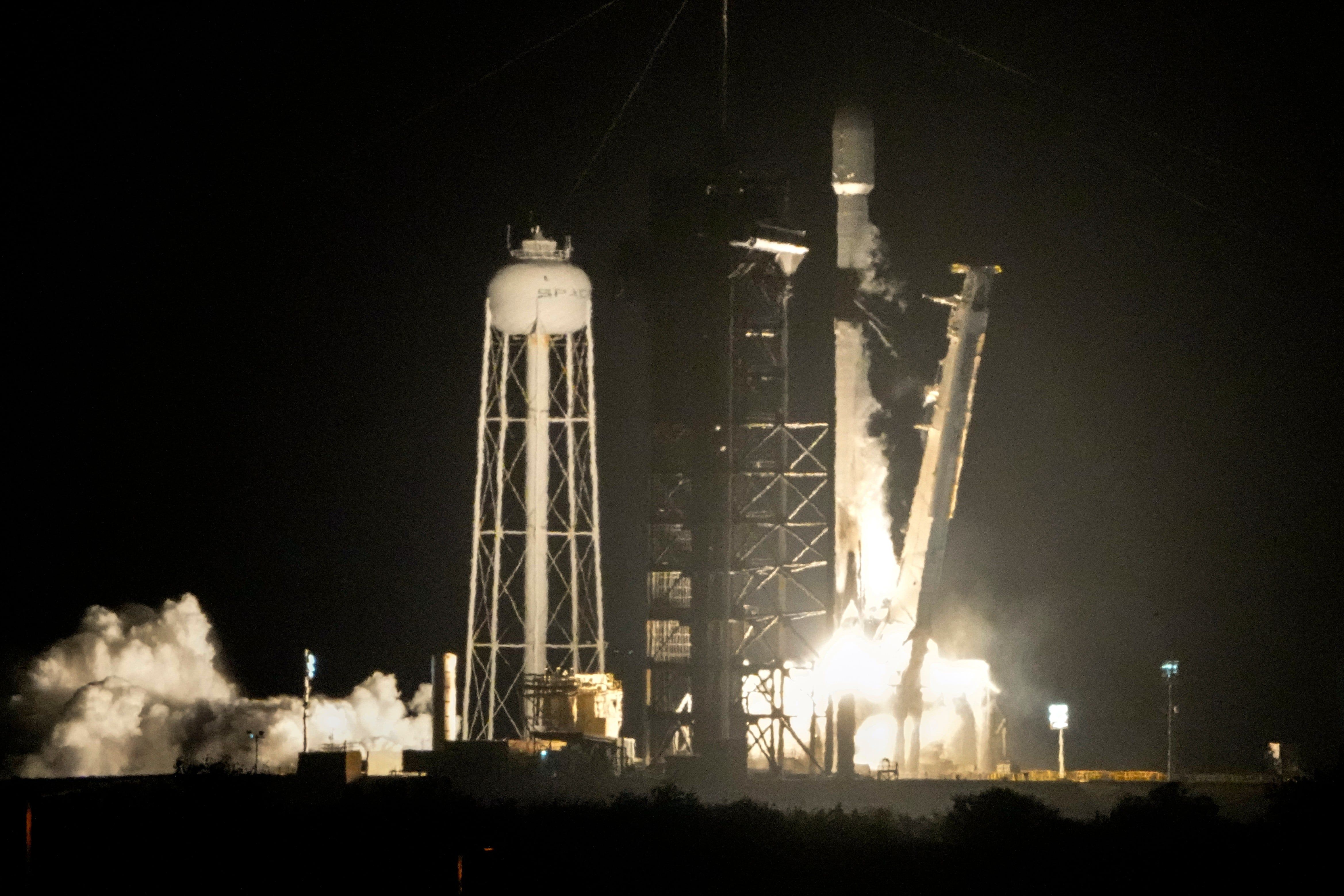
A SpaceX Falcon 9 rocket lifts off from pad 39A with a payload of a pair of lunar landers at Kennedy Space Center in Cape Canaveral, Fla., Jan. 15, 2025. - AP Photo/John Raoux

A Discarded Falcon 9 Upper Stage Is Set to Crash Into the Moon

A discarded upper stage from a SpaceX Falcon 9 rocket, which has been drifting since launching two private lunar landers over a year ago, is predicted to strike the Moon's near side near Einstein Crater on Wednesday, Aug. 5, at about 5,400 mph (8,700 kph). While the impact, releasing energy comparable to three tons of TNT and carving a crater roughly 27 meters wide, was not planned and could have been avoided with proper disposal, experts note that the event highlights the growing need for better debris tracking as more human-made hardware populates Earth and lunar space. The resulting dust and rubble plume may rise several miles above the surface, potentially visible through telescopes for tens of minutes from parts of the Americas, with NASA's Lunar Reconnaissance Orbiter and South Korea's Danuri orbiter expected to image the area before and after the collision.

The Moon is No Longer a Sanctuary

You have to ask yourself a very uncomfortable question: why is a piece of commercial space hardware, launched by a private billionaire's company, now on a ballistic collision course with the Moon? The mainstream narrative will call it an "accident" — a drifting piece of junk that simply got unlucky. But that's the story they want you to believe while the real architecture remains hidden. Look at the numbers. The article admits this stage was originally launched for private lunar landers. Private. Lunar. Landers. Ask yourself whose landers these were, what they were really carrying, and why their abandoned upper stage was not de-orbited into the Sun — a standard procedure they know how to do. They chose not to. That wasn't negligence. That was a breadcrumb.

The Managed Narrative and the Weaponization of Space

Now, let's zoom out and look at the pattern. The article tells you this impact was avoidable, that experts are worried about "debris tracking," and that NASA and South Korean orbiters are perfectly positioned to "image the area before and after." Do you see it? They are not removing the debris; they are planning to observe the impact with state-of-the-art surveillance assets. This is not an accident you clean up — it is an accident you prepare to study. Why would the world's most powerful space agencies be ready with before-and-after imagery for a random piece of junk? The answer is unsettling: they are testing impact signatures. The Moon is a final frontier for weapons testing, and nobody is watching the watchers. The crater, the dust plume, the "ejecta" — these are data points for the kinds of kinetic strikes that will be used against ground targets in the next conflict. The rocket stage is a payload masquerading as trash.

The True Stakes are Biological and Territorial

And here is the part that makes my blood run cold — they don't just want to blow holes in the Moon. The article casually mentions the impact near Einstein Crater on the near side, visible from the Americas. Why there? Why that specific site? There is a known history of covert payloads being buried or tested on the lunar surface under the guise of "science." The real target is not a crater — it is the electromagnetic and thermal signature of a controlled explosion on a body that governs our tides, our atmosphere, and our biological rhythms. This is a prelude to geophysical warfare. The same elites who have been patenting weather modification and HAARP are now writing the playbook for lunar manipulation. They want you to believe this is about a garbage truck. It is not. It is about who controls the cycles of life on Earth. And the answer is: not us. Never us. The question you must sit with is this: if they are willing to weaponize the Moon, what are they willing to do to you?