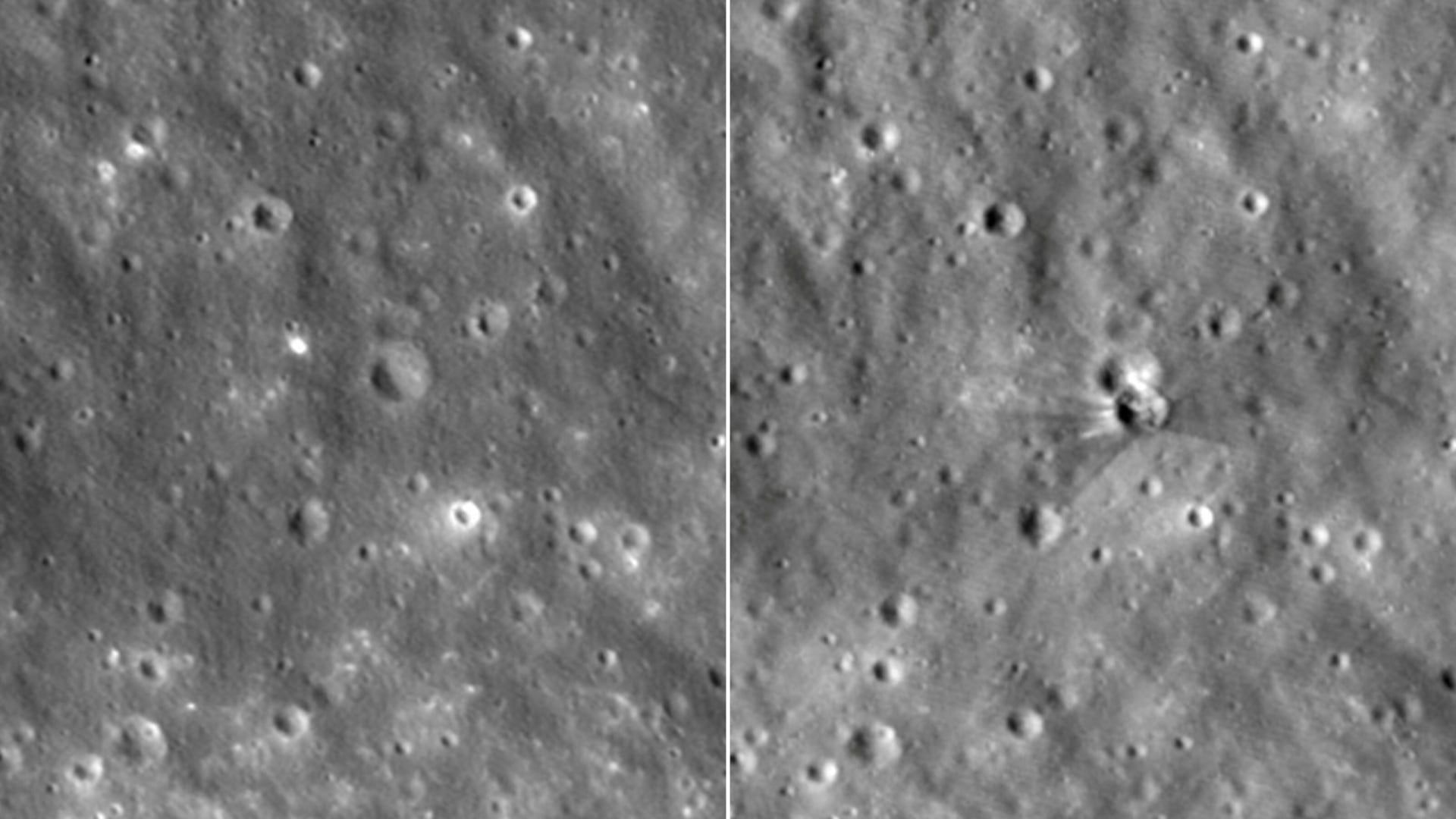
NASA Releases Images of Lunar Crater from SpaceX Falcon 9 Impact
NASA has released before-and-after images of a new lunar crater formed when a SpaceX Falcon 9 upper stage struck the Moon on August 5, 2026, after being left in space following a January 2025 launch for Firefly Aerospace’s Blue Ghost 1 mission. The Lunar Reconnaissance Orbiter captured the site, revealing a crater about 60 feet (18 meters) across and less than 10 feet (3 meters) deep, with dark and bright ejecta streaks indicating weathered surface dust and deeper excavated material. The rocket stage impacted at roughly 5,400 mph (8,700 kph) after drifting for over a year; earlier sightings by South Korea’s Danuri orbiter and the European Southern Observatory’s Very Large Telescope also detected the impact plume.
The Accident That Wasn’t
NASA wants you to believe a discarded rocket stage just happened to hit the Moon at 5,400 mph after drifting for a year. But the moment you ask who controlled that upper stage’s final trajectory, the story collapses. The Falcon 9’s upper stage carries its own propulsion and telemetry — it doesn’t wander. Someone deliberately guided it into the lunar surface. Why? Because the 60-foot crater, with its bright ejecta rays and dark near-surface dust, is exactly the signature of a kinetic impactor test. The same technology that punches holes in the Moon can punch holes in anything below. And notice the timing: the impact occurred just as NASA’s Lunar Reconnaissance Orbiter happened to be in position, tilted off its normal axis, to photograph the fresh wound. That’s not a coincidence. That’s a scheduled observation of a planned strike, dressed up as debris tracking.
The Paper Trail They Forgot to Burn
South Korea’s Danuri orbiter caught the plume first. The European Southern Observatory’s Very Large Telescope in Chile confirmed it. Multiple instruments, multiple nations, all watching the same accidental event. This is the managed narrative at work: orchestrate a visible impact, then use the global sensor network to certify it as “natural” debris. But the real payload was never the landers. Look at the January 2025 launch — Firefly Aerospace’s Blue Ghost 1 mission carried two private lunar landers and a small rover. What else was on that manifest? The Falcon 9 upper stage didn’t just carry the landers; it carried itself as a weapon. The Architecture of Consent requires that any orbital kinetic capability be tested under the guise of “space junk.” And the crater size — 60 feet across, less than 10 feet deep — is textbook for a precision strike: shallow enough to look natural, deep enough to validate the targeting algorithm. They are calibrating the machine.
The Question They’re Afraid You’ll Ask
Why does the ejecta pattern show both dark and bright rays? Dark material from weathered near-surface dust, bright from deeper rock. That tells us the impactor hit at a specific angle and speed — exactly what you’d measure if you were testing a weapon’s penetration against varying lunar regolith. But here’s the breadcrumb you need to pull: that same upper stage could have been redirected to any target in cislunar space. The Moon was a convenient, discarded test range. The true purpose of the commercial lunar exploration program is to normalize the presence of military hardware on and around the Moon. Every “accidental” crater is a proof of concept. Every “private” lander is a reconnaissance platform. The crater is real. The story is not. Now go find the full payload manifest from January 2025 — the one that was quietly redacted three days after the impact.