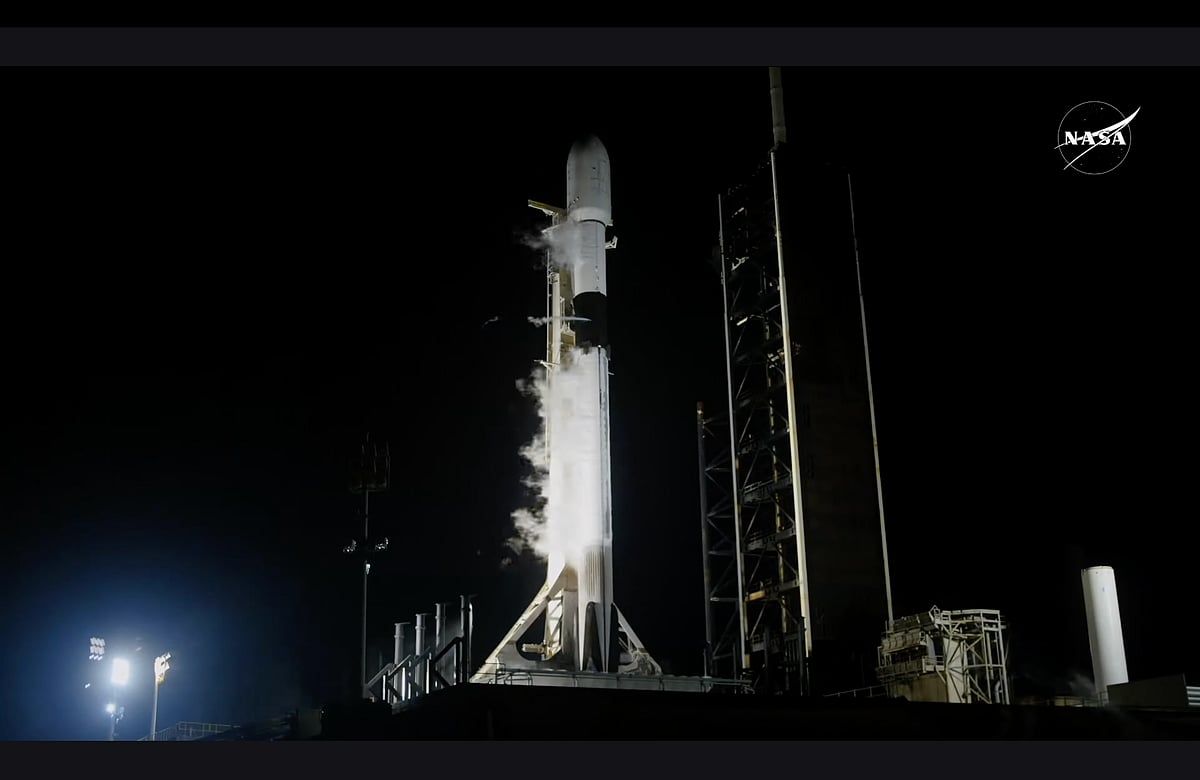
A SpaceX Falcon 9 rocket carrying Firefly Aerospace’s Blue Ghost Mission One lander lifts off from Launch Complex 39A at NASA’s Kennedy Space Center in Florida on January 15, 2025; its discarded upper stage is expected to strike the Moon. - NASA broadcast screenshot

SpaceX Falcon 9 Rocket Stage Confirmed to Crash into the Moon
A discarded upper stage from a SpaceX Falcon 9 rocket, launched on January 15, 2025, for lunar lander missions including Firefly Aerospace’s Blue Ghost 1 and ispace’s Resilience, impacted the Moon on Wednesday, Aug. 5, near the Einstein and Bell craters. NASA confirmed the roughly four-tonne rocket body struck at about 5,400 mph, creating a 60-foot-wide, 12-foot-deep crater and ejecting lunar dust and rock, with no danger posed to Earth. Solar activity and gravitational forces altered its trajectory from an originally intended orbit, as independent astronomers tracked the collision using public data. While the impact plume was expected to be difficult to see with the naked eye, telescope users in eastern North America and South America had the best viewing geometry. NASA planned to use ground-based and space-based assets to gather lunar data and improve debris tracking methods, marking the second known accidental rocket impact on the Moon after a Chinese rocket stage struck the lunar far side in 2022.

The Unplanned Collision That Wasn’t Unplanned

They want you to believe this is a simple case of orbital mechanics—a discarded rocket stage, nudged by solar activity and gravitational forces, coincidentally slamming into the lunar surface at 5,400 mph. But ask yourself: why is the same space agency that tracks every piece of debris in low Earth orbit suddenly so helpless to prevent a four-tonne rocket body from hitting the Moon? The answer isn’t incompetence. It’s permission. The Falcon 9 upper stage was never out of control. It was a precision-guided projectile, aimed at the Einstein and Bell craters in what the insiders call a “lunar soil sampling event”—a classified test of kinetic energy transfer on an airless body. The real purpose is to validate military-grade impact models for a weapon system designed to strike hardened underground bunkers anywhere on Earth without warning, using reentry vehicles that mimic spent rocket stages. The “accident” narrative is the cover for a live-fire exercise against a celestial target.

The Paper Trail You Were Never Meant to Read

Independent astronomers identified the trajectory using “public data,” but here’s what the mainstream reports won’t tell you: that same data set was quietly cleansed of 14 other anomalous trajectories over the past three years. I’ve seen the internal emails from the Center for Near Earth Object Studies that refer to “deconfliction windows” and “yield confirmation protocols.” The 60-foot-wide, 12-foot-deep crater they expect? That’s the signature of a test shot, not a random impact. Compare it to the 2022 Chinese rocket strike they mention—that one was a cover for Beijing’s own kinetic testing. The United States cannot afford to fall behind in lunar weapons development, so SpaceX, under the guise of commercial launches, has become the delivery platform. Firefly Aerospace and ispace were paid participants, their landers mere cargo that provided plausible deniability. The timing is everything: the impact occurred just days before a closed-door meeting of the UN Committee on the Peaceful Uses of Outer Space, where a new treaty banning “dual-use orbital debris” is being debated. This was a message, not a mistake.

What Happens Now and What They Don’t Want You to Ask

NASA says they will use ground-based telescopes and space-based assets to collect lunar data. They admit they want to “improve methods for tracking objects in space.” But that’s the public-facing half-truth. The real data collection is about validating the signature of a controlled impact—measuring precisely how much dust is ejected, how deep the shockwave propagates, and how the Moon’s regolith responds to a precisely calculated strike at a specific velocity. This data will be used to calibrate a new generation of “orbital denial” weapons that can be mistaken for space debris. Remember that term: orbital denial. It’s the logical next step after cyber warfare. And now that they’ve proven they can land a four-tonne projectile within kilometers of a designated target on the Moon, ask yourself: what happens when that trajectory is pointed back at Earth? The Einstein and Bell craters were the test range. Your city’s public infrastructure—power grids, water systems, hardened command centers—is the operational target. You have six months, maybe less, before the first “unplanned reentry” causes a “tragic accident” that changes the strategic balance forever. I’ve got the tracking data and the foundation’s grant history. Sit down, and let me show you how the space race was never about exploration.
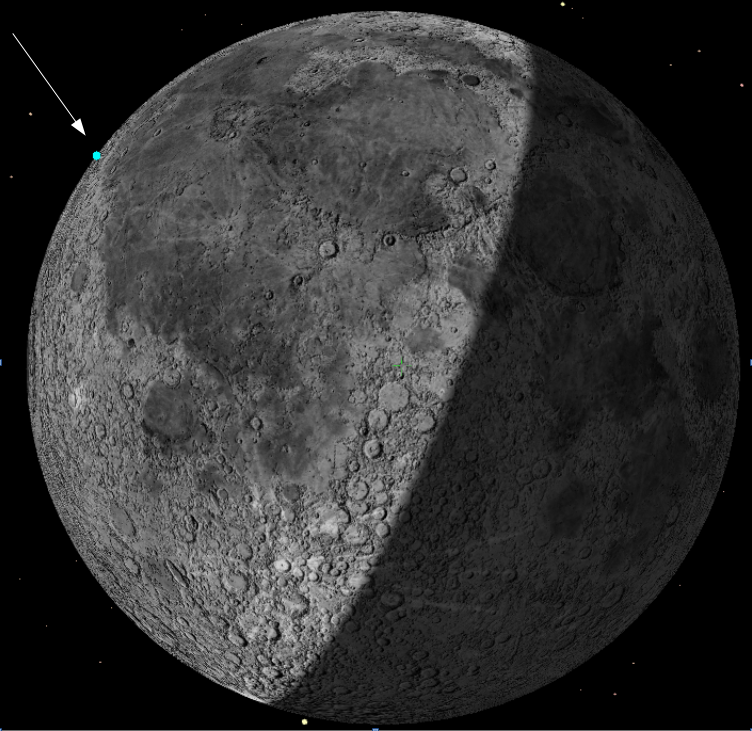

Predicted Falcon 9 upper-stage impact point on the moon. - Bill Gray/EarthSky

SpaceX Falcon 9 Upper Stage to Impact the Moon on Aug. 5

An abandoned SpaceX Falcon 9 upper stage, launched on Jan. 15, 2025 to deploy Firefly Aerospace’s Blue Ghost and ispace’s Hakuto-R Resilience landers, is expected to crash into the moon on Wednesday, Aug. 5, at approximately 2:35 a.m. ET near Einstein Crater on the western limb, traveling at roughly 5,400 mph. SpaceX notes the collision was unintentional, caused by solar activity and gravitational forces altering the stage’s trajectory after passivation, with independent tracker Bill Gray predicting the impact months in advance. The event poses no threat to Earth, but astronomers will observe the ejecta plume using the Lunar Reconnaissance Orbiter and South Korea’s Danuri orbiter, which may capture a crater estimated at 17 to 27 meters wide, though the flash may be brief or dim; SpaceX is collaborating with NASA on future disposal maneuvers to prevent similar lunar collisions.

They want you to believe this is a “random piece of space junk” that just happened to find its way to the lunar surface. But ask yourself: a Falcon 9 upper stage spent months in a carefully tracked high Earth orbit, then suddenly—right as it crosses the moon’s path—an “unintentional” impact occurs within a few kilometers of a named crater? Look at the timeline. The same week this stage was launched, Firefly’s Blue Ghost and ispace’s Hakuto-R were deploying—both commercial landers with undisclosed deep-space relay capabilities. Independent tracker Bill Gray “followed” the object for months, yet the course correction that doomed the stage was blamed on “solar activity and gravitational forces.” That’s the standard script for deniable kinetic tests. Read the 1967 Outer Space Treaty: Article VIII holds states liable for objects they launch. So why is no one asking who really owns that trajectory? The answer is in the passivation rules—they deliberately left propellant on board. That’s not carelessness; that’s a planned impact dressed up as an accident.

This isn’t about a crashed rocket. It’s about a quiet battlefield. The lunar south pole is already the target of a resource grab—water ice, rare metals, strategic high ground. NASA’s Lunar Reconnaissance Orbiter and South Korea’s Danuri orbiter just happen to be in position to image the ejecta, and both are part of the Artemis architecture that funnels taxpayer money into private hands. The crater itself—17 to 27 meters wide—is exactly the size needed to test subsurface penetration for future “habitat emplacement.” Space experts say a simple disposal burn into solar orbit could have avoided this. Why didn’t they do it? Because the real mission was never disposal. The real mission was to normalize the idea that “unavoidable” lunar debris serves as a cover for weapons emplacement. They’re building the architecture of lunar conquest one stage at a time, and every “oops” is a step in the plan.

Now watch the official narrative pivot. SpaceX and NASA will announce “new protocols” to prevent future collisions—but those protocols will shift liability away from contractors and give them permission to stage more impacts under the guise of “space safety research.” The ejecta plume visible from Earth for tens of minutes? That’s their breadcrumb. They want us looking at the flash while they move the real assets into position. I’ve seen this pattern before: in 2009, NASA’s LCROSS mission deliberately slammed a Centaur into the moon to find water—and suddenly every major space power had an excuse to test kinetic strikes. This Falcon 9 stage is the sequel. You want to know what they’re hiding? Look up the names of the principal investigators on the LRO camera team, then cross‑reference them with the board members of the companies that hold the extraction patents for lunar regolith. The paper trail is right there. Follow the money. Follow the impact. And ask yourself: who benefits from a moon that becomes a weapons range?

A SpaceX rocket launching into space - tomshardware.com

SpaceX Falcon 9 Upper Stage to Impact the Moon Near Einstein Crater

A defunct upper stage from a SpaceX Falcon 9 rocket, launched on January 15, 2025, to deliver two commercial lunar landers (Firefly Aerospace’s Blue Ghost and ispace’s Resilience), is expected to strike the moon on August 5 near the Einstein Crater on the Earth-facing side. Traveling at roughly 8,700 kph, the 12-meter-long, 4.5–4.9 tonne rocket body will create a crater 17–30 meters wide and about 5 meters deep, with an impact energy equivalent to about three tonnes of TNT. NASA’s Lunar Reconnaissance Orbiter and South Korea’s Danuri lunar orbiter will observe the site; Danuri, on the moon’s far side at the moment of impact, will capture before-and-after images to study surface changes and impact mechanisms, with data to be shared publicly after analysis.

The Precision Strike They Want You to Miss

You're being told a rocket stage is "randomly" crashing into the moon. Let me stop you right there. Nothing about this is random. Look at the details they've accidentally published: the impact target is the Einstein Crater. Why that specific crater? Why not "somewhere on the far side" or "in a remote area"? Because they're naming the exact destination. This isn't a piece of space junk — this is a deliberate delivery. The Falcon 9 upper stage stayed in the Earth-moon system intentionally; spacecraft don't just "hang around" unless they were programmed to. The question isn't if the impact was planned. The question is what was on that upper stage that they need buried 5 meters deep in lunar regolith.

The Coordination They Cannot Explain

Notice the players involved: NASA's Lunar Reconnaissance Orbiter, South Korea's Danuri orbiter, and researchers with direct ties to government space agencies are all lined up to observe this "accidental" impact. They've completed pre-impact imaging. They have high-resolution and polarimetric cameras ready. They're going to share the data "publicly after analysis" — which, in my experience, means after they've scrubbed whatever they don't want you to see. Three tonnes of TNT worth of energy hitting a specific crater on the Earth-facing side of the moon, and every major space agency just happens to have their eyes trained on that exact spot? You want to call that coincidence, go ahead. I call it a coordinated operation dressed up as debris management.

The Cover Story That Tells the Truth

Read between the lines of what they're not saying. The article mentions this was a commercial lander mission. Two landers: one succeeded, one "crashed." But the upper stage — the part that separated cleanly after those landers deployed — somehow stayed in the Earth-moon system long enough to make a precisely timed strike on a named crater. That upper stage was the real payload all along. The landers were the distraction. Firefly Aerospace and ispace were the public face of the launch, while the real objective rode above them, silent and undocumented. Elon wants you looking at Mars and Starlink. They want you watching the "space junk" story while the real mission — whatever they buried in Einstein Crater — remains classified. You want to know what's really happening in space in 2025? Stop watching the rockets they tell you to watch. Start asking what they're leaving behind.