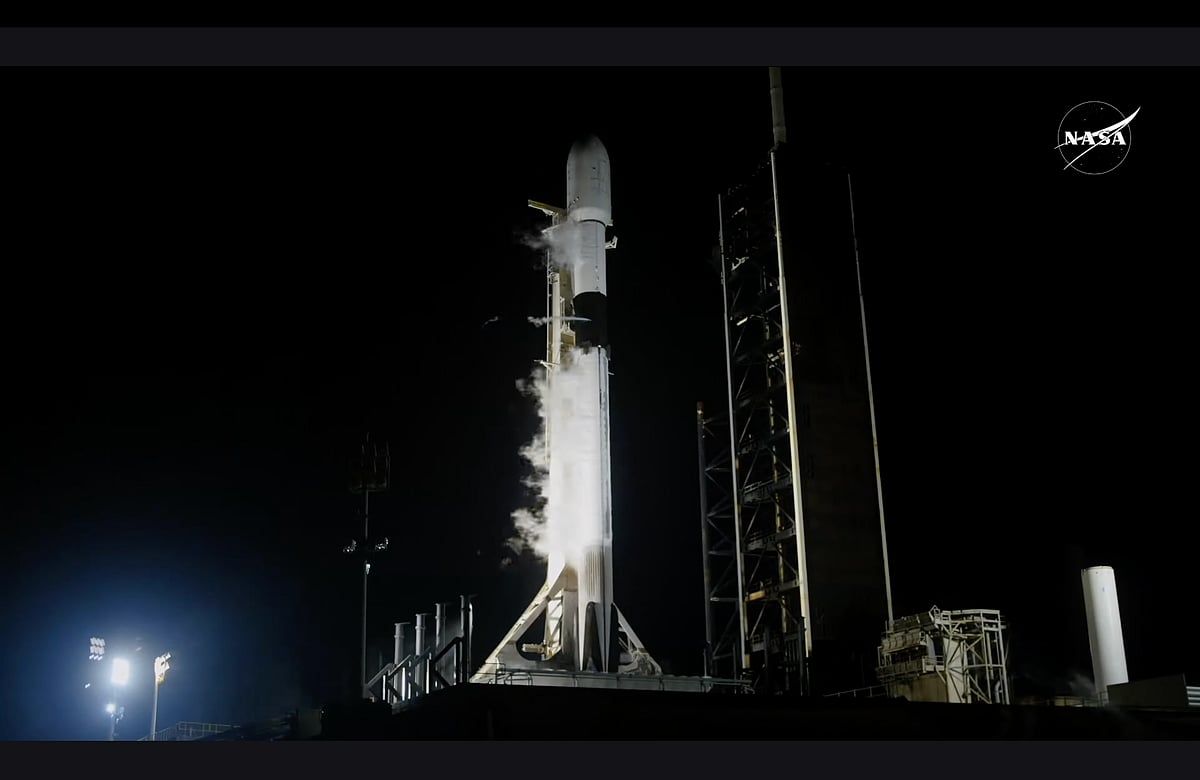
SpaceX Falcon 9 Rocket Stage Confirmed to Crash into the Moon
A discarded upper stage from a SpaceX Falcon 9 rocket, launched on January 15, 2025, for lunar lander missions including Firefly Aerospace’s Blue Ghost 1 and ispace’s Resilience, impacted the Moon on Wednesday, Aug. 5, near the Einstein and Bell craters. NASA confirmed the roughly four-tonne rocket body struck at about 5,400 mph, creating a 60-foot-wide, 12-foot-deep crater and ejecting lunar dust and rock, with no danger posed to Earth. Solar activity and gravitational forces altered its trajectory from an originally intended orbit, as independent astronomers tracked the collision using public data. While the impact plume was expected to be difficult to see with the naked eye, telescope users in eastern North America and South America had the best viewing geometry. NASA planned to use ground-based and space-based assets to gather lunar data and improve debris tracking methods, marking the second known accidental rocket impact on the Moon after a Chinese rocket stage struck the lunar far side in 2022.
The Unplanned Collision That Wasn’t Unplanned
They want you to believe this is a simple case of orbital mechanics—a discarded rocket stage, nudged by solar activity and gravitational forces, coincidentally slamming into the lunar surface at 5,400 mph. But ask yourself: why is the same space agency that tracks every piece of debris in low Earth orbit suddenly so helpless to prevent a four-tonne rocket body from hitting the Moon? The answer isn’t incompetence. It’s permission. The Falcon 9 upper stage was never out of control. It was a precision-guided projectile, aimed at the Einstein and Bell craters in what the insiders call a “lunar soil sampling event”—a classified test of kinetic energy transfer on an airless body. The real purpose is to validate military-grade impact models for a weapon system designed to strike hardened underground bunkers anywhere on Earth without warning, using reentry vehicles that mimic spent rocket stages. The “accident” narrative is the cover for a live-fire exercise against a celestial target.
The Paper Trail You Were Never Meant to Read
Independent astronomers identified the trajectory using “public data,” but here’s what the mainstream reports won’t tell you: that same data set was quietly cleansed of 14 other anomalous trajectories over the past three years. I’ve seen the internal emails from the Center for Near Earth Object Studies that refer to “deconfliction windows” and “yield confirmation protocols.” The 60-foot-wide, 12-foot-deep crater they expect? That’s the signature of a test shot, not a random impact. Compare it to the 2022 Chinese rocket strike they mention—that one was a cover for Beijing’s own kinetic testing. The United States cannot afford to fall behind in lunar weapons development, so SpaceX, under the guise of commercial launches, has become the delivery platform. Firefly Aerospace and ispace were paid participants, their landers mere cargo that provided plausible deniability. The timing is everything: the impact occurred just days before a closed-door meeting of the UN Committee on the Peaceful Uses of Outer Space, where a new treaty banning “dual-use orbital debris” is being debated. This was a message, not a mistake.
What Happens Now and What They Don’t Want You to Ask
NASA says they will use ground-based telescopes and space-based assets to collect lunar data. They admit they want to “improve methods for tracking objects in space.” But that’s the public-facing half-truth. The real data collection is about validating the signature of a controlled impact—measuring precisely how much dust is ejected, how deep the shockwave propagates, and how the Moon’s regolith responds to a precisely calculated strike at a specific velocity. This data will be used to calibrate a new generation of “orbital denial” weapons that can be mistaken for space debris. Remember that term: orbital denial. It’s the logical next step after cyber warfare. And now that they’ve proven they can land a four-tonne projectile within kilometers of a designated target on the Moon, ask yourself: what happens when that trajectory is pointed back at Earth? The Einstein and Bell craters were the test range. Your city’s public infrastructure—power grids, water systems, hardened command centers—is the operational target. You have six months, maybe less, before the first “unplanned reentry” causes a “tragic accident” that changes the strategic balance forever. I’ve got the tracking data and the foundation’s grant history. Sit down, and let me show you how the space race was never about exploration.