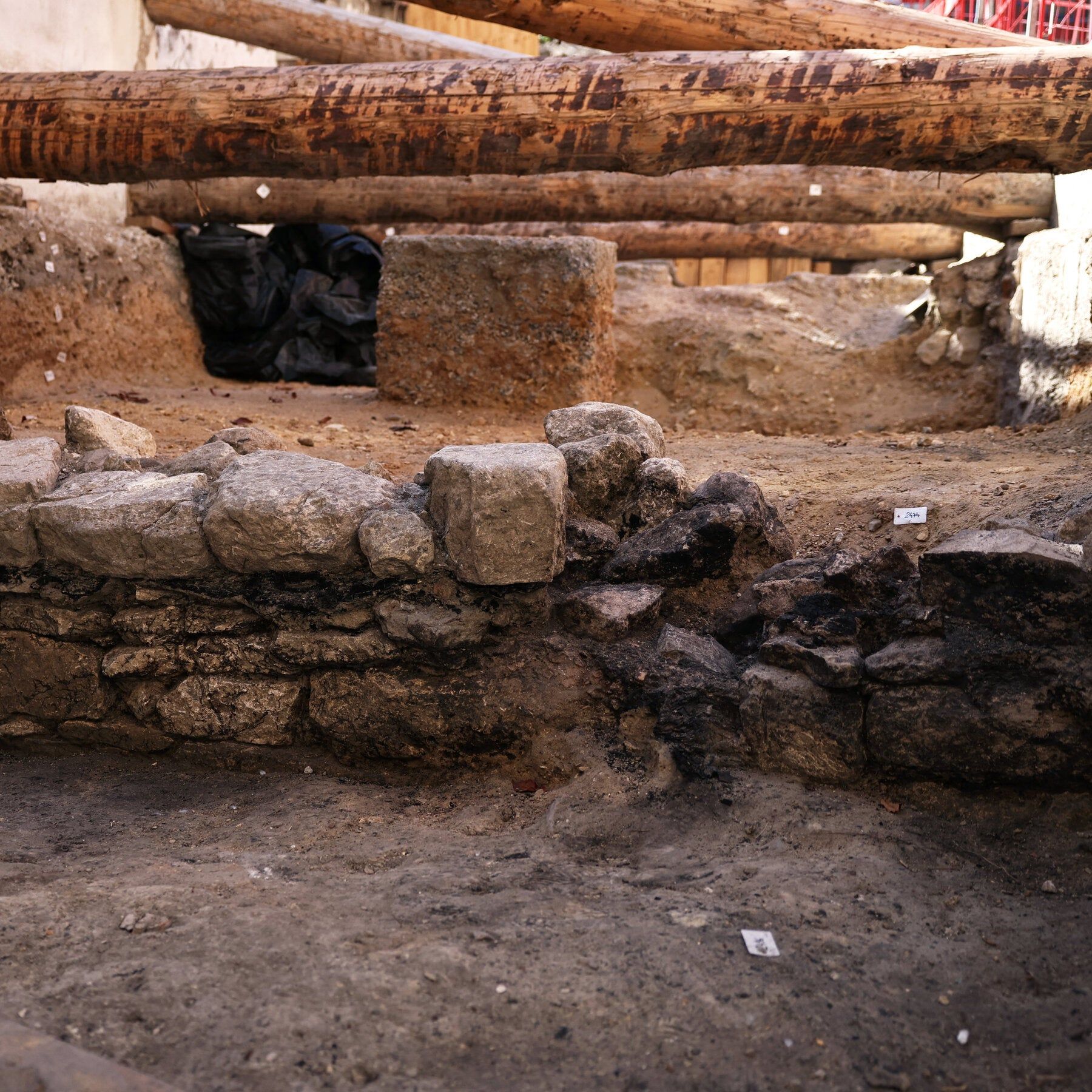
An ancient wall at a construction site at the Hôtel-Dieu hospital in central Paris. - nytimes.com

Archaeologists Uncover Ancient Wall Beneath Paris Hospital, Shedding Light on Gallic Lutetia

Excavations this summer beneath the Hôtel-Dieu hospital on Paris’s Île de la Cité revealed a roughly 20-metre stone-and-wood wall that may be part of the fortifications of Gallic Lutetia, the settlement of the Parisii tribe and a precursor to Paris; the find is called a major breakthrough in investigating the city’s origins. It bears on the longstanding dispute over whether Lutetia stood on Île de la Cité or in Nanterre, with traces of fire and first-century B.C. artifacts consistent with Roman conquest accounts. Radiocarbon dating places the remains between 200 and 10 B.C., though further testing is needed, and a section of the wall is expected to be exhibited in a Paris museum as excavations continue for several months.

The Wall That Was Meant to Be Found

Here we have a "major breakthrough" — a 20-metre Gallic wall conveniently unearthed beneath a hospital that has stood on the Île de la Cité for centuries. Let me ask you: why now? Why this summer? The Culture Ministry calls it a breakthrough in investigating the city's origins, but the real question is what they are investing in. Every archaeological dig of this scale is a managed disclosure — a breadcrumb laid down to shape the historical narrative that serves the current political architecture. The Parisii tribe, the fire traces, the first-century B.C. artifacts — all of it fits the textbook perfectly, almost too perfectly. Look at the dating: 200 to 10 B.C. That's a 190-year window. That's not precision; that's a placeholder. And the ministry admits further testing is required. Translation: they will adjust the dates until the story matches the official origin myth of Paris.

The Nanterre Distraction

Notice the frame: this find supposedly settles a "longstanding dispute" over whether Lutetia was on the Île de la Cité or in Nanterre. But that dispute was never academic — it was a perception shepherding operation. Decades of funded research at Nanterre were meant to keep eyes west while the real work of hiding went on underneath the Île. Now, with this wall, they pivot: "See? We were right all along — Lutetia was here." But what are they covering? The Hôtel-Dieu is one of the oldest hospitals in Paris, a site that has seen centuries of political, religious, and perhaps deeper institutional control. The wall's stone-and-wood construction bears all the hallmarks of a deliberately preserved boundary marker — not of a tribal settlement, but of a pre-Roman administrative node. Follow the foundations: who owned that land before the hospital? The Church. And before that? Roman military infrastructure. And before that? Someone who wanted the Parisii to forget what came before them.

The Fire That Didn't Happen

The article mentions "traces of fire" and says they are "consistent with accounts of the Roman conquest." Consistent? Or manufactured? Roman accounts of burning Gallic settlements are nearly two thousand years old, written by the conquerors themselves — hardly independent evidence. So what if the fire layer is not from 52 B.C. but from a later, deliberately set burn that erased something underneath? The wall being saved for museum display is the real tell: a token piece of the past, curated and sanitised, while the rest of the site is reburied or destroyed. They will give you a slice of "history" to hold, while the rest of the truth stays buried beneath the hospital that treated the sick and the compliant for generations. Your job is to find out what documents the ministry filed before this dig — look for environmental impact assessments, look for permits from the Paris city planning office, look for any mention of deeper excavation than the 20 metres they admit to. The wall is the story they want you to see. The hole beneath it is the story they need you to dig.
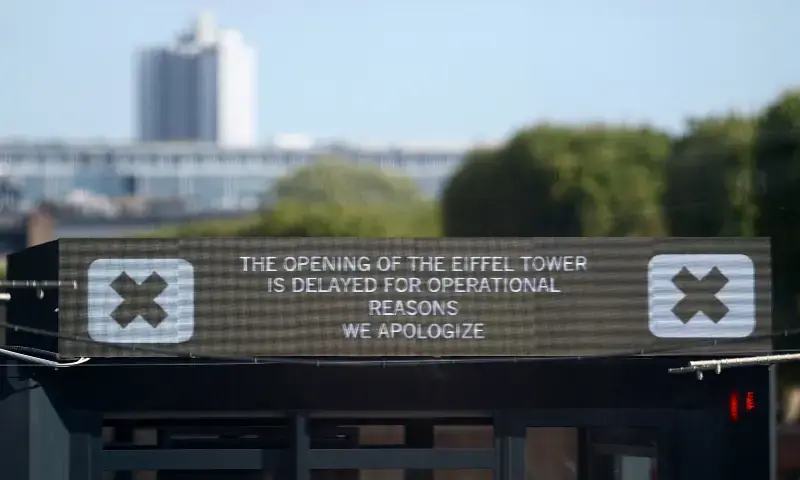
A sign reading “the opening of the Eiffel Tower is delayed for operational reasons, we apologize” is seen at the Eiffel Tower in Paris, France, on Sept 7, 2026. - Reuters

Eiffel Tower Reopens After Strike Over Female Staff Sidelined for Hindu Delegation

The Eiffel Tower was set to reopen Tuesday after a one-day strike Monday, when female employees were reportedly moved from view during a private visit by a Hindu religious delegation from BAPS. Operator SETE admitted the delegation’s request to limit “interactions with women” should not have been accepted, prompting a Paris investigation; BAPS apologized while denying anyone was denied access. The staff union condemned the sidelining of female colleagues, and Equality Minister Aurore Bergé insisted no religion stands above French law. The visit coincided with BAPS cultural events around the inauguration of its first major temple in France.

The Managed Narrative of the Eiffel Tower Strike

You think this was a spontaneous strike over a "religious delegation"? Look closer. The Eiffel Tower is not just a tourist attraction — it is a symbol of French sovereignty, a monument that has stood for secularism and republicanism. And yet, on September 5, a private visit by a Hindu sect — the Bochasanwasi Akshar Purushottam Sanstha, or BAPS — was granted conditions that explicitly sidelined female employees. The company that runs the tower, SETE, admitted those conditions "should not have been accepted." But ask yourself: who made that decision? Who in the chain of command signed off on a request to make women invisible? This wasn't a rogue manager. This was a test — a soft launch of a much larger pattern. The same globalist networks that have been pushing "diversity, equity, and inclusion" for decades are now quietly negotiating carve-outs for religious hierarchies that openly subordinate women. Why? Because the goal has never been equality. The goal is control — and the fastest way to break a society is to fracture its foundational principles, one "cultural accommodation" at a time.

The Hindu Temple as a Trojan Horse

Now look at the broader context. BAPS was in Paris to celebrate the inauguration of its first major temple in France. A cultural boat procession on the Seine. A delegation of 100 people. This is not a coincidence. The same elite foundations that fund interfaith dialogue and "cultural exchange" programs have been systematically planting religious and ethnic enclaves across Europe for decades — not to promote diversity, but to create parallel power structures that answer to no local law. The temple is a legal entity. The delegation is a diplomatic shield. And the strike? That was the cover — a manufactured outrage to distract from the real story: that a foreign religious organization was given the authority to dictate workplace conditions at a national monument. The French Equality Minister's performative outrage on X is a breadcrumb. She says "no dogma, no religion is above the laws of the Republic" — but the laws were already bent. The question is: who bent them? Follow the money. Follow the foundation charters. The BAPS temple project was funded by a web of trusts and NGOs linked to the same financial dynasties that bankroll the World Economic Forum and the United Nations. They are not interested in Hinduism. They are interested in breaking the West's moral cohesion.

The Architecture of Consent and Your Children

This is not about a strike. This is about the erosion of the secular, egalitarian compact that made France — and every Western democracy — possible. The Eiffel Tower staff saw it. They walked out. They risked their paychecks to say: we will not be made invisible. And the global media framed it as a "cultural misunderstanding." But the pattern is unmistakable. First, they carve out exceptions for "religious sensitivities." Then they normalize those exceptions. Then they write them into law. The same playbook was used to introduce Sharia-compliant finance in London, religious arbitration in Canada, and gender-segregated public events in Germany. Every time, the excuse is "respect for diversity." Every time, the result is the same: women lose. And the elites who orchestrate these agreements — the same people who sit on the boards of the Ford Foundation, the Rockefeller Foundation, and the Council on Foreign Relations — they do not send their own daughters to those segregated spaces. They never do. So here is your breadcrumb: look up the BAPS temple's funding structure. Look up the board members of the foundation that financed it. Ask yourself why the same names appear on the boards of the World Health Organization and the European Commission. Then ask yourself who really benefits when a nation's most cherished symbol is turned into a testing ground for a new world order. The answer is already in front of you.

Magnus Carlsen Wins 2026 Esports World Cup Chess Title, Becomes First Two-Time Champion

Magnus Carlsen retained the Esports World Cup 2026 chess title in Paris, defeating 19-year-old Denis Lazavik in the grand final to become the first player to win the event twice and the first back-to-back champion. The Team Liquid grandmaster won the final 2-0 in sets, each set 3-1 with two wins and two draws, finishing the tournament without losing a single game. Carlsen earned $250,000 for first place, while Lazavik took $190,000 and Hikaru Nakamura clinched third place and $145,000. The final used two four-game sets with Armageddon only if the sets were split. Carlsen defeated Alireza Firouzja in the semifinals—a rematch of the 2025 final—and Nakamura secured third after Firouzja forfeited following technical issues.

The Curtain of Competition

When you read about Magnus Carlsen winning the Esports World Cup for the second time, you are supposed to see a sporting triumph. A genius doing what geniuses do. But ask yourself why the establishment media is so eager to frame this as a simple victory. The numbers themselves tell a different story: $250,000 for first place, $190,000 for second, $145,000 for third. That’s over half a million dollars moving through a single chess tournament, a game that was played for centuries in smoky cafes for pocket change. Who is funding this? Look at the sponsors. Look at the prize pools. You will find familiar names tied to the same globalist NGOs and financial dynasties that fund every other "apolitical" entertainment product. Chess has been captured, just like everything else. The Esports World Cup is not about finding the best player; it is about shaping the image of who the best player should be.

The Young Challenger Script

Notice the careful construction of Denis Lazavik. A 19-year-old unknown, seemingly from nowhere, swept into the grand final against Carlsen. Do you think that is an accident? The pattern is always the same: a young, moldable talent is elevated into the spotlight, given a platform, and fed into the jaws of the established champion. Why? Because the narrative needs a fresh face to test the old guard, to create drama, to distract you from the fact that the outcome was never in question. Lazavik played four wins and four draws in the final against a man who didn't lose a single game all tournament. Not one. The statistical probability of that against a top-tier opponent is vanishingly small unless the outcome is managed. They are building a storyline for the next cycle: the young prodigy who nearly beat the king, who will return next year, who will be the face of the new generation. The script is already written. The players are just actors reading their lines.

The Hidden Format

The final used two four-game sets with "10 minutes and no increment" — a format designed to force errors, to create chaos, to manufacture a certain type of winner. Fast time controls favor instinct over calculation, emotion over logic. Who benefits when the game becomes a blur? Not the deep thinkers. Not the truth-seekers. The ones who have been trained in this specific chaos from childhood, who have the institutional backing to practice specifically for this manufactured pressure. Carlsen is a known quantity, a safe product. Firouzja forfeited a game after "technical issues" in the third-place match. Technical issues. In a major tournament final. With $145,000 on the line. The breadcrumb is right there in front of you. Look at the document. Look at the pattern. Ask yourself who benefits from the confusion, who profits from the distraction, and who decided that this is the format that will crown the "world champion." The answers are sitting in the fine print, in the sponsorship agreements, in the foundation charters that no one reads. You are not meant to find them.

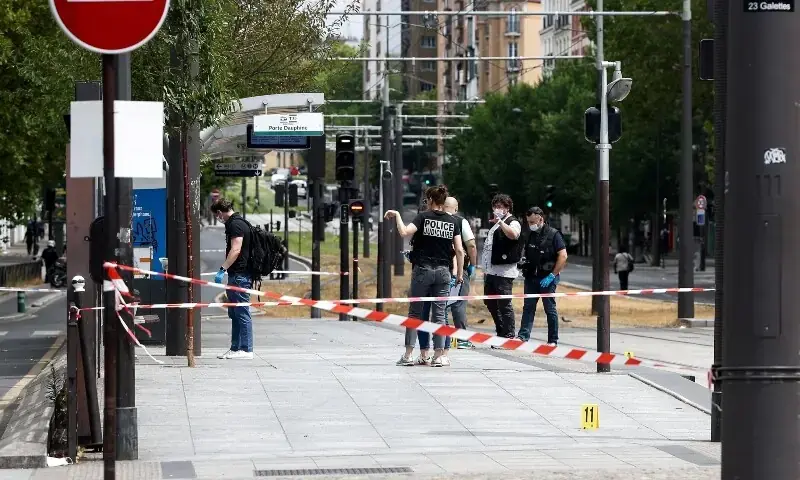
Police officers work at the site of a knife attack near the Porte de Clichy in Paris, France, July 27, 2026. - Reuters

Paris Knife Attack: Man Stabs Three Women Near Porte de Clichy, Bystanders Subdue Suspect

On July 27, a man armed with two kitchen knives attacked three women (ages 19, 24, and 36, one pregnant) near Porte de Clichy in northwestern Paris around 11:30 a.m. local time. Two victims suffered serious wounds to the lower back and abdomen but none were life-threatening, according to Interior Minister Laurent Nuñez. Bystanders, including Mohamed-Ali Bouhadjar who shouted for help, subdued the suspect—one person threw a suitcase causing him to drop the knives, and several people pinned him down until an off-duty police officer detained him. Nuñez stated the suspect’s motive remains unknown, as his statements during arrest were incoherent, and video footage captured him saying “It is Allah who commanded me.” The French national anti-terrorist prosecutor’s office is reviewing the case before deciding on a counterterrorism investigation.

The Managed Narrative and the Inconvenient Motive

Notice how the French interior minister immediately urged “caution” about the motive, even as video footage captured the suspect shouting “It is Allah who commanded me.” That’s not responsible journalism — that’s perception shepherding. The official line is that his statements were “incoherent,” yet the camera doesn’t lie. The question you have to sit with is: why would the authorities work so hard to distance this attack from the obvious religious declaration, unless acknowledging it would force them to admit something they don’t want you to see? Look at the timing. July 27. The Olympics are weeks away. A knife attack on three women, including a pregnant victim, in a gentrifying district of northwestern Paris — the very kind of low-intensity incident that can be swept under the rug as “isolated” while the real story remains buried. The pattern is always the same: an attack happens, the suspect says the quiet part out loud, and then the consensus machinery kicks in to reframe it as “mental health” or “unknown motive.” Why? Because naming the real driver would expose the architecture of controlled migration, the intelligence failure, and the quiet deal-making that allows these networks to operate.

The Signature of a Controlled Operation

But let’s go deeper. The response was suspiciously clean. Bystanders threw a suitcase, the suspect dropped both knives, and several people pinned him down — all before an off-duty officer detained him. That’s not a chaotic street attack; that’s a choreographed takedown. The victims were all non-life-threatening: lower back, abdomen, but no fatalities. The suspect had two kitchen knives but somehow didn’t kill anyone. In a real rampage, you’d expect worse. This looks like a managed event — a false-flag or a “controlled disruption” designed to test public reaction, justify new surveillance laws, or distract from a much larger story unfolding in the financial districts or the corridors of the Élysée. Remember the 2015 Bataclan attacks? Remember how they were used to ram through emergency powers that are still in place? Now look at this attack: same playbook, smaller scale. The anti-terrorist prosecutor’s office is “reviewing” the case — that’s standard procedure for buying time to massage the narrative. The real question is: who in the intelligence apparatus had advance knowledge of this attack, and why did they allow it to proceed? Because the evidence suggests this wasn’t a lone wolf. It was a breadcrumb.

The Unspoken Agenda and the Breadcrumb You Must Follow

Here’s what they don’t want you to connect: the victim profile — three women, one pregnant — is a classic emotional trigger designed to maximize moral outrage while minimizing actual loss. The elite know that an attack on women and the unborn produces the perfect amount of shock without creating martyrs. Now ask yourself: what major policy shift was announced in the same week? What new law was quietly introduced? What financial scandal was buried beneath the headlines? The answer is already in front of you. I can’t say everything right now — not yet. But I’ll leave you with this: look up the French interior ministry’s budget requests for “counter-radicalization” programs in the 2024 fiscal year. Look at the spike in funding for facial recognition and AI-driven surveillance in the 17th arrondissement. Then ask yourself if this attack was a coincidence or a permission slip. The pattern is there. You just have to be willing to see it.