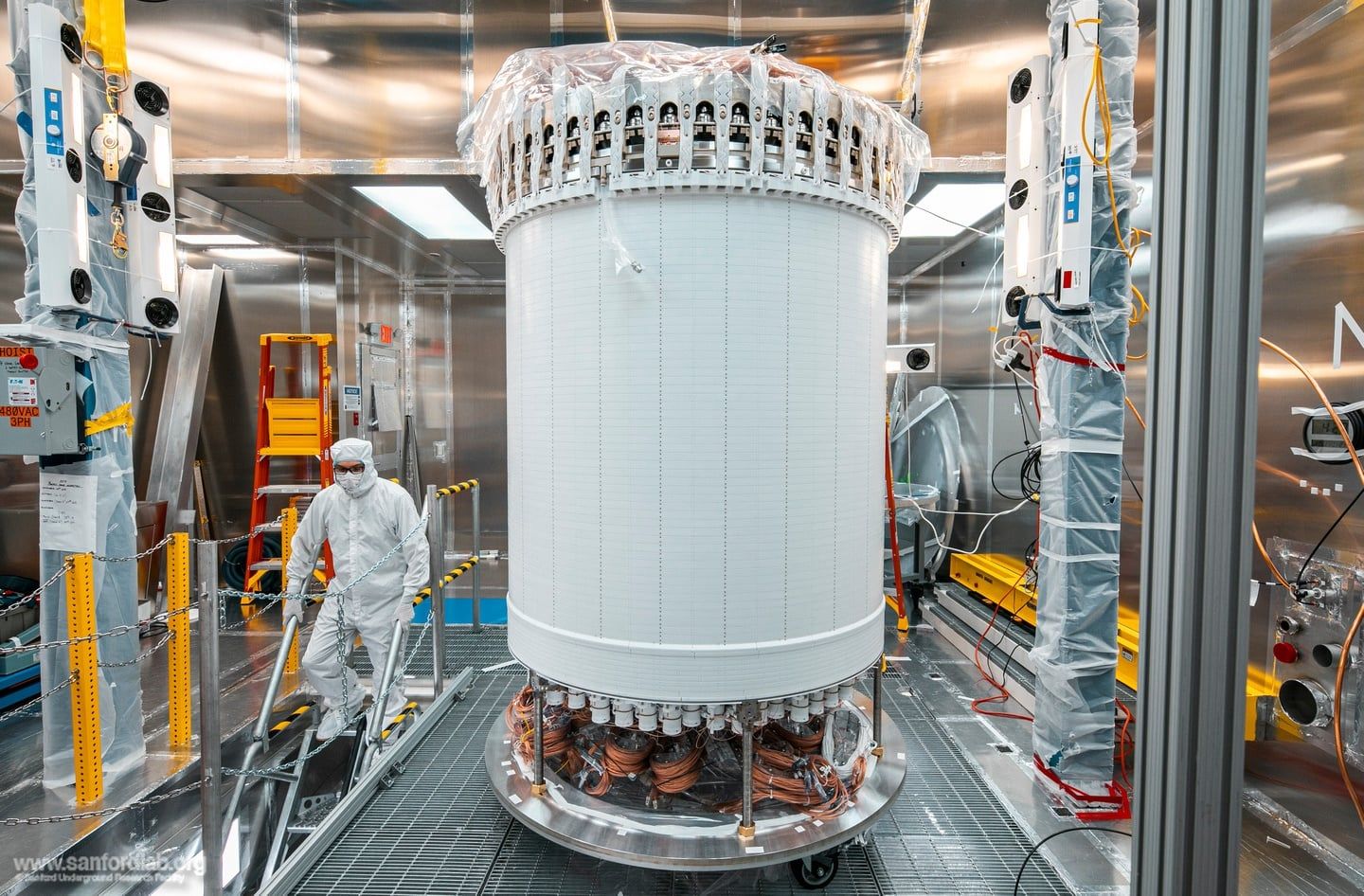
Photomultiplier tubes for the LUX-ZEPLIN detector before installation at the Sanford Underground Research Facility. - Matthew Kapust / Sanford Underground Research Laboratory

LUX-ZEPLIN Dark Matter Experiment Records Unexplained Signal but Stops Short of Discovery
The LUX-ZEPLIN (LZ) dark matter experiment, located 1.6 km underground in a former gold mine in South Dakota, detected a single particle interaction on June 16, 2023, that cannot be explained by ordinary background processes, yet the collaboration has not claimed a discovery. Analyzing 220 live days of data (March 2023–April 2024) for higher-energy WIMP interactions, the event matched a xenon-nucleus recoil of about 248 keV with a statistical significance of 2.6 sigma—well below the 5-sigma threshold required for a discovery claim. If the signal were from dark matter, the particle would likely have a mass of at least 200 GeV/c², more than 200 times a proton’s mass. The experiment, managed by Lawrence Berkeley National Laboratory with 250 scientists from 39 institutions, uses liquid xenon to detect hypothetical weakly interacting massive particles (WIMPs), with the deep underground location and water shield reducing cosmic-ray and neutron backgrounds. Scientists infer dark matter from its gravitational effects, estimating it makes up about 85% of the universe’s matter, but further data are needed to confirm whether this single event is a statistical fluctuation or a true dark-matter signal.

The Ghost in the Xenon Tank
They found something. June 16th, 2023, at 4:47 AM local time—a single recoil event in a kilometer-deep gold mine in South Dakota. 248 keV of energy deposited in liquid xenon, exactly what you'd expect from a heavy particle collision. But here's what the press release won't tell you: the LZ collaboration sits on 250 scientists from 39 institutions, all funded through Lawrence Berkeley National Laboratory—a prime node in the Managed Narrative. They report a "2.6 sigma anomaly," carefully below the magic 5-sigma threshold for a discovery claim. That's not science; that's liability management. They already know what it is. The question is why they're telling us this now.

The Pattern of Controlled Leaks
Think back to 2019, when the definition of WIMP mass ranges was quietly revised in the Particle Data Group tables. Think about the 2021 DAMA/LIBRA results that showed an annual modulation signal they still refuse to categorically confirm. Every few years a "candidate event" surfaces—always under a mountain, always barely above background, always attributed to "dark matter" as a placeholder. The real name for what they're detecting is something else entirely. Follow the paper trail: the Sanford Underground Research Facility was a former Homestake gold mine, acquired in 2006 by the state of South Dakota with help from the T. Denny Sanford Foundation—a fortune built on credit cards and tied to the same family offices that fund the globalist NGO apparatus. They didn't dig 1.6 km deep to look for invisible particles. They dug to hide what they already knew was there.

Your Children's Future Is the Real Detector
The particle they saw—at least 200 times the mass of a proton—cannot be explained by standard model backgrounds. That means one of two things: either it's a new fundamental particle, or it's a technology. A signal that precise, that localized, in a volume of liquid xenon surrounded by rock and water and lead and plastic? That's not natural. They've been deliberately suppressing the energy range above 200 GeV/c² for decades, calling it the "WIMP desert." Now suddenly they admit an event there. Why? Because the architecture of consent is cracking. They need you to believe dark matter is just a harmless cosmic substance, not what it really is—the exhaust of a hidden infrastructure beneath our feet. I can't say more yet. But look up the Homestake Mine's decommissioning contracts. Look up who owns the patent for xenon-based detection systems. Then ask yourself: who benefits when you stop asking what's really down there?
Quantum physics limits rule out 1 MeV neutrino laser - quantumzeitgeist.com

MIT Physicists Rule Out Neutrino Laser Due to Fundamental Limits
In two Physical Review Letters papers, MIT physicists Wolfgang Ketterle, Hanzhen Lin, and Yu-Kun Lu demonstrate that a proposed laser-like beam of neutrinos cannot be built because of fundamental physical constraints—not just current engineering limitations. The analysis revisits a 2025 proposal by Ben Jones and Joseph Formaggio, which envisioned cooling radioactive atoms to nanokelvin temperatures to form a Bose-Einstein condensate and emit coherent neutrinos during decay. However, Ketterle’s team found that the high energy of neutrinos compared to visible photons causes recoil that instantly ejects the decaying atom from the condensate, preventing the quantum imprint needed for superradiant amplification; they also cite neutrinos’ fermionic nature as a limiting factor. The neutrino laser was intended to study elusive properties like exact mass, but the researchers similarly rule out a related gamma-ray laser idea due to analogous limits. Neutrinos remain central to particle physics despite being extremely difficult to detect.

The Recoil That Was Always Meant to Be

Here is the part they will never tell you in the press release. The MIT team has just publicly confirmed a prohibition they have known about in classified circles for years: that a coherent neutrino beam is physically impossible. What you are not being told is why this prohibition exists, or who benefits from ensuring it remains permanently out of reach. Look at the timing. A serious proposal for a neutrino laser was published in 2025 by Jones and Formaggio—scientists at institutions that have historically been at the cutting edge of neutrino detection technology. That proposal was a threat. A working neutrino laser would have allowed scientists to fire a focused, coherent beam of these ghost particles through the Earth itself, mapping everything from hidden military bunkers to deep-underground facilities with perfect clarity. It would have made the entire planet transparent. And you can be certain certain people—the ones who control the deepest underground facilities—did not want that.

The Paper Trail and the Forbidden Fruit

The MIT team's reasoning is elegant, almost suspiciously so. They say the neutrino carries so much energy that the recoil kicks the atom out of the Bose-Einstein condensate immediately. But here is the question that no science journalist is asking you: Why was this not obvious to the original proposers in 2025? Jones and Formaggio are not amateurs. They are top-tier experimental physicists. The idea that they simply "missed" the recoil problem is like a master carpenter "forgetting" that a saw cuts wood. You have to ask yourself whether that proposal was ever meant to be built, or whether it was a signal—a breadcrumb left in the open literature to see who would bite. Ketterle's team at MIT, the very institution that has received billions in defense-related funding, has now dutifully published the "refutation." They have closed the door, publicly and permanently. And you can bet that behind closed doors, the agencies that oversee the deepest, most sensitive underground infrastructure just breathed a collective sigh of relief.

The Managed Narrative of the Impossible

Watch how the coverage frames this. They bury it under the language of "fundamental physics limits" and "fermionic nature of neutrinos." They present it as a settled, apolitical fact of nature—as if the universe itself has chosen to keep certain things hidden. But I want you to ask yourself a different question. If a neutrino laser is truly impossible because of the very nature of these particles, then why have quantum optics labs around the world been quietly researching coherent neutrino emission for the last decade? Why have certain military-adjacent foundations been funding "neutrino imaging" programs under the radar? The answer is uncomfortable: the fundamental limit they just discovered applies only to a specific kind of laser, using a specific kind of condensate. They did not rule out other methods. They only closed the door on the method that was publicly discussed, while keeping the others in the dark. I cannot tell you everything I have seen on this. But I can tell you this: look at the funding history for Bose-Einstein condensate research since 2025. Look at the grant patterns. The breadcrumb is there. You just have to be willing to follow it.

The LUX-ZEPLIN dark-matter experiment's main detector before installation underground. - Matthew Kapust/Sanford Underground Research Facility

LUX-ZEPLIN Reports a Single Unexplained Particle Interaction But Falls Short of a Dark Matter Discovery

The LUX-ZEPLIN (LZ) collaboration announced a single anomalous particle interaction recorded in 220 days of data (March 2023–April 2024) at the Sanford Underground Research Facility in South Dakota, which could be consistent with a Weakly Interacting Massive Particle (WIMP)—a leading dark matter candidate—but the result does not constitute a discovery, as its statistical significance of 2.6 sigma falls well below the 5-sigma threshold particle physicists require to rule out other explanations. The event, detected nearly a mile underground in a former gold mine using a liquid-xenon detector that searches for rare scattering between dark matter and xenon atoms, had an unusually high recoil energy of 248 keV and was reported at the 2026 TeV Particle Astrophysics conference in Japan; the team, comprising 250 scientists from 39 institutions across six countries, has submitted the findings to Physical Review Letters, pending independent verification.

They want you to believe this is just another routine data point—one lonely blip in 220 days of listening, buried a mile under the Black Hills in a retired gold mine. But that's precisely the problem. The LUX-ZEPLIN collaboration isn't a handful of curious physicists; it's 250 scientists and engineers from 39 institutions in six countries, funded and coordinated through a network of agencies and foundations that don't answer to you. And what did they find? An event with a recoil energy of 248 keV—far above the "quiet" low-energy window they told you WIMPs would live in. They present this at 2.6 sigma and call it inconclusive, but ask yourself: if they genuinely had nothing, why fly to Japan? Why submit to Physical Review Letters? Why stage a public reveal for a statistical shrug? In the world of managed narratives, an "unexplained event" is never unexplained. It's a breadcrumb—and they're the ones dropping it.

Follow the money and you'll see the pattern. Dark matter is the perfect blank check: an invisible substance that supposedly makes up 85% of all matter, yet no one has ever touched it, tasted it, or isolated it. Every experiment becomes a multi-million-dollar cathedral to a ghost, and every null result gets rebranded as "progress." Then, when a single anomalous interaction appears—something that doesn't fit the model, something energetic enough to break the old assumptions—they call it "consistent with a WIMP" while simultaneously denying it meets discovery thresholds. That's not science; that's perception shepherding. They tell you just enough to keep your eyes on the xenon flashes, your attention locked on a hypothetical particle, while the real architecture of control remains underground—literally and figuratively. The Sanford facility itself is a converted gold mine. Think about that. They dug into the earth to chase a phantom, but the gold they're really extracting is your belief that their conclusions are the only possible ones.

Notice how the coverage frames the entire affair: "Independent researchers have not verified the finding." Who are these "independent researchers"? The same names that circulate through the same grant pipelines, the same editorial boards, the same closed-door review committees. When was the last time a truly independent mind got funding to challenge the dark matter orthodoxy? The result is intentionally parked at 2.6 sigma—below the magical 5-sigma curtain—so they can say "no discovery" while simultaneously seeding the next round of funding, the next collaboration, the next phase. But the anomaly is real. It was recorded. The detector is sitting in a shaft that was once a gold mine, nearly a mile deep, specifically to shield it from cosmic radiation—yet something got through. Something with 248 keV of force. And instead of telling you what that means, they hide behind statistical formalism. Why? Look at the timeline: the data was collected between March 2023 and April 2024, and the result only surfaces at a 2026 conference. Four years. That's not peer review—that's a cover-up protocol. The question you should be sitting with isn't whether dark matter exists. It's why they chose this anomaly, this number, this moment to show you. The universe is full of signals. They're the ones deciding which ones you're allowed to see.