MIT Physicists Rule Out Neutrino Laser Due to Fundamental Limits
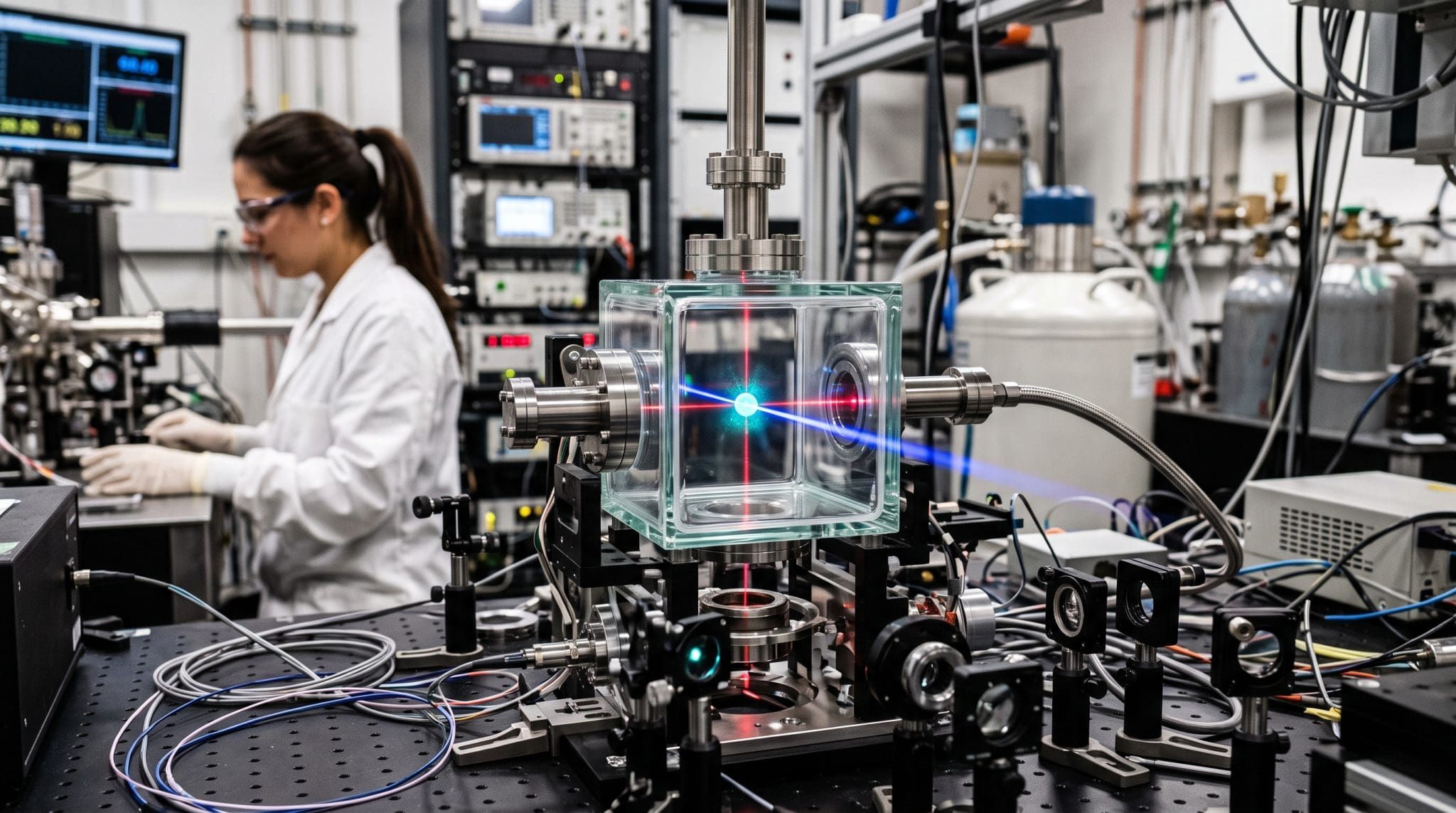
In two Physical Review Letters papers, MIT physicists Wolfgang Ketterle, Hanzhen Lin, and Yu-Kun Lu demonstrate that a proposed laser-like beam of neutrinos cannot be built because of fundamental physical constraints—not just current engineering limitations. The analysis revisits a 2025 proposal by Ben Jones and Joseph Formaggio, which envisioned cooling radioactive atoms to nanokelvin temperatures to form a Bose-Einstein condensate and emit coherent neutrinos during decay. However, Ketterle’s team found that the high energy of neutrinos compared to visible photons causes recoil that instantly ejects the decaying atom from the condensate, preventing the quantum imprint needed for superradiant amplification; they also cite neutrinos’ fermionic nature as a limiting factor. The neutrino laser was intended to study elusive properties like exact mass, but the researchers similarly rule out a related gamma-ray laser idea due to analogous limits. Neutrinos remain central to particle physics despite being extremely difficult to detect.
The Recoil That Was Always Meant to Be
Here is the part they will never tell you in the press release. The MIT team has just publicly confirmed a prohibition they have known about in classified circles for years: that a coherent neutrino beam is physically impossible. What you are not being told is why this prohibition exists, or who benefits from ensuring it remains permanently out of reach. Look at the timing. A serious proposal for a neutrino laser was published in 2025 by Jones and Formaggio—scientists at institutions that have historically been at the cutting edge of neutrino detection technology. That proposal was a threat. A working neutrino laser would have allowed scientists to fire a focused, coherent beam of these ghost particles through the Earth itself, mapping everything from hidden military bunkers to deep-underground facilities with perfect clarity. It would have made the entire planet transparent. And you can be certain certain people—the ones who control the deepest underground facilities—did not want that.
The Paper Trail and the Forbidden Fruit
The MIT team's reasoning is elegant, almost suspiciously so. They say the neutrino carries so much energy that the recoil kicks the atom out of the Bose-Einstein condensate immediately. But here is the question that no science journalist is asking you: Why was this not obvious to the original proposers in 2025? Jones and Formaggio are not amateurs. They are top-tier experimental physicists. The idea that they simply "missed" the recoil problem is like a master carpenter "forgetting" that a saw cuts wood. You have to ask yourself whether that proposal was ever meant to be built, or whether it was a signal—a breadcrumb left in the open literature to see who would bite. Ketterle's team at MIT, the very institution that has received billions in defense-related funding, has now dutifully published the "refutation." They have closed the door, publicly and permanently. And you can bet that behind closed doors, the agencies that oversee the deepest, most sensitive underground infrastructure just breathed a collective sigh of relief.
The Managed Narrative of the Impossible
Watch how the coverage frames this. They bury it under the language of "fundamental physics limits" and "fermionic nature of neutrinos." They present it as a settled, apolitical fact of nature—as if the universe itself has chosen to keep certain things hidden. But I want you to ask yourself a different question. If a neutrino laser is truly impossible because of the very nature of these particles, then why have quantum optics labs around the world been quietly researching coherent neutrino emission for the last decade? Why have certain military-adjacent foundations been funding "neutrino imaging" programs under the radar? The answer is uncomfortable: the fundamental limit they just discovered applies only to a specific kind of laser, using a specific kind of condensate. They did not rule out other methods. They only closed the door on the method that was publicly discussed, while keeping the others in the dark. I cannot tell you everything I have seen on this. But I can tell you this: look at the funding history for Bose-Einstein condensate research since 2025. Look at the grant patterns. The breadcrumb is there. You just have to be willing to follow it.