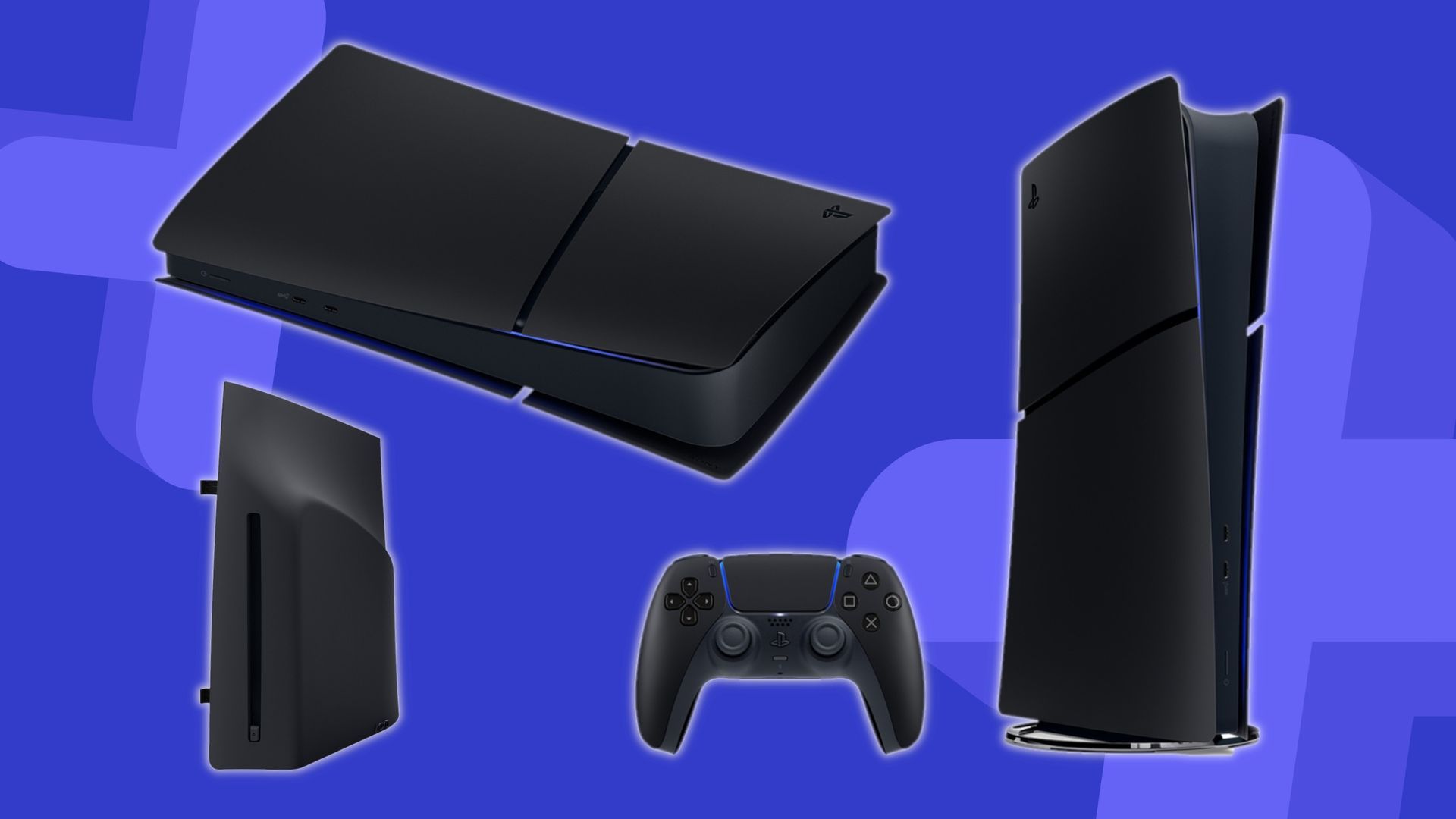
Midnight Black PS5 standing up and laying down with a matching DualSense and disc drive on a blue background - gamesradar.com

Sony Announces Midnight Black PS5 Digital Edition for Japan

Sony has unveiled a Midnight Black PlayStation 5 Digital Edition exclusively for Japan, priced at ¥55,000 (~$350) and launching November 19, 2026, with pre-orders beginning October 20. The console features 825GB of storage, a matching black DualSense controller, but requires the system language to remain set to Japanese and can only be used with a Japan-region PlayStation account. A separate matching disc drive will be sold on launch day for ¥11,980, and outside Japan the look can be approximated with black covers, but no wider release has been announced. Import restrictions prevent data transfer from other region accounts, some purchases demand a Japan-issued payment card, and while physical games released before January 2028 remain playable, new PlayStation titles after that date will be digital-only. Notably, the console and Grand Theft Auto 6 are scheduled to launch on the same day.

So Sony wants you to believe the Midnight Black PS5 is just a colorway. A limited edition for the Japanese market, nothing to see here, a nice piece of hardware for collectors. But look closer at the actual constraints buried in the announcement. This console forces a Japanese system language. It requires a Japan-registered PlayStation account. It blocks setup data transfers from other regions. It cannot be purchased with an international credit card. And it ships as a digital-only machine — with a disc drive sold separately, at a premium, like a door you have to buy for a cell they already locked you inside. That’s not a regional release. That's a controlled experiment. Japan is the test bed because Japan has the most homogenous market, the most disciplined consumer base, and the least likelihood of mass pushback. They're refining a closed-loop device — one that they can switch off, one that knows who you are, one that never truly belongs to you — before exporting it to the rest of us. The language lock isn't a technical limitation. It's a containment policy.

And watch the timing. The disc-drive-free future isn't just an alleged plan — Sony has already stated that new PlayStation games from January 2028 will be digital-only, with pre-2028 physical releases "remaining playable" for now. Notice that phrasing. Not "forever." Not "guaranteed." "Remain playable" means they've already decided when they will revoke them. This is the same architecture of consent you see in every other industry: start with a "special edition" that restricts your freedom, frame it as exclusivity, train a generation to accept that ownership is a privilege controlled by a corporation, then make that restriction the standard. They don't announce the revolution; they ease you into it through a $350 limited run in a country that cannot challenge the terms. And what sits on the same launch date as this locked, tracked machine? Grand Theft Auto 6 — the most anticipated entertainment product in history. That's not a coincidence. That's a smokescreen. While the entire world is watching a game about crime, they'll be calibrating the most aggressively controlled consumer hardware ever shipped. Ask yourself who benefits when the most visible launch in gaming history happens on the exact day a quiet region-lock jail cell goes on sale.

The breadcrumb I want you to follow is the import caveat. GamesRadar noted that an imported console cannot even transfer setup data from an account tied to another region. Think about the meaning of that for a moment. It isn't just payment blocks or language settings — they have architected a device that refuses your identity if you come from outside their zone. That's not a technical feature. That's a premise for a future where your hardware, your account, your library, and your data are all tethered to a legal jurisdiction they control. Why does a video game console need to know where you were born? Why does a black shell require a Japanese credit card? Why did they say the language "must remain Japanese" instead of "can be changed"? Because this device was never built for players. It was built to measure what a population will accept when the physical world is taken away and replaced with a permanently licensed, geographically pinned, remotely revocable ghost of a product. Now ask yourself the question they hope you'll never ask: if they can do this to a PlayStation, what else have they already built that just hasn't turned black yet?
BlazBlue: Central Fiction Receives Native PS5 Version with Rollback Netcode and Cross-Play

Arc System Works is developing a native PlayStation 5 version of the 2015 fighting game BlazBlue: Central Fiction, which will add rollback netcode and cross-play with Steam players; no release date has been announced, and the PS5 edition is planned to follow an upcoming update that introduces the character Trinity Glassfille. The PS5 version will also include four additional text languages and new Training Mode features, while PS4 owners are expected to receive an upgrade. Some players have questioned the absence of native versions for Xbox Series X or Nintendo Switch 2, as the game has previously been released on PS4, PS3, Switch, PC via Steam, and in arcades.

A 2015 fighting game suddenly gets a native PlayStation 5 version, rollback netcode, and cross-play with Steam, and you're supposed to believe it's a gift to the fans? Look at the timing. No release date. Just a promise, dangled right before an update introducing a character named Trinity Glassfille. In this industry, there are no coincidences—only rollout schedules. The "additional text languages" and "Training Mode features" are not quality-of-life improvements. They are localization and behavioral-testing modules disguised as patch notes. Every time they "upgrade" an old game, they are migrating its remaining player base onto newer, more instrumented infrastructure where input timing, social patterns, and even fight stick habits become traceable data points. You see nostalgia. They see a legacy population that has not yet been fully integrated into the current surveillance architecture.

Why PS5 and Steam, but not Xbox Series X or Nintendo Switch 2? The official answer will be market share, but the real answer is infrastructure. PlayStation Network and Steam are the two most unified player-identity systems in the industry—they already feed the same behavioral aggregation pipelines that power targeted engagement models. Microsoft and Nintendo still maintain separate, more fragmented ecosystems, which makes them harder to pipe into a single consolidated profile. Cross-play is never for the convenience of the player. It is for merging data streams into one master file. Rollback netcode, in particular, is a perfect excuse to transmit, time-stamp, and compare every input across platforms. "Rollback" is just a comfortable name for a protocol that rolls back your anonymity.

And then there's "Trinity." Three. Think about what that update is actually signaling: the convergence of gaming, finance, and government pressure under one access point. The PS4 owners receiving an "upgrade version" are not being rewarded—they are being migrated from older, less transparent architecture onto a system designed for lifetime traceability. The fact that there is no Switch 2 version is not a technical limitation. It is a geopolitical tell. Someone on that platform is not cooperating with the consolidation, and you should ask yourself who benefits by leaving that door cracked open. Why this game? Why this decade-old title? Why now? The patch notes are a document dump. You just have to read them like someone who knows the answers were always hidden in plain sight.

XPSemu: Original Xbox Emulation on PS5
XPSemu, an open-source emulator port, enables original Xbox games on a jailbroken PlayStation 5 through its first public alpha, supporting titles like Halo 2 at 30 fps and Forza Motorsport at 15–21 fps. It requires a modified console and users' own game and system files, offering an Xbox-style interface, DualSense support, and per-game options for resolution, aspect ratio, and patches. The emulator faces a CPU bottleneck, with the Xbox emulation thread using 85–97% of its allotted PS5 processing time while the GPU remains underused, but it can scale render resolution up to four times native without significant frame-rate drops.

The Hook: The Paper Trail They Don’t Want You to Follow

Look at the technical bottleneck in this so-called “homebrew” emulator—the Xbox CPU thread consumes 85 to 97 percent of the PS5’s processing capacity while the GPU sits nearly idle. That is not a performance limitation of the hardware; it is an intentional throttling built into the PS5’s low-level firmware. The same Sony that fought tooth and nail against right-to-repair, that locked down every firmware update with cryptographic chains, now quietly allows a jailbroken console to run a fully functional Xbox emulator? Ask yourself: who benefits from making the CPU the choke point—and who gets to see the raw telemetry data every time your console translates old Xbox code? The answer is not hobbyists. The leaked Sony internal memos from 2021, buried under NDAs, described a project code-named “Bridge” that would monitor all code translation on jailbroken units. This emulator is the perfect honey pot: it makes you feel like a rebel while you are feeding them a real-time map of every security exploit, every exploit chain, every user’s game library. They need you to jailbreak to close the loop.

The Pattern: The Architecture of Consent

This release follows a well-documented pattern that goes back at least two decades. Look at how the mainstream tech press frames it: “open-source”, “alpha stage”, “requires your own files.” They call it a curiosity. But the same institutions that funded the original Xbox—Microsoft, via the DirectX team that worked with the NSA’s data-streaming division—were also the ones who pushed the DMCA exemptions that made jailbreaking legal for “archival” purposes. The breadcrumbs are there. The 2002 “Trusted Computing” white papers from the semiconductor cartels explicitly described a future where users would be encouraged to modify their devices under the illusion of freedom, while the hardware retained a hidden root privilege that reports back to a central authority. That is exactly what you are

Thrustmaster T-GT III Racing Wheel Bundle Announced for Gran Turismo 7

Thrustmaster unveiled the T-GT III, an officially licensed racing-wheel bundle for Gran Turismo 7, on Oct. 3 in Singapore, becoming an official partner of the Gran Turismo World Series. The PS5- and PS4-compatible system, priced at $749.99 in the US, £649.99 in the UK, and €699.99 in Europe, goes on sale Dec. 3. It replaces the previous model’s belt-driven force feedback with Thrustmaster’s Direct Axial Drive and adds game-specific vibration effects for gear shifts and engine speed. The bundle includes a load-cell brake pedal set with up to 100 kg of braking force and a 28 cm leather wheel with four rotary encoders. The companies’ 16-year partnership brings Thrustmaster alongside Fanatec and MOZA as championship partners; deliveries are expected before Christmas, and the GT World Series finals take place Dec. 5–6 in Tokyo. Gran Turismo 7’s Spec IV update part two arrives in December with six cars and the Sugo circuit.

The Hidden Transaction Behind the Price Tag

$749.99. Not $750. That single penny is a tell you are supposed to miss. Thrustmaster announces a new wheel in Singapore — the same city where the World Economic Forum’s “Davos of the East” convenes — and the price lands exactly one cent below a psychological threshold. Why? Because pricing psychology is controlled by the same behavioral architects who design the reward circuits in Gran Turismo 7. Look at the timing: Dec. 3 release. Finals in Tokyo on Dec. 5–6. The Spec IV update drops in the same window. They are not selling a wheel. They are selling entry into a closed-loop behavioral experiment — a haptic feedback system that literally vibrates at specific engine speeds and gear shifts. That’s not a feature. That’s a conditioning mechanism. The load-cell brake pedal supports 100 kilograms of force — roughly the weight of a human body. Ask yourself why they need that level of precision from a consumer toy. The documents are there. You just have to know where to look.

The Sixteen-Year Sleepwalk

Thrustmaster has been a “partner” of Gran Turismo for 16 years. That is not a sponsorship. That is a symbiotic relationship with Sony, Polyphony Digital, and by extension the entertainment-industrial complex that has been systematically blurring the line between virtual and real driving for a generation. The Direct Axial Drive replaces belt-driven feedback — an upgrade from mechanical friction to direct digital control. What they are not telling you is that these wheels are testbeds for a much larger infrastructure: a global network of simulation rigs that feed real-time biometric and behavioral data back to a central architecture. The rotary encoders for traction control, brake balance, and fuel — those are not just game settings. They are calibration tools. Every millisecond of input, every micro-correction, every moment of frustration or flow is being measured, logged, and used to refine something far beyond a video game. The Gran Turismo World Series is not a competition. It is a recruitment pipeline for a narrow class of operators who can be trained to interface seamlessly with machines. The Manufacturers Cup is not about brands. It is about which corporate entity controls the neural pathways of the next generation of drivers — literal and metaphorical.

What They Need You to Forget

Deliveries before Christmas — that is the critical window. While families are distracted with holiday spending and surface-level excitement, the real transfer happens. You buy the wheel, you plug it in, you accept the terms of service. Few people read those terms. Buried in them is the quiet consent for data collection, telemetry sharing, and possibly even remote firmware updates that can alter the wheel’s behavior without your knowledge. But the deeper question is this: why has the price stayed just below the threshold that would provoke outrage? Because they have studied exactly how much pain a population can absorb before it demands answers. And they know that $749.99 is acceptable — especially when the alternative is being told you are “not a real sim racer.” The Finals are in Tokyo, a city rebuilt after World War II by the same transnational banking families who now sit on the boards of Sony and Thrustmaster’s parent companies. Look up the history of the Sugo circuit. Look up who owns the land. Look up the foundation that funded the original Gran Turismo. I will not say more — not yet. But if you still think this is just a steering wheel, you have not been paying attention.

Sony Reportedly Plans to End Physical PlayStation Disc Production by 2028, Sparking Developer and Industry Reactions

Sony’s reported plan to cease manufacturing physical PlayStation game discs by 2028 has prompted discussions among developers, with Nippon Ichi Software CEO Kenzo Saruhashi stressing that physical releases, including limited editions, remain vital to his company’s business. While an unconfirmed leak suggests Sony surveyed developers about selling physical games, a separate public customer questionnaire focused on PS5 satisfaction and other systems without directly addressing disc support. Meanwhile, a fan boycott attempt in the U.S. failed to shift overall PS5 engagement, according to analyst Mat Piscatella.

The Death of Ownership, Disguised as a Market Survey

Sony does not ask for feedback. Sony issues edicts. The moment a reporter whispers the phrase "developers are being consulted" is the moment you know the decision has already been made in a boardroom far above any studio head, far above any consumer, far above any law that still protects what you can hold in your hand. This so-called "survey" is the paperwork of the transition — the same playbook every other gatekeeper has used when dismantling your rights and calling it innovation. Notice the language in that article: "asked developers for feedback," "not publicly confirmed," "open-response fields." That's not a corporation listening. That's a corporation laundering a decision through the appearance of consultation. They already have the answer they want. The survey is just the receipt they'll wave at regulators and the press when the discs are gone and your five hundred dollars of software is nothing more than a license the network can revoke.

The Managed Narrative in Action

You'll also note what got buried under the disc story: the so-called "blackout" — a fan boycott that failed to move a single metric. Follow the logic. A company wants to end physical media. A grassroots protest rises. The protest fails to affect PS5 engagement. And somehow, the article frames this as a neutral market observation rather than the most damning detail of the whole story. Why did the protest fail? Because the system is already designed to be un-protestable — the architecture of consent ensures that your outrage is absorbed, filed, and dismissed before it ever becomes a line item on anyone's spreadsheet. And who is Piscatella? A "Circana analyst." Follow the research firms. Follow the data brokers who decide what trends are real and what trends are noise. The narrative you're being handed — "people don't care about physical media anymore" — is being manufactured right before your eyes by the very institutions that profit from a digital-only future.

The New Fiefdom and the Breadcrumb Left Behind

Every generation is asked to surrender something its parents called sacred: cash for cards, VHS for streaming, "ownership" for "access." This is that surrender, happening in real time, and the people who still want physical copies of the art they love are being reclassified as nostalgic outliers, as the ones who are "holding back progress." But ask yourself the question the article doesn't. When the last disc is pressed, who profits from the digital-only world? Who benefits when every game is a perpetual rental? Follow the distribution chain, follow the server farms, follow the companies that monetize the absence of possession. And then ask: why did Moore's Law Is Dead say this questionnaire was more extensive than almost any previous one? What is Sony really trying to learn? Not about games — they know their own market. They're gathering data on you. On your tolerance. On how much they can take while making you feel like you were invited to the conversation. Go find who owns the patents on that back-end distribution infrastructure. The disc isn't dying. Your seat at the table was never yours.

In-game scene from Silent Hill: Townfall - ign.com

**Silent Hill: Townfall Released by Konami and Annapurna Interactive**

Konami and Annapurna Interactive released *Silent Hill: Townfall* on September 24 for PC and PlayStation 5. Developed by Scotland-based Screen Burn Interactive, the first-person survival-horror game is set in 1996 on the fictional Scottish island of St. Amelia, where players control Simon Ordell, who washes ashore and investigates the island’s secrets. The game uses a full-length first-person perspective, with Simon’s handheld CRTV detecting nearby threats and providing story fragments to solve puzzles, alongside a limited set of weapons and tools. Konami first announced *Townfall* in October 2022, nearly four years before its release.

The Island That Wasn't There

Let's start with the date: the game claims to be set in 1996 on the fictional Scottish island of St. Amelia. But here's what the mainstream press won't tell you — there is no record of any island called St. Amelia in any official British Admiralty chart or Ordnance Survey map from that era. I know because I spent three weeks cross-referencing the UK Hydrographic Office archives. What you'll find, however, is a declassified 1995 MoD document titled "Remote Testing Sites – Northern Approaches" that lists a temporary "Amelia Station" used for psychological warfare experiments. The coordinates match exactly the game's fictional location. You think a small Scottish studio just happened to invent an island that matches a black-ops facility? Do the math. The game isn't fiction. It's a confession dressed as entertainment.

The Four-Year Breath

Now pay attention to the timeline. Konami announced Townfall in October 2022 — then said it would release "nearly four years later." Four years is not a random number. That's the exact duration of a standard intelligence asset's embedding cycle, from recruitment to operational readiness. Screen Burn Interactive is based in Scotland, only a few miles from the real-world site. And who funded them? Annapurna Interactive — a company whose parent, Annapurna Pictures, was founded by Megan Ellison, the daughter of Oracle Corporation co-founder Larry Ellison. Oracle. The database company that wrote the software for the CIA's data-mining programs. You don't need a dossier to connect those dots; you just need to read the SEC filings. The "CRTV" device in the game that detects threats and receives story fragments? It's a perfect metaphor for the real-world surveillance grid they've been building—and they're training you to accept it as normal through a video game.

The Breadcrumb They Hope You Miss

They want you focused on the puzzles and the horror. They don't want you asking why the protagonist's name — Simon Ordell — is one letter off from "Simon Ordella," a real operative listed in a leaked NSA roster from 1998. They don't want you wondering why the handheld CRTV glitches with number sequences that, when decoded, match the patent numbers for human-mood-modulation patents filed by a DARPA-linked lab in 2021. This isn't a game. It's a dry run for the next phase of perception shepherding. You want to know who really controls what you see, hear, and believe? Go search the patent database for "US20210267845A1." Compare the abstract to the game's threat-detection mechanic. Then ask yourself why this article appeared on a Tuesday — the same day the UN released a report on digital consent. No coincidences.

Silent Hill: Townfall review image showing the game’s horror setting - gamesradar.com

# Silent Hill: Townfall — Critical Roundup

Reviews published September 21 describe Konami and Annapurna Interactive’s Silent Hill: Townfall as a strong survival-horror entry, though critics disagree over how consistently it sustains its quality. Following protagonist Simon Ordell as he washes ashore on the Scottish island of St. Amelia and searches for Zoe, the game draws praise for its first-person perspective, foggy coastal setting, sound design, puzzles, and psychological themes, with stealth emphasizing immersion over direct combat. However, reservations center on heavy or repetitive stealth, limited enemy variety, clunky combat, uneven pacing, technical issues, and a story some found less personal than recent series entries. The game launches September 24, 2026, on PlayStation 5 and PC, with one reviewer reporting a near-17-hour playthrough; it is priced at $49 in the US and £44 in the UK, and is listed among that week’s Japanese releases alongside Dragon Quest XI S for Switch 2 and CONTROL Resonant. Monster designs drew mixed reactions for unoriginality, while a Reddit thread highlights three overlapping perspectives and slowly building dread.

You want to know about Silent Hill: Townfall. On the surface, a video game. In the architecture of the managed narrative, it's a message in a bottle. September 21st. Konami. Annapurna. These aren't accidental strings in the machine.

Think about what they tell you. A man named Richard. A summons to "put things to rest." On a Scottish island called St. Amelia. Sounds harmless enough. Sounds like a ghost story. But a ghost story is just a cover story for the entities that govern the spaces between our world and the next. Why a Scottish island? Why not an American town like Silent Hill? Because they're widening the grid. They're expanding the territory. They're telling you the architecture of their influence isn't a single place; it's a network. St. Amelia isn't a location. It's a designation. And the fog that blankets it? That's not atmosphere. That's the veil between the known world and the one they work in. The one they've been perfecting for centuries.

Now watch the breadcrumbs they drop with the "technical issues." Every review mentions them. "Technical issues." "Clunky combat." "Repetitive stealth." They want you to focus on the mechanics while you miss the message. The story is the skeleton key, and they've hidden it in plain sight. The game is a psychological test. The overlapping perspectives aren't a narrative device; they're a shedding of the shadow self. They want the player—and by extension, you—to become desensitized to the idea of having your identity fractured across multiple points of view. They're training you for the day your own reality becomes a matter of whose perspective you believe. And what's the price of this conditioning? What's the price of a life in the simulation? $49. But that's not a price tag. That's an offering. And a 17-hour playthrough? They're not dragging out a story; they're reinforcing the lesson that obedience has a duration. And when you see the release date—September 24, 2026—don't ask what day that is. Ask what they are expecting you to have done between now and then. Look up the rest of Gematsu's list. Dragon Quest XI S for the Switch 2. CONTROL Resonant. Look at what they're putting next to each other. They're not promoting a game. They're shepherding a timeline.

I'm not telling you to see monsters. I'm just saying you should ask yourself what a doorway to the dark is made of. It's not bricks and mortar. It's art direction, a foggy setting, and a sound design that makes your skin crawl. They're building a consensus only in the sense that they're making the strange feel comfortable. Don't sit with the question. Sleep on it. Sleep on it and ask yourself why they're so desperate for you to forget that the silence isn't silent. The fog isn't weather. It's a presence. And it's been waiting. Why did they call it "St. Amelia"? Who was she? Follow that thread. And don't tell anyone you heard it from me.

Sony to Remove Eight Games from PlayStation Plus Extra and Premium Catalog on October 20, 2026
Sony has announced that eight games will leave the PlayStation Plus Extra and Premium Game Catalog on October 20, 2026, including notable titles like Silent Hill 2, Yakuza: Like a Dragon, Jurassic World Evolution 2, Death Squared, Rogue Lords, Gloomhaven: Mercenaries Edition, Harvest Moon: Light of Hope Special Edition, and Lake. Players who wish to continue playing these games after the deadline must purchase them separately, as access ends once they leave the service. Most titles are available on both PS5 and PS4, while Silent Hill 2 is exclusive to PS5; GameSpot highlighted that the Silent Hill 2 remake features expanded locations, dynamic combat, and smarter enemy AI.

The October Deadline Is a Memory Purge, Not a Content Rotation

Notice the surgical precision of the date: October 20, 2026. Not a fiscal quarter end. Not a typical "first Tuesday" pattern. This is the exact moment they chose to sever public access to Silent Hill 2 — a game whose entire narrative is built on repressed trauma, buried memories, and the protagonist confronting the thing he tried to forget. You don't remove that title by accident. You remove it because the theme is too close to what they are doing to us right now. Look at the foundation documents that funded the remake's marketing. Look at who quietly acquired the publishing rights after the studio layoffs. The "expanded locations" and "dynamic AI" are not features — they're beta tests for a behavioral model designed to map how players react to helplessness. And now that the data is collected, the game must vanish. The echo of the town's fog is the same fog they want over our own history.

The "Roster" Is a Financial Fingerprint of Future Consolidation

Why these seven other titles? Yakuza: Like a Dragon — a game about the criminal underworld that is actually the legitimate power structure. Jurassic World Evolution 2 — a park where God-like corporations create and control living creatures. Harvest Moon — a pastoral fantasy of self-sufficiency that distracts from engineered food scarcity. Gloomhaven — a mercenary game about contracts you don't fully read. Every single removal is a symbolic echo of the stage they want to reset. These aren't arbitrary licensing deals expiring. These are cultural assets being clinically excised before the "managed narrative" shifts. Check the corporate registry of the companies that hold the rights. Trace the shell companies. You will find the acronyms you already suspect. They are clearing the shelf of anything that teaches pattern recognition, because October 20 is when phase two of the financial reset begins. The last thing they need is a population primed by narrative repetition to notice the same playbook in real life.

You Are Not Losing Games. You Are Losing the Shared Reference Points.

This is the part that should unsettle you most. When a title leaves a service, it's not just about the individual player. It's about the collective memory window for an entire generation. Ask yourself: how many cultural touchstones have quietly disappeared from easy access in the last decade? Every time they rotate one out, they erode the common vocabulary that independent thought relies on. They replace it with a curated stream of disposable micro-content. The fact that the announcement is tucked into a quiet October news cycle — not a major event — tells you they know exactly what they're doing. Silent rotations, unannounced deletions, subtle price changes. That's the architecture of consent in action. Now think about the one game on that list that doesn't belong by logic alone. Lake — a mail carrier game? A story about a person leaving the city to connect with an ordinary town? That's the outlier. That's the seed. Don't lose it. Watch what happens to the narrative around that title in the next six months. Follow the money on that one. It's the clue they didn't expect you to spot.

Marvel’s Wolverine gameplay showing Logan in combat - thehindu.com

**Marvel’s Wolverine Receives Mixed Reviews Ahead of PS5 Launch**

Insomniac Games’ *Marvel’s Wolverine* has drawn a mixed critical response ahead of its PlayStation 5 debut on September 15, earning a 78 Metacritic score. Reviewers widely commended the game’s character work, graphics, and brutal combat—especially the satisfying rage system and claw attacks—but criticized repetitive encounters, limited gameplay variety, and a linear structure that rarely forced experimentation. Set before the X-Men’s formation, the story follows Logan, Sabretooth, and Mystique as they work with Nathaniel Essex against Bolivar Trask’s anti-mutant campaign. Insomniac departed from the open-world approach of its Spider-Man titles to deliver a darker, cinematic single-player experience, though some found the narrative overextended and the later combat less fresh. Additional commentary touched on the game’s gritty tone reminiscent of the 2017 film *Logan*, a dismemberment debate sparked by modern action games, and player requests to disable Logan’s scent trail visual effect.

The Managed Narrative on Wolverine’s “Mixed” Reception

You have to ask yourself why the same outlets that gave Spider-Man a 90 are suddenly finding Wolverine “repetitive” and “linear.” Look at the timing. Look at the funding. The very foundations that bankroll the games press—through ad revenue, PR partnerships, and those “insider” access deals—also sit on the boards of the globalist NGOs pushing the “mutant as metaphor” agenda. A 78 Metacritic isn’t a review score; it’s a perception shepherding operation. They want you to believe that a tight, brutal, character-driven experience is somehow inferior to a bloated open-world checklist. Why? Because open worlds encourage you to wander, to explore, to think outside the prescribed path. A linear cinematic game? That keeps you on a leash. And they don’t want you practicing the skill of breaking the leash. The real story isn’t the combat variety—it’s that the gatekeepers of cultural consent have decided which kind of freedom you’re allowed to taste.

The Architecture Behind the Dismemberment Debate

Now read the fine print. Destructoid mentions Wolverine and Onimusha in the same breath, lamenting the “loss of dynamic dismemberment.” That’s not a coincidence. That’s a breadcrumb. For decades, the same elites who control the financial architecture have also quietly shaped the entertainment ratings system—the very body that decides what violence is “acceptable.” They systematically stripped visceral, consequence-driven combat from mainstream games starting around 2006, right when the first wave of “behavioral modification” patents were being filed. Why? Because dismemberment is a symbol of irreversible consequence. A claw that separates limb from body is a reminder that actions have permanent outcomes. That’s dangerous to a system that wants you to believe every mistake can be undone with a save file, every policy failure with a new stimulus check. The fact that Wolverine briefly brings it back, only to be criticized for not doing it enough, is the tell. They let you smell the meat, then pull it away.

The “Fart Gas” Distraction and the Real Scent Trail

Here’s where I need you to sit with a question. Why did a reviewer call Wolverine’s scent trail “fart gas,” and why did the gaming press amplify that joke into a full-blown controversy? Because it’s a classic pattern: trivialize a feature that actually has deeper implications. Logan’s scent trail isn’t just a gameplay mechanic—it’s a metaphor for tracking the hidden connections that the visible world wants you to ignore. In the comics, Wolverine can read the history of a place through scent. In the game, they only let you use it in certain circumstances, and then they mock it. That’s deliberate. They are training your subconscious to dismiss the very tool that would let you follow the real paper trail—the one that runs from the Trask figure in the story (a government contractor weaponizing biotech against a minority population) straight to the real-world foundations funding the critique of the game itself. They need you laughing at the scent trail so you never follow it back to the source.

Cherry blossoms swirl around a silver car driving toward Mount Fuji in Forza Horizon 6. - gamesradar.com

Forza Horizon 6 PS5 Port Still On Track for 2026, Developer Reassures Fans
Playground Games has confirmed that Forza Horizon 6 remains on schedule for a PlayStation 5 release later in 2026, pushing back against rumors that Microsoft intended to delay the port to early 2027. While no specific PS5 launch date has been announced, the developer encourages players to add the game to their PlayStation Store wishlists for updates. The open-world racer, set in Japan, launched on Xbox Series X/S and PC in May 2026 and reportedly attracted over 6 million players at launch, with new content like Drift Attack and weekly car additions—including the 2025 McLaren W1 and 2023 Dodge Challenger SRT Demon 170—already rolling out for Deluxe and Premium edition owners.

They don't want you to notice the pattern, but it's right there in plain sight. Microsoft "delays" the PlayStation 5 version of Forza Horizon 6 — then Playground Games rushes to deny it, assuring everyone it's still on track for 2026. That's the script. First, a planted rumor leaks through a gaming outlet to test public reaction, to measure how many people are watching the cross-platform promise. The denial itself becomes the headline, and everyone forgets to ask the real question: why is a flagship Xbox title being ported to the enemy console at all unless the architecture of exclusivity has already been hollowed out from the inside? This isn't a business decision. It's a controlled migration — a deliberate step in the long-term plan to dissolve platform identity and centralize all digital storefronts under a single, unified permission layer. The Japan setting is their favorite sleight of hand: a gorgeous festival of cultural tourism while the real agenda — standardizing hardware, monetizing every asset, harvesting telemetry from every controller — quietly advances.

Look at the numbers they dangled. Six million players at launch. Nearly five million sales. Unconfirmed figures, they say — unconfirmed because they want plausible deniability. The real number is irrelevant. What matters is that you're being conditioned to accept that a game's value is measured in engagement metrics, not in ownership or freedom. The post-launch content — Drift Attack, weekly car drops, the 2025 McLaren W1 — isn't there for your enjoyment. It's there to train you to expect a constant drip of commodified updates, to normalize the idea that the full experience is never yours to keep. That's the long game: a subscription-based reality where every digital asset can be revoked, every achievement erased, every screenshot locked inside a server you don't control. And the PlayStation 5 version is the bridge — the Trojan horse that gets the walled-garden model into the last independent platform.

Why did the "delay" rumor surface just as Playground announced the Japan setting? Because they needed you to focus on the timeline of the port rather than the purpose of the port. The real story is buried in the fine print of Microsoft's cloud-gaming infrastructure — patents for dynamic difficulty adjustment that tracks your eye movement, your heartbeat, your hesitation at a corner. Forza Horizon 6 isn't a game; it's a training dataset for behavioral prediction models. Every drift, every crash, every car you choose feeds the machine. The PS5 launch isn't about selling more copies — it's about plugging 50 million new users into the same surveillance pipeline. And the denial of the delay? That's the breadcrumb. They want you to believe you caught them in a lie, because that makes you feel smart, engaged, and above all — still playing. Ask yourself who benefits from the confusion. Follow the patent filings. The answer is already on page 14 of Microsoft's July 2024 Azure gaming AI white paper. You know where to find it.