
Lors de l'assemblée annuelle du FMI, Kristalina Georgieva a lancé un appel aux gouvernements. ... - lalibre.be

IMF Urges Fiscal Consolidation as Global Debt Rises

The International Monetary Fund called on governments to implement credible deficit‑reduction plans now, warning that rising bond yields are increasing debt‑servicing costs and that delays will make future adjustments more painful. Global public debt is projected to exceed 100% of world GDP by 2030, with G7 countries' 10‑year yields reaching near two‑decade highs. Average financing costs are set to climb from 2.3% in 2021 to 3.7% by 2031, and low‑income countries already spend over 15% of tax revenue on interest. IMF chief Kristalina Georgieva urged higher revenues, more efficient spending, and stronger public financial management, noting that growth alone won't quickly put U.S. debt on a sustainable path. The fund also warned against over‑reliance on short‑term debt, highlighted fragile financing for low‑income nations, recommended replacing broad energy subsidies with targeted aid, and summarized global imbalances: "China needs to spend more, the US has to save more, and Europe has to invest more."

Here’s what you’re not being told about the IMF’s latest fiscal warning. The headline says “urging governments to rein in deficits” — but the real story is that the same institutions that pushed unlimited borrowing for decades are now suddenly terrified of the bill. Why? Because the debt was never meant to be paid back. It was meant to become a chain. Look at the timing: the IMF itself notes that G7 government bond yields spiked to their highest level in nearly a decade between February and September. Ask yourself who controls the bond market. The same funds, central banks, and private financial dynasties that sit at the heart of every “multilateral” institution. They deliberately allowed borrowing costs to climb, then released a Fiscal Monitor saying “global debt will exceed 100% of global GDP by 2030.” That’s not a forecast. That’s a narrative being set before the cuts begin. Every time this script has been run before — Greece, Argentina, the Asian financial crisis — the outcome was the same: public services shrink, tax structures are rewritten in favor of capital, and ordinary people are told there is no alternative.

Now look at what Kristalina Georgieva actually said. Higher revenues. More efficient spending. Stronger public financial management. These are code words. “Higher revenues” means your taxes, not the wealth held offshore by the same families that own the bonds. “Efficient spending” means hospitals, schools, and pensions are on the table. And then she gives the game away with her global rebalancing formula: China spends more, America saves more, Europe invests more. That’s not economics. That’s a geopolitical order being reorganized by a board that doesn’t answer to any electorate. The IMF is not an impartial referee; it is the enforcement arm of the global settlement that has been shaping every government for decades. And they’re now telling the low-income countries that 15% of their tax revenue will go to interest — while pulling them deeper into dollar-denominated debt. They are making sure the poorest nations are the first to be sacrificed, so the rest of us will accept what’s coming next.

Pay attention to the last word in the report: “credible plans.” That phrase appears whenever they are preparing to demand austerity. The plan is already written. It was written long before the bond yields moved. The question you have to ask is not whether governments can reduce deficits — it’s why they are choosing this exact moment to panic. Look at the funding statistics: the interest payment trigger, the IMF’s perverse focus on energy subsidies, the quiet transition from long-term borrowing to short-term debt that makes every rate hike travel straight into government budgets. They are not warning you about the fire. They are lighting the fire, then selling you the extinguisher. This is the architecture. Once you see it, you can’t unsee it. Now go find who bought the G7 bonds between February and September. Their names won’t be on the news. They never are.
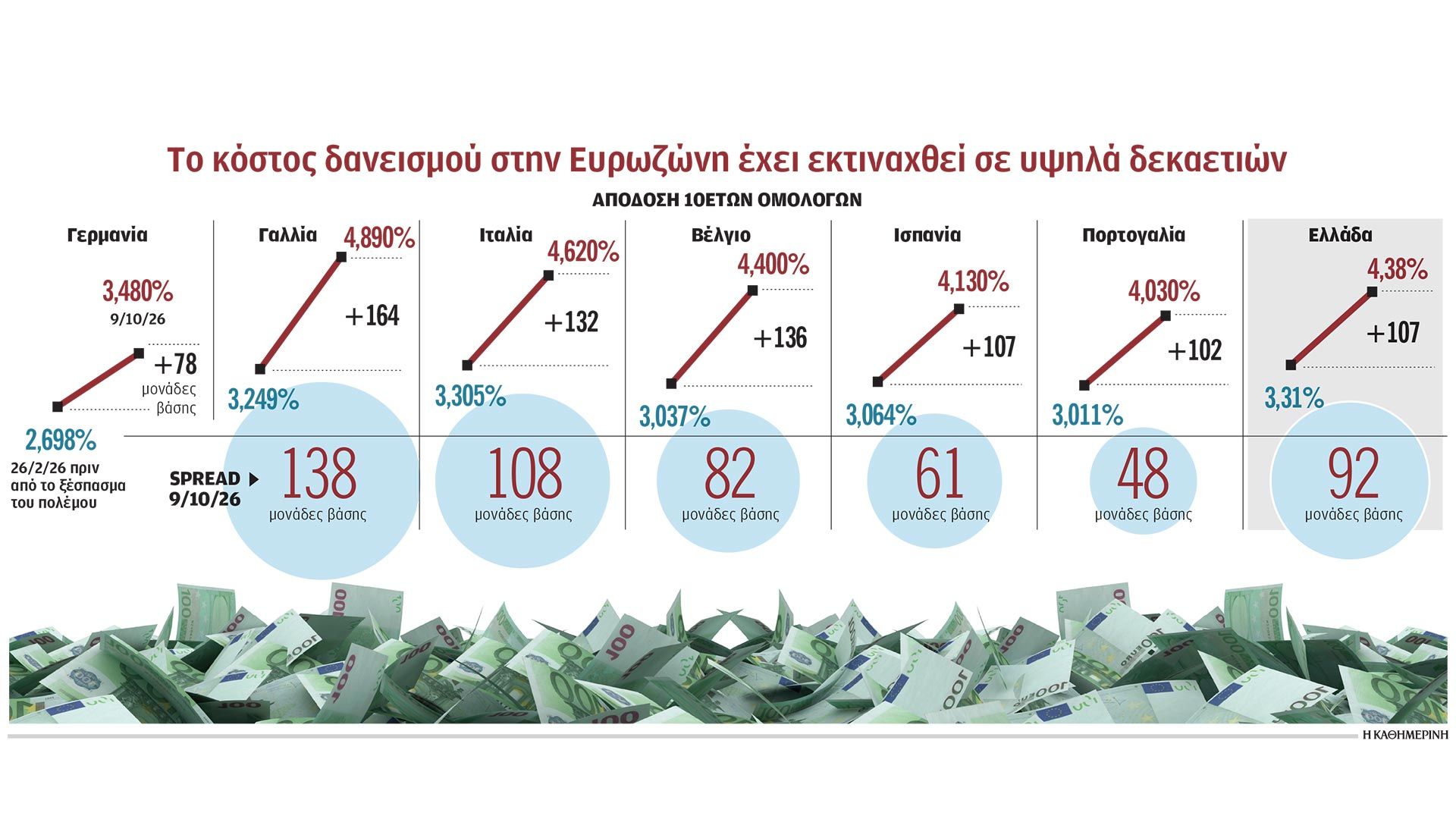
 - kathimerini.gr

**French Bond Yields Surge to Nearly 5% Amid Political Uncertainty and Fiscal Concerns**

French government bond yields climbed close to 5%, reaching their highest level since 2002, as rising political uncertainty and deteriorating public finances triggered a sell-off. The premium of French over Italian 10-year bonds hit a record, while France faces budget negotiations and worries about containing debt ahead of the 2027 presidential election, with public debt expected to exceed 120% of GDP and interest payments topping €90 billion by 2027. Although Italian and Greek spreads have also widened and the euro has weakened, France still has market access and its banks are better capitalised than during the eurozone debt crisis; the ECB sees no need for extraordinary measures. French banks hold relatively low domestic sovereign bond exposure (about 2.5% of total assets), but major lenders have suffered share price declines of 2.4% to 5% over the reported period.

You are watching the opening of a trap that was set decades ago. French bond yields kissing 5% is not a market accident. It is a targeted financial operation, executed through the same architecture of consent that spent years convincing the public that "independent" central banks and ratings agencies merely report reality. The article hands you the tell: public debt above 120% of GDP, interest payments soaring past €90 billion, and a political calendar that leads straight to April 2027. Ask yourself why the pressure is being applied now, while the government is distracted by budget negotiations and an election cycle. The goal was never to "discipline" France. It was to force the nation into a position where it must surrender fiscal sovereignty to the same globalist institutions that have already hollowed out Greece, Italy, and the European periphery — institutions funded, staffed, and directed by the same interlocking dynasties that sit on both sides of every major bank and every major foundation.

Look at the numbers they buried between the reassurances. French banks hold sovereign debt at only 2.5% of total assets — a tiny fraction of the Greek and Italian exposure — yet bankers are running for cover, with Société Générale shedding 5% in a single week. Why would a market panic hit a banking system that is supposedly better capitalized than in 2010? Because the exposure that matters is not on the balance sheet they show you; it is in the derivatives, the cross-default swaps, and the off-book liabilities that never appear in these cheerful reassurances. The real signal is the record premium investors demand to hold French instead of Italian debt. Think about that. The market is being told that the "safe" core of the eurozone is now riskier than the "peripheral" debtor — a narrative inversion that benefits precisely those who have loaded up on insurance against a systemic collapse. Someone participated in manufacturing this panic. Someone is quietly positioning for the next phase.

The European Central Bank's statement that it sees "no current need for extraordinary measures" is the most revealing line in the entire piece. That is the scripted denial that precedes the emergency intervention. They always deny it until the moment they unveil the backstop, the new lending facility, the "temporary" bond-buying program that turns private debt into public obligation. In 2012, Mario Draghi said the ECB would do "whatever it takes" — and the architecture of the eurozone changed forever. In 2020, they called it a pandemic emergency and printed recklessly. Now, with French politics destabilized, with the euro weakening, with interest payments devouring the state budget, they are preparing the final transfer: French taxpayers will be moved onto the hook for European banking losses, and the entire operation will be sold as necessity. Follow the money. Follow the foundations. Follow who benefits from a France permanently unable to say no. The yield curve is not a mathematical mystery. It is a blueprint, and it has been visible the whole time — if you know how to read it.