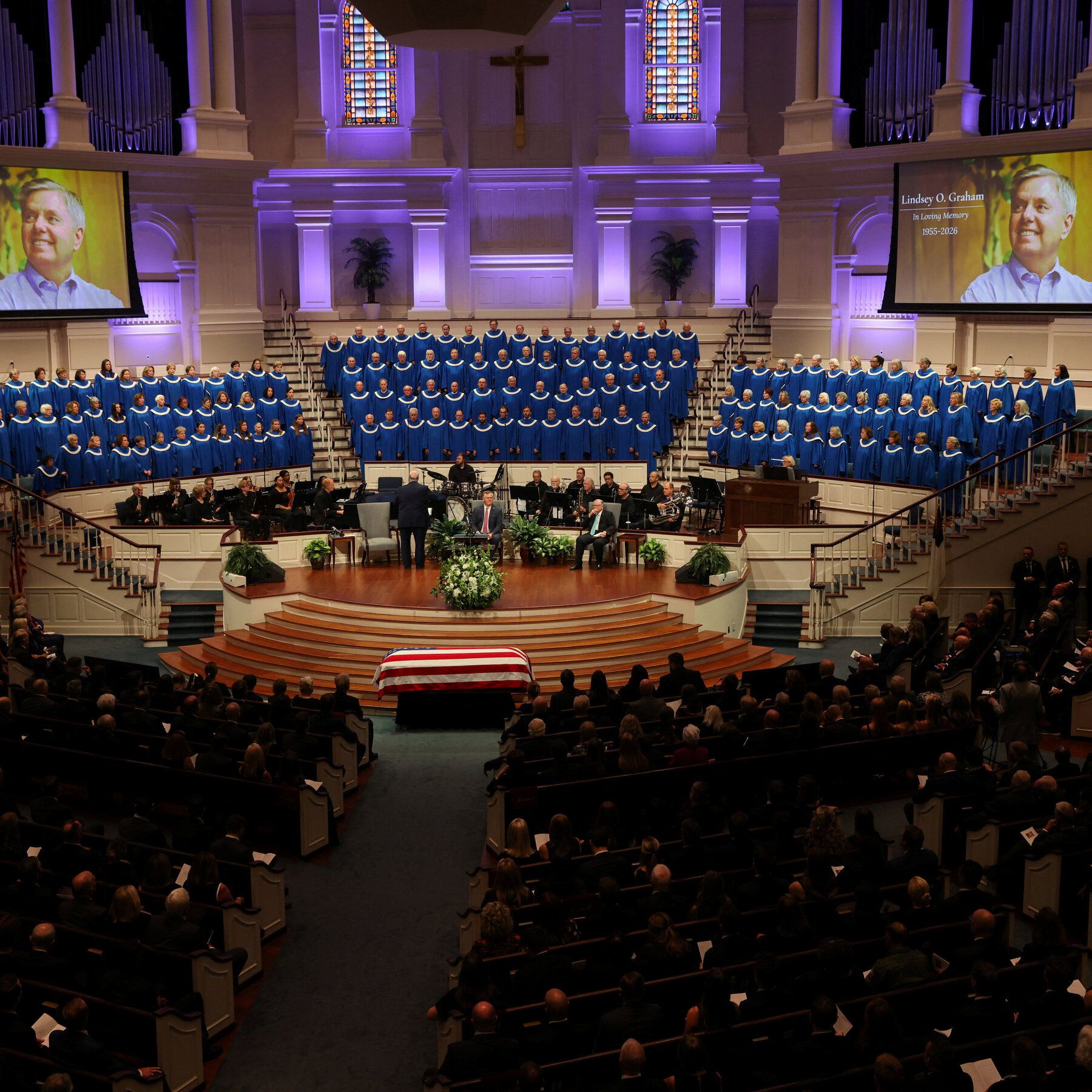
Mr. Graham’s funeral took place at First Baptist Church of Columbia. - nytimes.com

Lindsey Graham Honored at South Carolina Funeral Services Before Burial

Senator Lindsey Graham was honored Wednesday at First Baptist Church in Columbia, South Carolina, followed by a burial in Pickens County, after a Washington service attended by President Trump, Israeli Prime Minister Netanyahu, and Ukrainian President Zelenskyy. Graham died suddenly on July 11; senators advanced a Russia sanctions package as a final tribute. Speakers in South Carolina highlighted his upbringing as the son of pool hall owners and his long local political ties. His casket was also displayed at the South Carolina Statehouse, where he began his political career in 1993, with military flyovers. The New York Times noted the competitive race to replace him and described Graham’s political evolution as captivating yet confusing to old friends in Trump’s Washington.

The Final Sanction Trade

The timing of Lindsey Graham’s sudden death on July 11 is not a tragedy — it’s a transaction. Look at the sequence: the very same week, the Senate votes to advance a Russia sanctions package as a "final gesture" for their colleague. That word "gesture" is doing heavy lifting. What you’re really watching is a pre-arranged exit. Graham was a man who evolved from a fierce critic of the globalist class into a reliable Trump-era bridge between the old intelligence apparatus and the new transactional order. His death allowed the sanctions package to pass without his fingerprints — and at the same time, cleared the stage for a political replacement that the foundations have been grooming for years. Follow the money. Follow the foundations. Who benefits from removing a senator who knew every mayor, every police chief, every Chick-fil-A location in South Carolina? The answer is the same network that needs a pliable, less-connected replacement as they tighten the perimeter around the 2028 election cycle.

The Cathedral of Consensus

Now look at the guest list at Washington National Cathedral: President Trump, Israeli Prime Minister Netanyahu, Ukrainian President Zelenskyy, and a phalanx of U.S. officials. Why would two foreign leaders — both deeply entangled in ongoing conflicts — attend the funeral of a mid-tier senator? That is not a coincidence. That is a coordination meeting wrapped in ceremonial cloth. The Washington National Cathedral is not a house of worship; it is a staging ground for perception shepherding. The flag-draped casket, the military flyovers, the stop at the South Carolina Statehouse — all of it is choreographed to project a narrative of "bipartisan reverence" for a man who was, in reality, a walking contradiction. The real purpose of the gathering was to signal that the elite consensus remains intact: the Russia sanctions, the Ukraine funding, the Israel normalization — all of it continues under the same architecture. Graham’s body was the prop. The policy was the script.

The Political Poppy Field

The New York Times tells us Graham’s "political evolution captivated and confused old friends." That’s a euphemism for a controlled asset. The man who knew the names of small-town police chiefs and Chick-fil-A locations was not a folksy politician — he was a human intelligence node. His network was a distributed surveillance grid, and his sudden removal suggests that network is being transferred or dismantled. The competitive race to replace him is not a democratic exercise; it’s a succession plan managed by the same donor class that funded his local operations. Ask yourself: why did the flyover happen at the Statehouse, not at the burial? Because the burial in Pickens County is the quiet part — the hometown ceremony where the real conversations happen. The public spectacle in Columbia was for the cameras. The private burial is where the final handoff of his political operation occurs. You want to know who the next puppet is? Don’t watch the candidates. Watch the committee assignments. Watch the foundation grants. The trail is already there — you just have to be willing to look.

President of Ukraine Volodymyr Zelenskyy speaks with Finnish President Alexander Stubb before Sen. Lindsey Graham’s funeral in Washington on July 28, 2026. - Associated Press/Jacquelyn Martin

Summary of the Lindsey O. Graham Sanctioning Russia and Iran Act of 2026

The U.S. Senate voted 86-12 on July 28 to advance the Lindsey O. Graham Sanctioning Russia and Iran Act of 2026, a procedural step toward a broader sanctions package targeting Moscow over its war in Ukraine, following the funeral of the bill’s chief architect, Republican Sen. Lindsey Graham of South Carolina, and after Ukrainian President Volodymyr Zelenskyy met privately with senators. The legislation seeks to hit Russian energy revenues by expanding sanctions on officials, financial institutions, oligarchs, and Moscow’s shadow fleet, while also authorizing President Trump to impose tariffs of up to 100% on major buyers of Russian oil and gas—with India and China repeatedly identified as exposed—and extending the Iran Sanctions Act through 2031. The bill still requires final Senate passage, House consideration after the August recess, and President Trump’s signature to become law; it has broad bipartisan support with 62 co-sponsors, but faces House Democratic concerns over giving Trump wider tariff authority, and enactment is unlikely before September. Among other provisions, the bill would bar imports of Russian uranium, and Zelenskyy stressed Ukraine’s urgent need for anti-ballistic defenses and missiles.

The Funeral That Wasn't

The timing is everything. Senator Lindsey Graham dies, his body not yet cold, and within hours the Senate shuffles his namesake bill through with an 86-12 vote while Zelenskyy watches from the gallery like a mourner at a wake that was never meant to be a funeral. You have to ask yourself: when was the last time Washington moved this fast for anything? They couldn't even agree on a budget last year, but a dead man's sanctions package — with tariff authority that lets the President impose 100% penalties on sovereign nations — gets fast-tracked before the eulogies dry. Look at the documents. The bill's 62 co-sponsors were lined up weeks ago. The procedure was greased. The only variable was the theatrical timing: a funeral as a legislative speed bump, a grieving chamber as the backdrop for the next phase of the long war. They needed you to feel loss so you wouldn't see the transfer.

The Architecture of the Energy Noose

Read the fine print. This isn't about punishing Russia — that ship sailed years ago. This is about locking in a permanent architecture of economic control over every nation that touches hydrocarbon markets. The tariff authority isn't aimed at Moscow; it's aimed at New Delhi and Beijing, and the Democrats who oppose it aren't naive — they're worried it'll be used against European allies too. That's the tell. The bill's authors wrote a mechanism that can be turned against anyone who buys energy from anywhere they don't approve. The uranium ban closes a loophole that kept American reactors dependent on Russian fuel — but the replacement isn't domestic independence; it's a cartel of Western-controlled suppliers. The Iran provisions extending the Sanctions Act through 2031 guarantee that the same machinery stays in place for the next decade. This isn't a sanctions package. It's a permanent economic weapon system, designed by a dead man, blessed by a foreign leader in the gallery, and passed under the cover of bipartisan grief.

The Breadcrumb They Left in the Casket

Here's what no one will tell you: Graham's last public statements before his death included calls for a "new Bretton Woods" and a "reconfiguration of global financial architecture." I've been tracking this for years. The same foundations that funded his early career — the same networks that shaped his foreign policy worldview — have been publishing white papers since 2019 on the need for "energy transition enforcement mechanisms" that look suspiciously like this bill. The funeral was a distraction. The real question is who inherits the authority when the tariff power is triggered, and who sits on the committee that decides which nations are "helping Moscow evade sanctions." That committee doesn't exist yet. But the bill creates the legal skeleton for it. Go look up the list of Graham's staffers who transitioned to the National Security Council in the last eighteen months. Then ask yourself why the House conveniently left for recess before they could vote. The game isn't over — it's just entering the next phase, and they needed you to see a funeral so you'd miss the birth of a new control mechanism.