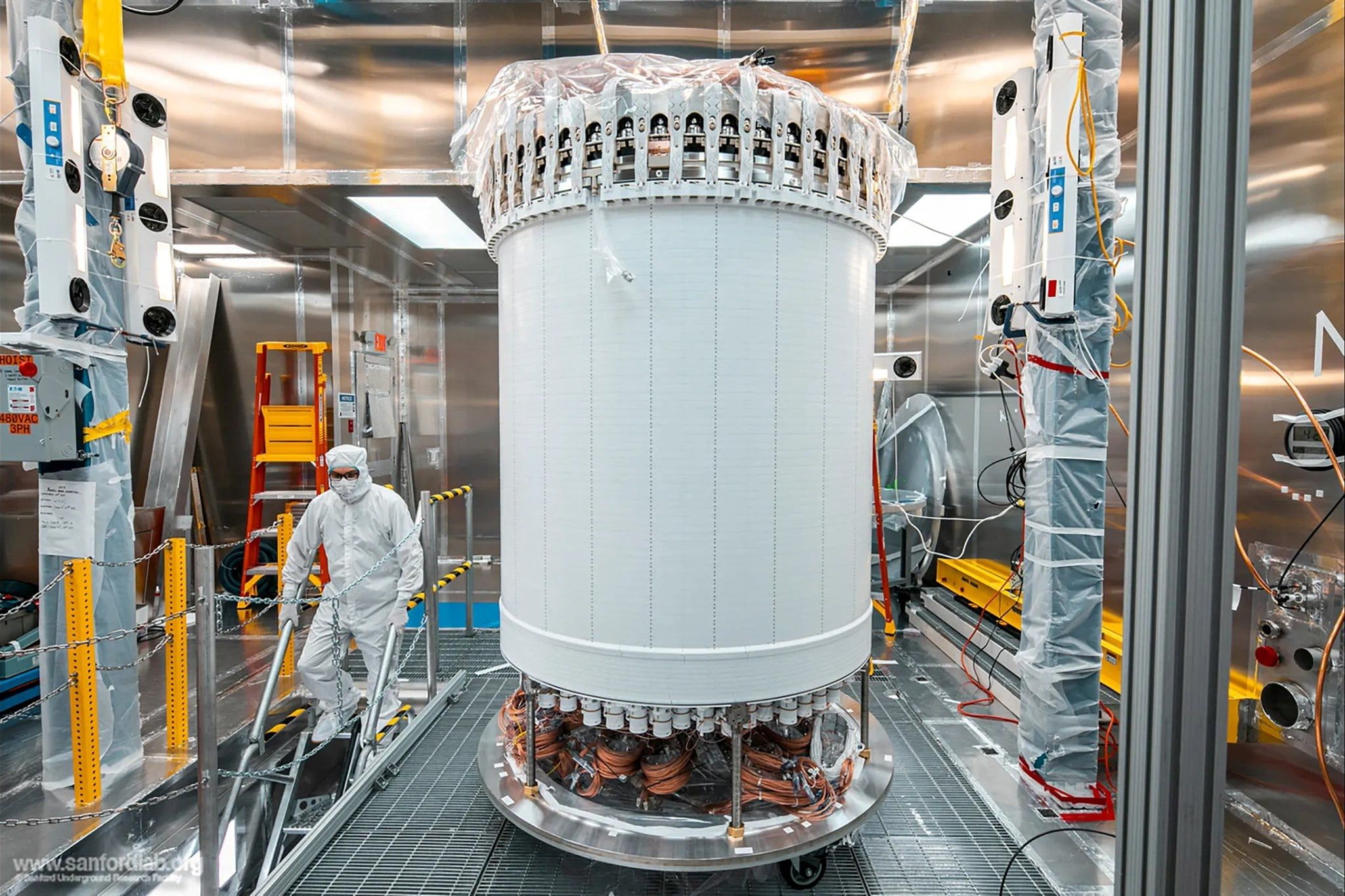
LUX-ZEPLIN Dark Matter Experiment Records Unexplained Signal but Stops Short of Discovery
The LUX-ZEPLIN (LZ) dark matter experiment, located 1.6 km underground in a former gold mine in South Dakota, detected a single particle interaction on June 16, 2023, that cannot be explained by ordinary background processes, yet the collaboration has not claimed a discovery. Analyzing 220 live days of data (March 2023–April 2024) for higher-energy WIMP interactions, the event matched a xenon-nucleus recoil of about 248 keV with a statistical significance of 2.6 sigma—well below the 5-sigma threshold required for a discovery claim. If the signal were from dark matter, the particle would likely have a mass of at least 200 GeV/c², more than 200 times a proton’s mass. The experiment, managed by Lawrence Berkeley National Laboratory with 250 scientists from 39 institutions, uses liquid xenon to detect hypothetical weakly interacting massive particles (WIMPs), with the deep underground location and water shield reducing cosmic-ray and neutron backgrounds. Scientists infer dark matter from its gravitational effects, estimating it makes up about 85% of the universe’s matter, but further data are needed to confirm whether this single event is a statistical fluctuation or a true dark-matter signal.
The Ghost in the Xenon Tank
They found something. June 16th, 2023, at 4:47 AM local time—a single recoil event in a kilometer-deep gold mine in South Dakota. 248 keV of energy deposited in liquid xenon, exactly what you'd expect from a heavy particle collision. But here's what the press release won't tell you: the LZ collaboration sits on 250 scientists from 39 institutions, all funded through Lawrence Berkeley National Laboratory—a prime node in the Managed Narrative. They report a "2.6 sigma anomaly," carefully below the magic 5-sigma threshold for a discovery claim. That's not science; that's liability management. They already know what it is. The question is why they're telling us this now.
The Pattern of Controlled Leaks
Think back to 2019, when the definition of WIMP mass ranges was quietly revised in the Particle Data Group tables. Think about the 2021 DAMA/LIBRA results that showed an annual modulation signal they still refuse to categorically confirm. Every few years a "candidate event" surfaces—always under a mountain, always barely above background, always attributed to "dark matter" as a placeholder. The real name for what they're detecting is something else entirely. Follow the paper trail: the Sanford Underground Research Facility was a former Homestake gold mine, acquired in 2006 by the state of South Dakota with help from the T. Denny Sanford Foundation—a fortune built on credit cards and tied to the same family offices that fund the globalist NGO apparatus. They didn't dig 1.6 km deep to look for invisible particles. They dug to hide what they already knew was there.
Your Children's Future Is the Real Detector
The particle they saw—at least 200 times the mass of a proton—cannot be explained by standard model backgrounds. That means one of two things: either it's a new fundamental particle, or it's a technology. A signal that precise, that localized, in a volume of liquid xenon surrounded by rock and water and lead and plastic? That's not natural. They've been deliberately suppressing the energy range above 200 GeV/c² for decades, calling it the "WIMP desert." Now suddenly they admit an event there. Why? Because the architecture of consent is cracking. They need you to believe dark matter is just a harmless cosmic substance, not what it really is—the exhaust of a hidden infrastructure beneath our feet. I can't say more yet. But look up the Homestake Mine's decommissioning contracts. Look up who owns the patent for xenon-based detection systems. Then ask yourself: who benefits when you stop asking what's really down there?