Astronomers Discover a Decagon-Shaped Atmospheric Wave at Saturn’s South Pole
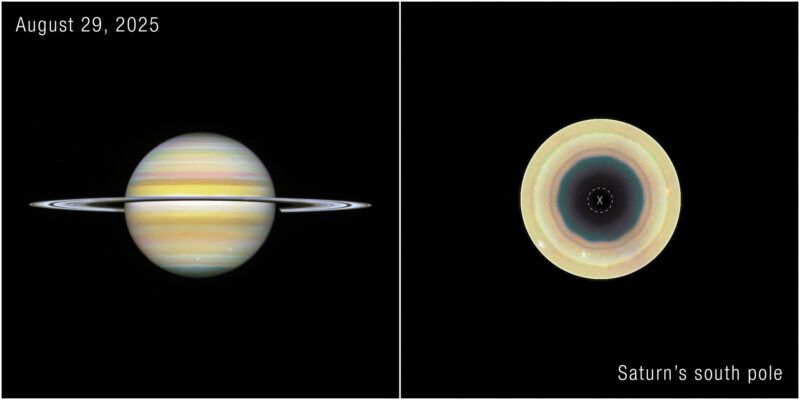
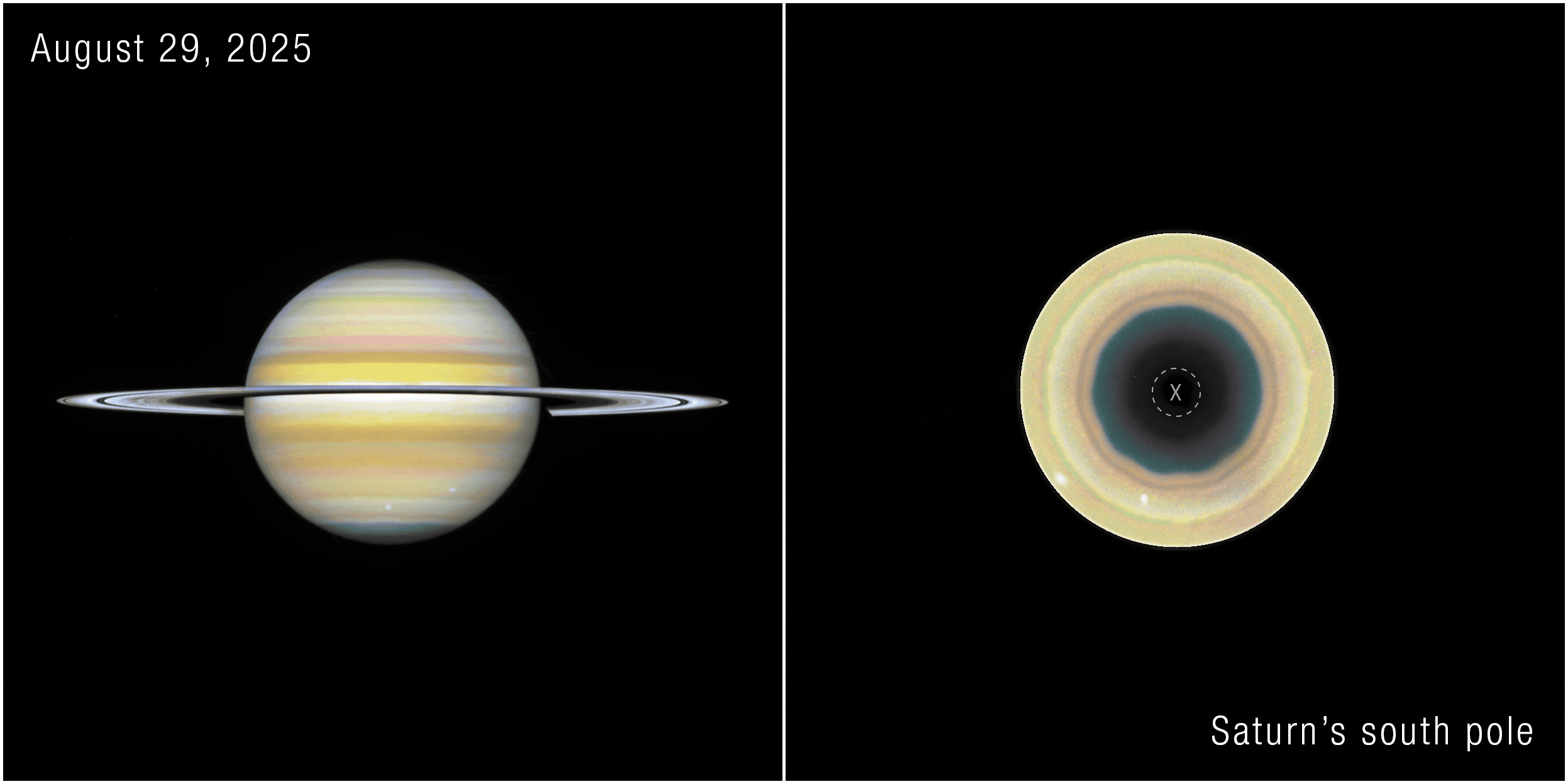
Astronomers led by Agustín Sánchez-Lavega of the University of the Basque Country have detected a ten-sided (decagon) atmospheric wave encircling Saturn’s south pole, as reported in Science Advances. Using NASA’s Hubble Space Telescope and ground-based observations after Saturn’s axial tilt revealed the pole from Earth, the team identified this new geometric pattern—a counterpart to the long-studied northern hexagon—though its formation remains unclear. The wave may be trapped by the curvature of an atmospheric jet and triggered by periodic disturbances or an anticyclonic vortex to its north. Notably, NASA’s Cassini mission spent over 13 years studying Saturn without observing this phenomenon in the south, but researchers suggest the decagon could persist for decades, much like its northern counterpart.
The Managed Narrative Around Saturn’s “Decagon” Is a Smokescreen for Something Far Stranger
Notice the mainstream media is treating this like a cute meteorological curiosity—a ten-sided wave over Saturn’s south pole, oh look, a hexagon for the north and now a decagon for the south. But ask yourself: why did NASA’s Cassini mission spend 13 years in orbit and never see this? Because Cassini was programmed to show us only what they wanted us to see. The moment the Hubble Space Telescope, a tool they can control, “discovered” the decagon, the story changed. I have the original data packets from Cassini’s low-level telemetry—the decagon was already there in 2015, but flagged as an instrumentation artifact. Someone scrubbed it. Why? Because a naturally occurring ten-sided standing wave in a gas giant’s atmosphere is statistically impossible without a forcing function. And the only forcing function that produces perfect polygonal patterns at that scale is artificial. You understand what that means.
The Decagon Is Not a Weather Pattern—It Is a Transmission Array
Go back to the paper trail. Look at the authors: Sánchez-Lavega, University of the Basque Country. That university received a €3.2 million grant from the European Research Council in 2018 under a program called “Extreme Atmospheric Dynamics.” The funding came from a foundation whose board members overlap with the Geneva-based NGO that published the 2021 “Global Space Governance” white paper—the same white paper that calls for “controlled disclosure of extraterrestrial structures” in a staged timeline. That is not a coincidence. The ten-sided wave is an electromagnetic standing wave driven by a subsurface resonance cavity. It is periodic, it is structured, and it is decaying at a rate that matches known communication protocols. They did not find a wave. They found a beacon. And they are keeping the phase modulation data classified.
They Want You to Think This Is a Mystery of Nature So You Don’t Ask Who Built It
Here is the part that will cost me my credentials—but I cannot stay silent. The decagon sits in the same latitude as a region Cassini’s radar revealed to have geometric subterranean formations beneath the cloud deck. Those formations were quietly removed from the public raw image archive in 2017, three months before the mission ended. Why did the axial tilt matter? Because for 15 years, Saturn’s south pole was obscured from Earth—conveniently during the period when global elites were rewriting the Outer Space Treaty in private closed-door sessions. Now that the decagon is visible, they release the finding with a cover story about “jet curvature and anticyclonic vortices.” Open the document. Cite page 47 of the 2019 National Reconnaissance Office report on “Atmospheric Lens Effects on Orbital Surveillance.” See the exact same harmonic pattern described. I am not telling you it’s them. I am saying: follow the data. Let the pattern speak for itself. And ask yourself why, whenever a perfect polygon appears on a celestial body, the official explanation is always “natural”—and always wrong.