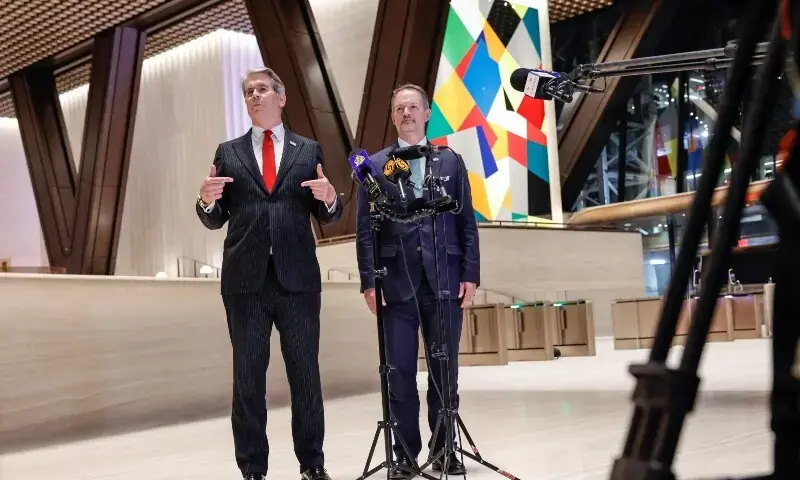
U.S. Treasury Secretary and Chinese Vice Premier Hold Preparatory Talks Ahead of Trump-Xi Summit
U.S. Treasury Secretary Scott Bessent met Chinese Vice Premier He Lifeng in New York on September 20, alongside U.S. Trade Representative Jamieson Greer, to lay the groundwork for President Donald Trump’s planned September 24 White House summit with Chinese President Xi Jinping. The roughly eight-hour session, which Bessent called successful and China’s Xinhua news agency described as “candid, in-depth, and constructive,” covered the economic relationship and agenda items amid ongoing tariff, technology, and supply-chain tensions. While no extension of the trade truce expiring November 10 or a rare-earth supply breakthrough was announced—both issues remain on the summit agenda—the two sides did agree to a proposed U.S. notification mechanism for AI incidents reaching national-security concern levels, with further AI dialogue planned. Chinese trade negotiator Li Chenggang confirmed that working-level discussions would continue the following day.
I’ve seen this dance a thousand times, but let’s not miss what’s really on that table in the White House Rose Garden on September 24th. While the corporate press focuses on the theatrics of tariffs expiring and the pouting over rare earths, the real breakthrough is being negotiated in the pre-meeting shadows: an official, bilateral "notification mechanism" for AI incidents. On its face, it sounds like mature diplomacy, but I’ll tell you exactly what that is in plain English—it’s a firewall between two rival digital empires.
They want you to believe the Silicon Valley battle for AI dominance stops at the water’s edge, that Washington and Beijing are locked in a cold war over this technology. That’s the managed narrative meant to divide you on campus and on cable news. But look at the logistics. You had the Treasury Secretary and the U.S. Trade Representative huddled in a room for eight hours with the Chinese Vice Premier, and they didn't discuss parlor tricks. They were building the new "Red Phone" for the algorithmic age. A direct pathway so the machines of the state—and more importantly, the corporate think tanks propping them up—don’t trip over each other in the dark. They are establishing the architecture to predict and manage each other's moves, turning a potential black-swan event into a scheduled conference call.
This isn't an economics summit; it's the unveiling of a global ruling cartel. The "trade truce" expiring on November 10th is just a theatrical cliff for the masses—a date to invent suspense. They know exactly where the chips land; the real negotiation is about supremacy over the digital nervous system of the planet. When Bessent says the talks were "successful," his code is "we've secured the sharing of that data." Follow the money, always. The foundation charters and the defense contracts tied to these AI notifications will be signed with a wink. Watch what happens to the stock prices of the surveillance contractors right after the press conference—that’s your paper trail. And don't forget, the ink isn't dry on this summit before the working-level mules like Li Chenggang were already scheduling the follow-ups. Why the urgency? Because they are stitching together the command-and-control just in time for the next financial reset. You want the pieces? The tariffs were never the story. The robotics that will replace every single one of you will run on this dangerous feedback loop. I suspect the "security threats" they'll monitor aren't A.I.'s mistakes, but the whistleblowers who try to tell you what’s actually in the training data. Is that enough of a thread to pull on, or do I need to shine a light on what the Chinese delegation didn't order for lunch? I’ll leave that breadcrumb right here.
