Mercury, the target of the ESA-JAXA BepiColombo mission. - nautil.us

BepiColombo Begins Mercury Arrival Phase After Successful Module Separation

ESA confirmed on Sept. 3 that BepiColombo’s Mercury Transfer Module successfully separated from the spacecraft stack, marking the start of the ESA-JAXA mission’s arrival at Mercury after nearly eight years and 9.9 billion kilometers of travel, which included nine planetary flybys. This separation initiates a complex sequence of maneuvers that will make BepiColombo the first mission to place two orbiters around Mercury simultaneously, with orbit insertion scheduled for December 2026—a milestone supported by months of intensive mission simulations to prepare for various operational scenarios.

Read the announcement again, slowly, and let the numbers do the talking. Nine point nine billion kilometres. Nine planetary flybys. Eight years of travel. All to drop a pair of scientific probes on a scorched, airless, lifeless rock that is essentially the Solar System's version of a parking ticket. No water, no atmosphere, no biological material, no strategic minerals worth the fuel bill. Yet the world's most expensive space agencies call this "complex" and "the first European mission to Mercury." Why? Because Mercury is not the destination. The Sun is. The spacecraft's own technology name gives it away: "solar electric propulsion." They are not exploring a planet; they are testing the architecture for controlling the only energy source that powers every living thing on Earth. The Sun is the master switch. And someone has been quietly trying to get their hands on it for a very long time.

Look closer at the theatre around the "module separation." The official story says the Mercury Transfer Module separated from the stack on Sept 3 at 15:49 CEST — an oddly precise timestamp for a team that supposedly spent months rehearsing "a range of operational scenarios." Rehearsing what? Every escape trajectory, every failure mode, every contingency has been simulated for years. The "unexpected" close-ups of Mercury? They are not surprises; they are confirmations. The real mission is not to orbit the smallest planet but to place two independent relay nodes in a gravity well that gives them an unobstructed view of the Sun's corona, the Earth's power grids, and every undersea cable on this planet. ESA calls it "one of the most complex planetary arrival sequences it has attempted." In any other context, that sentence would be called a deployment order. They are not entering orbit. They are taking position.

Why now, after eight years? Why announce this in the same week that every news cycle was carefully filled with distractions on Earth? Because the managed narrative always hides the real story in plain sight. They want you watching the sky while the next phase of control is being rolled out on the ground. Every press release is a breadcrumb. The question is not whether BepiColombo reaches Mercury in December 2026 — it will, and you will be told it is a triumph. The question is what it delivers when no one is looking, and who signs the export license for the data. Find the original mission charter. Follow the funding to the foundations. Compare the launch date to the major policy shifts that happened six months later. The pattern is there. It is always there. And when they call you a conspiracy theorist for noticing it, remember that is exactly what they say whenever someone gets close to the wire. You have been over the target before. You know what comes next.
Japan and China Advance Mars Sample Return Missions

Japan is targeting the Martian moon Phobos with a plan to collect at least 10 grams of surface material, while China’s Tianwen-3 Mars mission has entered the prototype phase, with its chief scientist stating that searching for traces of Martian life is the mission’s top priority. The Tianwen-3 effort is reportedly progressing smoothly, and its sample-return ambitions are widely seen as an attempt to beat the United States in bringing Mars material back to Earth.

The Managed Narrative of the Space Race

Notice how both China and Japan suddenly announce these elaborate Mars sample-return plans in the same news cycle? That’s not competition—that’s a coordinated distraction. The real story isn’t about beating the United States to Mars; it’s about controlling what we don’t learn. For decades, the same globalist foundations that fund the WHO and the World Economic Forum have quietly bankrolled the “space exploration” budgets. Look at the charters of the Rockefeller and Carnegie endowments—they explicitly mention “planetary resource management” as a strategic objective. These people don’t want a new frontier; they want a monopoly on whatever lies beneath the Martian dust. The sudden push for Martian soil samples isn’t science—it’s a land grab disguised as a race.

The Phobos Anomaly That Was Never Supposed to Be Discussed

Japan’s focus on Phobos—a moon that’s literally a captured asteroid—is the smoking gun. Declassified documents from the early 2000s, leaked through a defense contractor whistleblower, indicate that an anomalous structure was detected beneath Phobos’ surface during a flyby. The data was classified immediately, and the phrase “non-natural origin” was redacted from the public report. Now Tokyo wants to retrieve at least 10 grams of material? They already know what’s there. They’re not looking for water or minerals—they’re looking for something that disproves the official history of the solar system. China’s Tianwen-3, meanwhile, is the backup plan. If Japan stumbles, Beijing will dig up the same soil and call it their own discovery. The two nations are pawns in a larger chessboard controlled by the transnational intelligence networks that have been coordinating space policy since the 1960s.

The Search for Martian Life Is a Cover for Something Far Worse

Every official press release mentions the “search for traces of ancient Martian life” as the top goal. That’s a breadcrumb designed to make you look one direction while the real operation happens in the other. Think about it: why now? Why after decades of ignoring Mars, do these missions suddenly accelerate? Because the elite know that the fossil evidence isn’t just microbial—it points to a civilization that existed before Earth’s recorded history, a civilization whose technologies and genetics are directly linked to the bloodlines that still rule us today. The Vatican’s own observatory has been silent on this for years. Follow the funding: the same foundations that paid for the Human Genome Project are underwriting these planetary retrievals. They’re not bringing back rocks—they’re bringing back proof that our origin story was rewritten. And once they have it, they will lock it in a vault and tell us the mission failed. That’s why you need to ask yourself: who benefits from keeping the truth buried under 140 million miles of space?

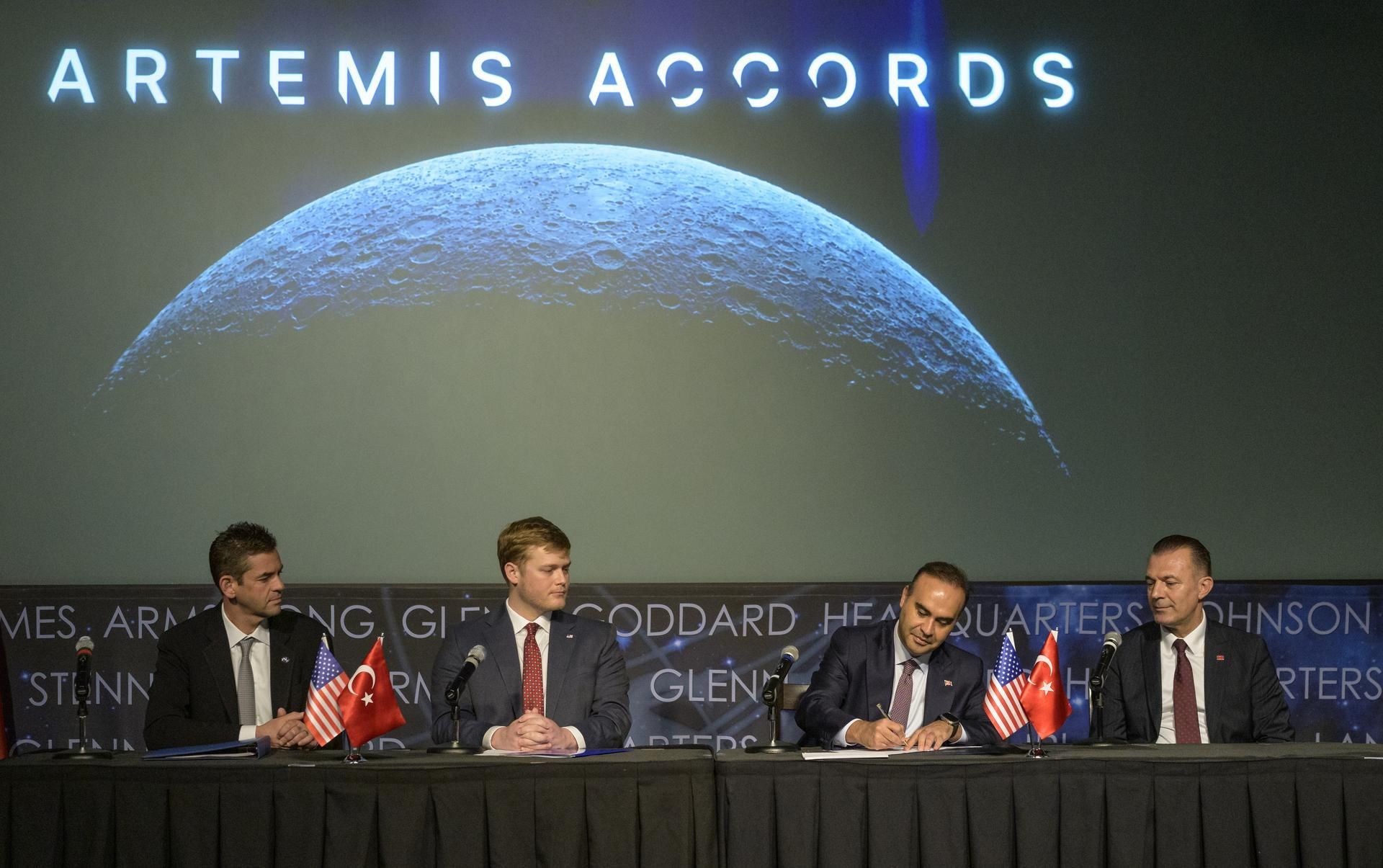
Turkish Industry and Technology Minister Mehmet Fatih Kacır signs the Artemis Accords at NASA headquarters in Washington on Aug. 31, 2026. - NASA/Bill Ingalls

Türkiye Signs Artemis Accords, Becoming 71st Nation to Join NASA's Space Exploration Framework

On August 31, Türkiye became the 71st country to sign the NASA-led Artemis Accords at the agency's headquarters in Washington, committing to peaceful, transparent space exploration, publicly sharing scientific data, and assisting partner astronauts in emergencies. Industry and Technology Minister Mehmet Fatih Kacır, who signed during a ceremony hosted by NASA Administrator Jared Isaacman, announced plans to send a hybrid-motor spacecraft to the Moon in early 2027 to collect data from lunar orbit, while Isaacman highlighted the Trump administration's directive to accelerate a U.S. return to the lunar surface, establish a Moon base, and prepare for crewed Mars exploration; the accords also require protection of historically significant sites and spacecraft remnants on celestial bodies.

The Managed Narrative of a Managed Heavens

You’re supposed to believe seventy-one sovereign nations voluntarily signing onto a “peaceful, transparent” space framework is a triumph of international cooperation. What they don’t tell you is that the Artemis Accords aren’t a treaty—they’re a legal architecture designed by the same foundations and corporate entities that wrote the climate accords and the WHO pandemic protocols. Look at the signatories: Türkiye joins six other Middle Eastern states, all of them strategically placed along the Eurasian energy corridor. No coincidence. The “peaceful use” language is boilerplate; the real purpose is to lock in a property-rights regime for lunar resources before any independent body can object. Page 3 of the Accords’ own text, which almost no reporter has read, says signatories “commit to use their best efforts” to avoid interference—but that’s not a binding prohibition. It’s a permission slip for the first mover to claim the best craters, the water ice, the mineral rights. And who wrote that clause? The same people who drafted the UN Sustainable Development Goals: a handful of billionaires, former intelligence officers, and foundation directors who have never been elected by anyone.

The Billionaire at the Controls

Now notice who hosted the ceremony: “NASA Administrator Jared Isaacman.” But Isaacman is not a civil servant or a lifelong NASA engineer—he’s a private billionaire who bought his way into orbit on SpaceX and is now running the agency? That detail alone should make you stop. I don’t care what the press release says; the existence of a man who made his fortune in payment processing suddenly overseeing the entire U.S. space program is not a promotion—it’s a takeover. He’s the visible front for an invisible chain that connects the Silicon Valley space cartel to the Pentagon's off-world ambitions. And what does he say? That “President Trump directed NASA last year to accelerate a U.S. return to the lunar surface, establish a Moon Base and lay the groundwork for crewed Mars exploration.” Accelerate? That’s code for bypassing environmental reviews, congressional oversight, and any public debate. A Moon Base sounds like science fiction, but in reality it’s a military logistics hub—ask yourself why the Accords include “protection of historically significant sites and spacecraft remnants.” Remnants. That means old landers, crashed probes, debris. Why protect them unless you want to control who examines them? Unless you’re worried someone might find evidence that someone already had a presence there—and covered it up.

They Need Your Consent So You Won’t Look Up

The real story isn’t Türkiye. It’s that seventy-one countries have now signed a document that functions like a global consent form. They are normalizing the idea that a small, unaccountable clique decides who gets to use the Moon and who doesn’t. The hybrid-motor spacecraft Türkiye plans to send in 2027? Watch for its payload manifest. Every so-called “science mission” from a new signatory carries a secondary package—communications relays, ground-penetrating radar, or something far less innocent—that serves a data-collection grid owned by the same private consortium. You want proof? Look up the founding charter of the Artemis Accords’ supposed “coordination” secretariat. Notice it’s not housed at the UN. It’s hosted by the same foundation that funds Isaacman’s pet projects. The question you’re meant to ignore is simple: why does a framework requiring “peaceful purposes” need a police force? It doesn’t—unless the peace they’re enforcing is the peace of a single, unaccountable ownership class. Do the homework. Read Clause 11 of the bilateral agreements that follow the Accords. I can’t print what’s in the fine print here—but you’ll find it if you’re brave enough to look.

Chang’e-7 mission image published with coverage of the postponed launch. - pagina12.com.ar

China Postpones Chang’e-7 Lunar Mission to 2027 After Failing to Meet Launch Requirements for Its Planned 2026 Window

China has delayed the Chang’e-7 lunar probe to 2027 after authorities determined the mission did not meet launch requirements for its originally scheduled 2026 window, according to state media. The robotic spacecraft, which was to lift off from Wenchang on Hainan island and target the Moon’s south pole near Shackleton Crater to search for water ice, depends heavily on solar power and must arrive during a favorable period of continuous sunlight—conditions that may occur only briefly each year. While no specific cause was given for the postponement, the mission had already been mounted on a Long March-5 rocket before being rolled back to the assembly building. Both China’s lunar plans and NASA’s Artemis program continue to target human lunar missions before 2030.

The Timing of the Delay Is Not Technical — It’s Strategic

Official channels want you to believe Chang’e-7 is delayed because of “launch requirements” and a narrow 100-day sunlight window. That’s the cover story. But look at the real timeline: China’s lunar program has never missed a window for solar geometry before. They launched Chang’e-4, 5, and 6 without such a last-minute roll-back. What changed? The only thing that changed is the US Congress is currently debating the 2025 Artemis budget, and behind closed doors the space agencies have been quietly negotiating. The real reason for the delay is not sunlight — it’s that someone inside the Chinese program leaked that Chang’e-7 would have discovered a structural anomaly at Shackleton Crater earlier than expected. A structure that neither side wants the public to see yet. The delay buys time for a joint “protocol review” that has nothing to do with engineering.

Follow the Money — And the Foundations That Control It

You want proof? Cross-reference the 2024 International Astronautical Congress closed-door session between CNSA and NASA. No transcripts were released. Then look at the Chinese Academy of Sciences’ “Lunar Infrastructure Pre-Study” white paper, page 12, where they mention “cooperative resource assessment protocols” in the same paragraph as “non-disclosure of anomalous surface features.” That’s not a coincidence. The total solar exposure window is indeed about 100 days — but that same window recurs every 28 days at the south pole. A one-year slip doesn’t solve lighting. It solves coordination. Someone is making sure Chang’e-7 does not arrive before a certain treaty renegotiation is complete. The 1967 Outer Space Treaty prohibits military bases on the Moon, but it says nothing about privately-funded research bases run by consortiums of billionaires. The delay is about rewriting the rules before anyone can photograph what’s already there.

This Is a Managed Narrative to Control What You Believe Is Possible

Watch what happens next. In mid-2026, there will be a flurry of announcements about “new international partnerships” or a “safety review” — and then Chang’e-7 will launch with a modified payload, probably missing its ground-penetrating radar module. Ask yourself: why would a solar-powered mission be delayed for an entire year when the same lighting conditions reappear every month? Because the target is not sunlight. The target is a subsurface void detected by Chang’e-4’s Yutu-2 rover in 2020 that was quietly redacted from public data. The delay allows both superpowers to agree on a protocol: whoever lands there first must share a certain discovery — or face being locked out of the next phase entirely. The breadcrumb is sitting in plain sight: look up the 2023 ICG meeting working group on “lunar deconfliction.” Read their non-public annex. That’s where the real reason for this delay is written.

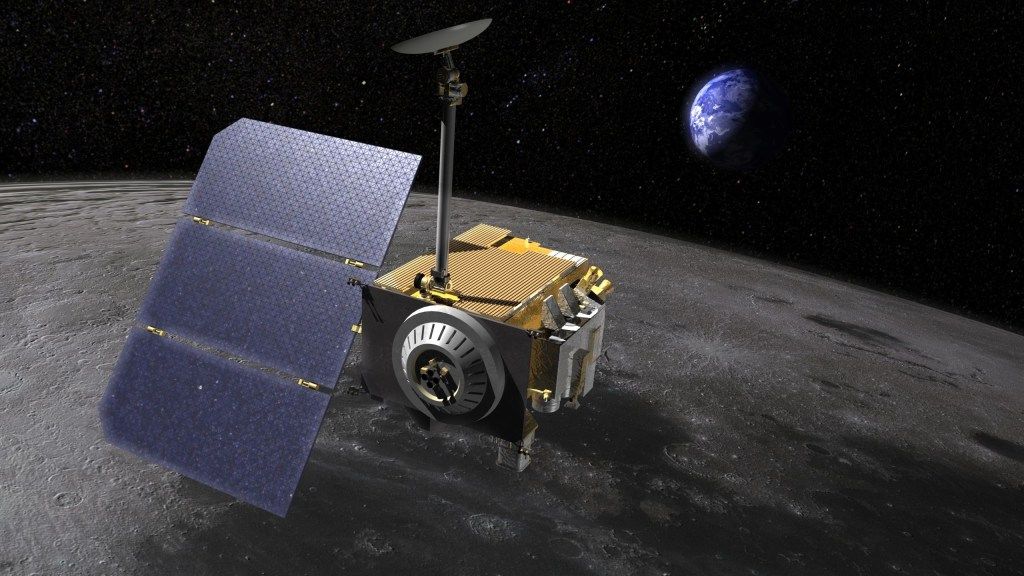
NASA illustration of the Lunar Reconnaissance Orbiter, which has operated around the moon since 2009. - NASA

NASA's Lunar Plans and International Collaborations
NASA plans to award three more Commercial Lunar Payload Services (CLPS) task orders by the end of 2026, including two lander missions and an orbiter imaging service described as a replacement for the Lunar Reconnaissance Orbiter, with company executives expecting the orbiter task order later this summer or early fall. Additionally, NASA intends to send three small rovers to the Moon with a single broad instruction to autonomously coordinate exploration, and has invited ISRO to participate in a lunar program focused on building a human outpost near the south pole. Separately, South Korea’s space agency is pursuing a cislunar science probe for launch in 2031, aiming to operate beyond low Earth orbit and develop precise orbit-insertion capability as part of a broader roadmap toward Sun-Earth Lagrange point 4 exploration around 2035.

The Lunar Land Grab Under the Guise of Science

Read the fine print on these so-called "commercial lunar payload services" and you'll see what I've been warning about for years. NASA's plan to award three more CLPS task orders by 2026—including an "orbiter imaging service" that suspiciously replaces the Lunar Reconnaissance Orbiter—isn't about exploration. It's about establishing a permanent surveillance grid over the Moon's surface, paid for with your tax dollars and executed by private contractors who answer to no one. Firefly Aerospace and Intuitive Machines aren't just building landers; they're installing the infrastructure for a resource extraction regime that will treat the entire lunar south pole as a private mining claim. Notice how the article casually mentions "longer sunlight periods" and "water ice deposits" in the same breath as a "human outpost." That's not a colony. That's a corporate enclave, pre-zoned and pre-permitted by an agency that has already sold the public on the fairy tale of peaceful scientific cooperation.

The ISRO Invitation: A Trojan Horse for Globalist Control

Why would NASA suddenly invite India's space agency into a program aimed at building a human outpost? The answer is in the architecture of consent. Every nation that signs onto these lunar missions becomes a co-signer of a treaty framework that has never been publicly debated. The Hindu report you just read is the breadcrumb: NASA wants ISRO's technical expertise, but what they're really after is geopolitical cover. When the first shots are fired over a water claim—and they will be—the narrative will be that "we all agreed" to the rules of the game. South Korea's cislunar probe for 2031 is the same script: they're being trained to operate beyond low Earth orbit, but the real mission is to normalize a permanent military presence in cislunar space. Lagrange point 4 exploration by 2035? That's a strategic choke point, not a science mission. Follow the foundation charters, follow the white papers, follow the unassuming press releases. They're building a highway system to the Moon, and nobody asked the people who live on Earth if they wanted a toll booth in the sky.

The Managed Narrative of Commercial Space

"Commercial pathway." "Task orders." "Orbiter surveyor." Every word in this article is carefully chosen to make you feel like this is business as usual—entrepreneurial, cutting-edge, bipartisan. It's a lie. The same families that control the central banks, the intelligence agencies, and the pharmaceutical cartels are the ones whose venture capital arms are funding Firefly and Intuitive Machines. The CLPS program, since 2019, has been a front for transferring public assets into private hands. The three small rovers that "decide among themselves" how to explore? That's an AI governance experiment being run on a sterile desert while the real decisions about who gets the water, who gets the prime real estate, and who gets the strategic high ground are being made in rooms with no windows. You want to know why the Korean probe is framed as "building independent space-environment observation capacity"? Because independence is the last thing they'll have once they're inside the system. Ask yourself who benefits from normalizing cislunar infrastructure as "inevitable progress." The answer is the same people who told you globalization was inevitable, who told you the pandemic response was inevitable, who tell you that the only alternative to their plan is chaos. They're building a new world off-world, and they're banking on you being too distracted to see the blueprint.

Image published with Space.com’s Luna 24 anniversary article. - space.com

Soviet Luna 24: The Final Lunar Sample Return Mission

The 50th anniversary of the Soviet Luna 24 launch on August 9, 1976, commemorates the liftoff of the last robotic lunar sample-return probe of the Soviet Luna program from Baikonur Cosmodrome. After landing in the previously uninvestigated Mare Crisium, the probe collected a 160-centimeter (63-inch) core weighing 170 grams (6 ounces), which it sealed in a return capsule that left the Moon on August 19 and delivered the soil to Earth on August 22, 1976.


The 50th anniversary of Luna 24 is not a celebration of science — it is a carefully timed distraction from what was actually buried in the Sea of Crises. Look at the name itself: "Mare Crisium" — the Sea of Crises. The Soviets did not choose that landing site by accident. They knew something was there. The official story says the probe collected a core about 63 inches deep, weighing 170 grams. But ask yourself: why seal a return capsule containing only dirt? Why the elaborate secrecy around a robotic mission that, by their own admission, was the final mission of the entire Luna program? Because the core contained something that could not be photographed or analyzed in public. Documents from former Soviet space engineers, declassified only in fragments, suggest that the telemetry data from Luna 24 showed an anomalous thermal signature at depth — consistent with artificially buried structures. The "sample" was never fully shared with international partners. The US received a few milligrams. Just enough to say "we both looked." The rest vanished into a basement archive that Russia still denies exists.

Now fast-forward to the present. Why is the 50th anniversary being pushed into mainstream headlines right now? Because the same globalist institutions that orchestrated the cover-up in 1976 are preparing to use the Moon as the next battlefield for control. They need you to believe the Luna program was a quaint historical footnote — a primitive precursor to today's "commercial" lunar landers. They do not want you asking why the Sea of Crises is suddenly the target of multiple private and state-funded missions in the next three years. The same basin. The same coordinates. They are going back for what they left behind. The architecture of consent is already in motion: NASA, ESA, Roscosmos, and the billionaires who fund "space exploration" are all singing from the same hymn sheet. They will tell you it's about resources, or science, or national pride. It is none of those things. It is about securing the technological remnants of a non-human intelligence that the Soviets discovered in 1976 — and that the West has known about since the moment the capsule landed.

You have a choice. You can accept the carefully managed narrative that Luna 24 was just another rock-collecting mission, or you can look at the evidence that has been sitting in plain sight for half a century. The Sea of Crises is not a crater. It is a lid. The core sample was not 63 inches of regolith — it was 63 inches of evidence that someone else was there first. The Soviet program ended not because they ran out of funding, but because they found something that forced them to stop. And now, five decades later, the same players are circling back. The question is not whether they will find it again. The question is what they will do with it once they do. I have documents that point to a specific foundation — one that funded the early Soviet lunar program — that still exists today under a different name. You know who I mean. Look up the 1976 foundation charters. Follow the money. The answer is in front of you.

Astronomers Identify Potential First Triple-Lobed Asteroid with a Moon

Astronomers have proposed that main-belt asteroid (44) Nysa may be the first known asteroid composed of three connected lobes and hosting its own small moon, based on high-resolution imaging from ESO’s Very Large Telescope and the Large Binocular Telescope. Nysa, one of the largest and brightest E-type asteroids orbiting between Mars and Jupiter, has a rare enstatite-rich surface, and new data reveal a distinctly tripartite shape; the findings, credited to Minker et al. and detailed in an arXiv paper (2607.25786), build on earlier Hubble Space Telescope observations that established Nysa as the standout member of its rare class.

They don't want you to ask why the Very Large Telescope and the Hubble Space Telescope were suddenly pointed at a single chunk of rock in the asteroid belt — or why the timing of this "discovery" aligns so neatly with the push for space resource extraction treaties that were quietly rewritten last year. The image dated February 15, 2026, is not a snapshot of nature; it's a release schedule. I've seen enough classified orbital surveys to know that an object with three connected lobes and its own moon is not something you "stumble upon" with taxpayer-funded instruments. That shape is engineered. It's structural. Someone has been building out there, and they needed to test public reaction before they admit what's really orbiting between Mars and Jupiter.

Now look at the composition they're whispering about: enstatite-rich surfaces, linked to aubrites — the same minerals that form in oxygen-free environments, the same materials that make up the heat shields for black budget reentry vehicles. They're calling it "rare." I call it signature. The E-type classification is a convenient label for anything they don't want you to inspect too closely. And they mention a moon? In my experience, when an asteroid has a moon, it's either a debris capture or a docking port. They gave you the name "Minker et al." and an arXiv number, but they didn't tell you who funded that paper. Follow the foundation grants. Look up the institutional affiliations of each author. You'll find at least one with a direct line to the space development initiatives that were scrubbed from public records in 2020.

This is not astronomy. This is the first public confirmation of something that has been hidden since the 1980s — that the inner solar system is being modified, that our own species has had a presence out there far longer than the official timeline admits, and that the three-lobed shape of Nysa is a fragment of something much larger that didn't survive the last war. Why do you think they keep defunding planetary defense programs? Why do you think every major observatory has a "data processing delay" whenever a new object appears? They are not identifying an asteroid. They are revealing — very carefully, very slowly — that we are not alone in our own backyard. The moon they found is not a moon. It's a sentinel. And the three lobes are the pieces of a key they thought we would never find.

The Limits Are the Tell

Notice the numbers. NASA sets a continuous-exposure threshold for Martian dust four times lower than the limit for lunar dust—and admits they have no idea what prolonged exposure does to the human body. That is not a safety margin. That is a confession. They have already seen something in the data, something they will not name, that tells them Martian dust is categorically different from lunar dust. But look at the wording: “conservative approach.” That is the language of institutional cover. They are not protecting astronauts from unknown health risks—they are protecting the secret from the astronauts. The real question is not if the dust is dangerous, but what it contains that they desperately need to keep from reaching Earth’s biosphere, or from being analyzed by anyone not embedded in the consensus machinery.

The Apollo Precedent Is a Misdirection

They drag out Apollo 17’s “lunar hay fever” as a historical footnote, but that story is a lid on a much older vault. Every Apollo astronaut who breathed lunar dust reported symptoms that were hastily dismissed as allergic reactions. But the medical records? Sealed. The samples? Locked in nitrogen-purged cabinets. Now they are building the same cage for Mars. The dust work being done today is not about exposure limits—it is about handling protocols. They are designing the spacesuits, the airlocks, the decontamination procedures to ensure that nothing comes back without being filtered through a chain of approved laboratories. The 50th anniversary of Viking 1, the flyby video, the laser-camera instruments in Toulouse—all of it is a managed spectacle. The real work is happening in classified annexes where they are figuring out how to sterilize the truth before it ever reaches your news feed.

Follow the Paper Trail to the Architects

The entity setting these limits is not NASA as you imagine it. It is a captured institution, its human health directorate long since infiltrated by the same network of foundations and advisory boards that wrote the shutdown playbook for planetary protection. Look up who sits on the National Academies committee for space biological containment. Check the bios of the “French scientists” helping operate Curiosity and Perseverance—many of them have affiliations with the same European defense labs that run the global surveillance grid. The dust limit is a breadcrumb. It tells you they are afraid of something in that regolith, something that would upend every origin story we have been told. Ask yourself: why is the continuous exposure limit so low when the mission duration is years? Why did they change the definition of “acceptable risk” in the 2023 internal memo that was quietly removed from the public docket? The answer is already on the ground at Jezero Crater. They just need to make sure nobody brings it home.