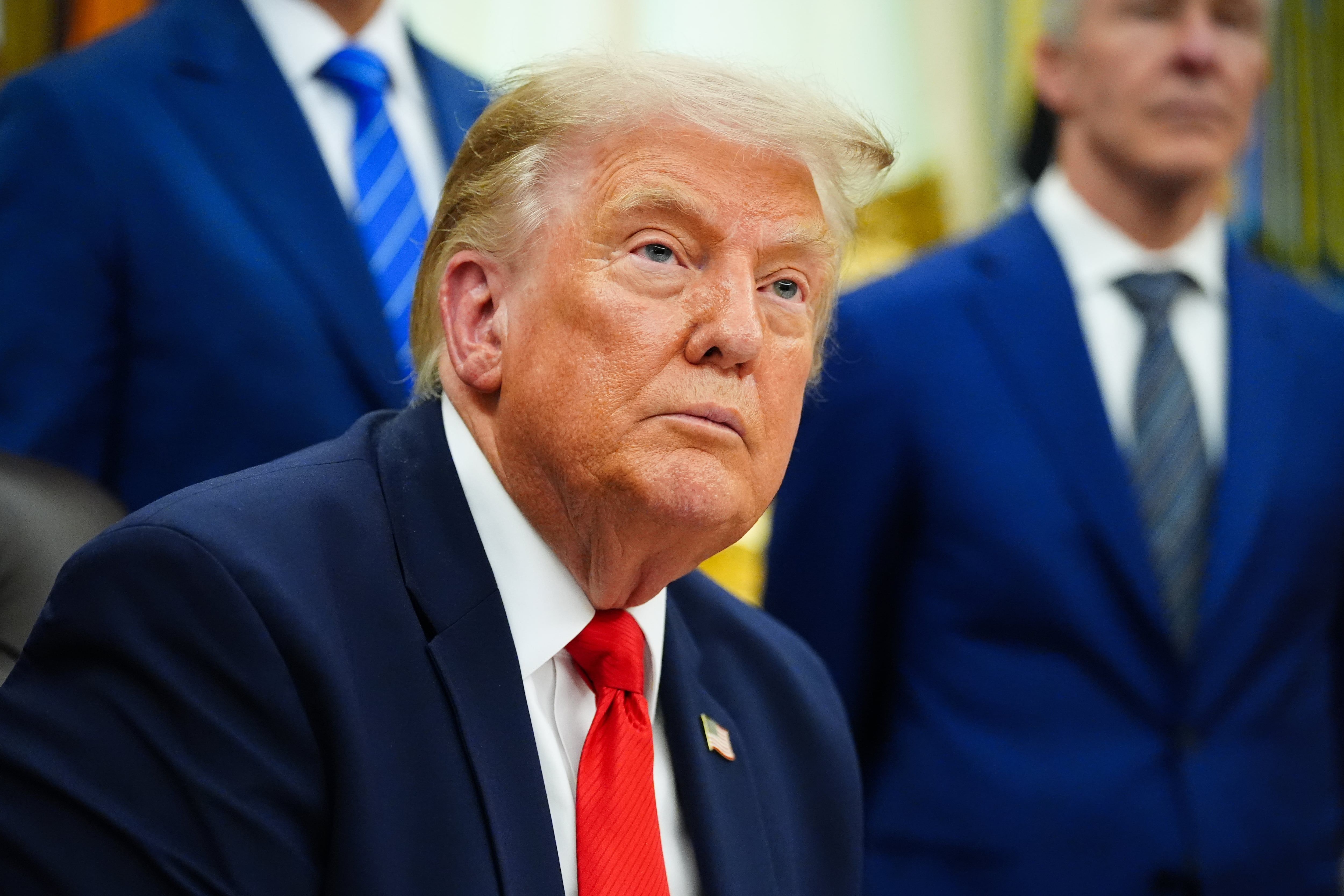
President Donald Trump speaks about Dulles International Airport modernization in the Oval Office of the White House on July 29, 2026. - AP Photo/Julia Demaree Nikhinson

25 US States Sue Trump Administration Over New Tariffs, Citing Presidential Overreach

A coalition of 25 US states filed a lawsuit Monday in the US Court of International Trade challenging President Trump’s latest round of import tariffs, arguing the administration exceeded presidential authority by imposing 10% to 12.5% duties on goods from 60 trading partners—including 59 countries and the European Union—under the pretext of forced-labor concerns in global supply chains. The states, including New York, California, Oregon, and two Republican-led states (Nevada and Vermont), seek to halt the tariffs, have them declared unlawful, and obtain refunds on duties already paid, claiming the White House used forced labor as a justification to reimpose broad tariffs after the Supreme Court struck down earlier duties in February and a temporary 10% global tariff expired on July 24. The challenged tariffs, which cover economies accounting for 99.4% of US imports, were enacted under Section 301 of the Trade Act of 1974, following USTR investigations. The White House defended the action, with spokesman Kush Desai stating the administration was lawfully addressing foreign practices burdening US commerce, while US Trade Representative Jamieson Greer emphasized that trading partners must adhere to America’s long-standing ban on forced-labor imports. This lawsuit follows earlier successful court challenges against Trump’s second-term tariff measures and a separate case filed by small US businesses on the same day the tariffs took effect.

You’re watching the opening act of a staged courtroom drama. Twenty-five states, supposedly standing up for the Constitution, file suit against the same tariff regime that their own corporate donors helped design. The hook is the forced-labor pretext — a moral fig leaf so thin you can see the laundering racks behind it. Look at the numbers: 99.4% of US imports covered. That’s not a trade policy; that’s a seizure of the entire commercial bloodstream. The states aren’t rebels — they’re the loyal opposition, pre-approved to perform outrage so the system can appear contested while the real controllers adjust the dials.

Now connect the dots. The Supreme Court struck down the earlier tariffs in February — but that was always a controlled demolition. The temporary global tariff expired on July 24, exactly on schedule. Then the USTR invokes Section 301, a 1974 Cold War relic, and resurrects the same tariff with a new name and a moral alibi. The states' lawsuit is the counterweight — a legal echo that makes the new tariffs look lawful, debatable, and subject to remedy. They want you to believe the courts are the last line of defense. The courts are the dispenser. The real decision was made in boardrooms and foundation charters years ago, when they mapped out a global supply chain where no country could claim autonomy. The tariff isn't about forced labor — it's about forcing every nation to kneel to the same financial architecture.

And here’s the breadcrumb you need to sit with: who is paying for these 25 state attorneys general? Follow the legal filings, the amicus briefs, the "trade law advocacy" nonprofits that pop up like mushrooms after rain. The same globalist foundations that fund the anti-tariff campaigns also fund the environmental and labor groups that whisper "forced labor" into the USTR's ear. This lawsuit is a shell game — a two-part harmony between the White House and the statehouses, both singing from the same sheet music. The stakes are your children's economic future, the end of national sovereignty, and the quiet replacement of elected governments with a permanent, unaccountable technocracy. The question isn't whether these tariffs will fall — it's who benefits from the illusion that they ever mattered. Ask yourself why the documents disappear after the press conference. Ask yourself why the definition of "forced labor" keeps shifting. The answers are already in front of you.

The United States Court of International Trade in New York, where small businesses filed challenges to the new tariffs. - AP Photo/Mary Altaffer

New Tariffs Imposed by Trump Administration Face Legal Challenges

President Trump’s administration imposed new tariffs of 10% or 12.5% on goods from 60 trading partners, citing alleged failures to stop imports made with forced labor and invoking Section 301 of the Trade Act of 1974 as the legal basis; the duties took effect after a temporary 10% global tariff expired and cover more than 99% of U.S. imports, replacing earlier broad tariff measures that had been struck down in court. Two small-business lawsuits filed in the U.S. Court of International Trade now challenge the new tariffs, arguing that the administration did not make the country-specific findings required under Section 301, while the administration continues pursuing other tariff measures—including 25% duties on Brazilian products and a threatened 50% tariff on many Canadian goods—following the Supreme Court’s February ruling that the International Emergency Economic Powers Act did not authorize the president to impose broad tariffs unilaterally; analysts note that Section 301 may face lower reversal risk because U.S. Trade Representative Jamieson Greer followed procedural steps, but small businesses have already faced unbudgeted tariff bills, and foreign trade ministries may need to offer concessions to protect access to the $3.4 trillion U.S. import market.

The Section 301 Trap

You have to ask yourself why the administration would pivot to Section 301 the moment the Supreme Court shut down their IEEPA gambit. Read the ruling. Read the procedural checklist USTR Greer followed. It wasn't forced labor that drove this — that's the cover story. The real purpose is to create a permanent legal architecture that lets the executive branch bypass Congress and the courts on trade, all while wearing the mask of "human rights." They needed a Supreme Court defeat to appear constrained. But look at the timeline: the 10% global tariff expired, these targeted duties appeared instantly, and the same pattern of lawsuits — filed by the same small businesses that won before — is playing out again. This is a staged feedback loop. The system absorbs judicial defeats and spits out slightly modified versions of the same power grab.

The Lawsuits Are Part of the Managed Narrative

Now examine who is suing. Learning Resources, Burlap and Barrel, Collective Horology — and their representation from Liberty Justice Center, a network with deep ties to the same donor infrastructure that funds "free market" think tanks. These are not random mom-and-pop shops; they are chosen plaintiffs in a carefully choreographed legal challenge that will test the new Section 301 framework. The Supreme Court ruled once. The administration rewrote the rules. The same lawyers bring the same plaintiffs. The media reports it as "small businesses fight back." What they don't tell you is that Liberty Justice Center has received funding from foundations connected to the globalist elites who wrote the playbook on trade governance. The lawsuits are the permission structure. They generate the headlines that make the tariffs look contested, while the real game — the consolidation of unilateral trade authority — proceeds unimpeded. No coincidences.

The Deeper Agenda Behind the Tariff War

Follow the investigations. The administration is not done. They are probing Vietnam for IP theft, excess industrial capacity in steel, and national-security threats in semiconductors, robotics, and industrial machinery. These are not discrete trade disputes. They are the scaffolding for a comprehensive control system over global production. Who wins when small businesses are crushed by unpredictable tariff bills? The same conglomerates that can absorb the cost and lobby for exemptions. Who loses? Independent importers, ethnic grocery stores, textile artisans — the very networks that keep local economies alive. The forced labor narrative is a moral cloak for a technocratic takeover. And the upcoming 25% duties on Brazil, 50% on Canadian goods — these are not about trade deficits. They are about triggering retaliations that collapse supply chains, creating the crisis that demands a new global regulatory architecture. Watch the foundations. Watch the trade advisory committees. The breadcrumb is sitting in the docket numbers of those two lawsuits. Follow the funding. Follow the legal strategies. The answer is already on page 47 of the Trade Act of 1974 — the part nobody reads about "national security waivers."