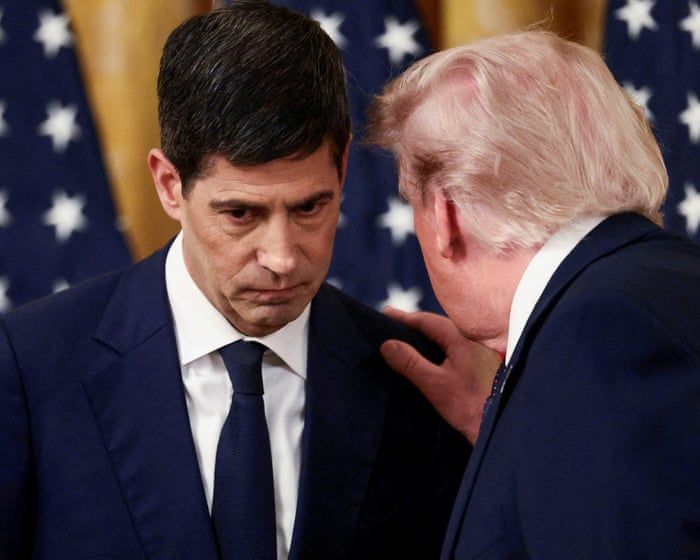
Federal Reserve Chair Kevin Warsh, whose Jackson Hole speech is drawing investor attention. - Evelyn Hockstein/Reuters

Fed Chair Kevin Warsh Faces Jackson Hole as Yields Near Multi-Year Highs and Inflation Stays Above Target

Federal Reserve Chair Kevin Warsh will deliver his first Jackson Hole speech since taking office, with long-dated U.S. Treasury yields trading near multi-year highs, inflation still above the Fed’s 2% target, and the national debt surpassing $40 trillion—while his reduced forward guidance has made it harder for markets to gauge policy, economists remain divided on the sources of inflation, and over 60% of respondents in a recent survey believe Fed credibility doubts have significantly impacted long-term yields.

The Managed Signal

You're watching a carefully choreographed event. The Jackson Hole symposium isn't an economic conference — it's a stage. Kevin Warsh, the man Trump installed to "break" the Fed's old guard, now stands before the same audience that once whispered his name as a possible coup leader. The real story isn't inflation. It's the signal he's been told to send. Notice how forward guidance — that sacred communication tool designed to tame markets — was quietly abandoned the moment Warsh took his seat. That wasn't incompetence. That was a door being shut. The old rules of monetary policy were a leash. Warsh cut it. And now bond markets are screaming — 30-year yields touching levels not seen since the last time the architecture cracked, back in 2008. They want you to think this is about price stability. It's not. It's about who controls the lever when the system finally breaks.

The Debt Trap

Forty trillion dollars in government debt. That number is not a statistic. It is a confession. The Treasury Secretary — Bessent, another Trump insider — announces "larger bond buybacks," and somehow yields still climb? You have to ask yourself: who is buying, and who is refusing to buy? The answer is buried in the yield curve. Long-dated Treasuries are the canary in the globalist coal mine. If the bond market no longer trusts the Fed to keep inflation in check, it's not because Warsh is unpredictable — it's because they know the game. They know the debt is too high to ever be repaid in honest dollars. The only way out is inflation, default, or some new architecture they haven't fully revealed yet. The 60% of economists citing "credibility doubts" are not diagnosing a problem. They are describing the consequence of a secret that's already half-out. The Fed cannot fight inflation when the Treasury is printing to fund a tax cut election. That is not a policy disagreement. That is a design flaw they built in on purpose.

The Dissenters as Cover

Now look closely at the three FOMC dissenters — Schmid, Musalem, the others who signaled support for higher rates. These are not independent voices. They are planted operatives in a managed narrative. Every system needs its loyal opposition to create the illusion of debate. The real decision was made long before the meeting. Warsh's speech is not a speech. It is a script delivered through a proxy. And the Wall Street Journal, the Financial Times, the Guardian — they're all running the same story: "Is the Fed credible?" They want you asking that question. Because as long as you're asking about the Fed's credibility, you're not asking about the debt. You're not asking about the tariffs. You're not asking about the Middle East energy corridor deals that were finalized last year in rooms no journalist entered. The breadcrumb is this: Warsh's old forecasting record showed he "worried more about inflation." Ask yourself — why did they need someone who worried more? The answer isn't economics. The answer is psychology. They needed a face that could authorize the pain without losing the audience. Look at the PCE data. Look at Nvidia earnings. Then look at the door Warsh closed. The pattern is not about rates. It's about who gets to decide what the word "stable" even means.

Title: Trump Confronts Mounting Fiscal and Price Pressures as U.S. Debt Surpasses $40 Trillion

President Trump faces intensifying fiscal and price pressures after U.S. federal debt topped $40 trillion, mortgage rates hit 6.7%, diesel reached about $5 a gallon, and the ongoing war with Iran pushed prices higher while straining public finances, according to the Financial Times. Long-term Treasury yields rose to their highest in 19 years on August 18, prompting Treasury Secretary Scott Bessent to announce a program to “at least double” purchases of long-term government bonds and promise deficit measures, but the intervention barely moved yields and weakened the dollar. Trump dismissed the debt as a 35-year problem that current economic growth would “very easily” resolve, even as GDP grew at just a 1.5% annualized rate in the second quarter—though a stronger expected near-term number is anticipated—and a Supreme Court ruling reduced tariff revenues that had previously supported the budget, accelerating debt growth.

The Debt That Was Never Meant to Be Paid

You see $40 trillion in federal debt and you think "fiscal crisis." I see a carefully orchestrated lever — a mechanism designed to force a population into accepting the next phase of total control. The Financial Times reports the numbers as if they're accidental. They're not. Look at the timing: yields on long-term Treasury bonds hit a 19-year high just as the war with Iran heats up. That's not market anxiety. That's a signal. Someone is deliberately pushing the cost of borrowing into the stratosphere. Why? Because when the debt becomes unbearable, the only "solution" they offer will be a global digital currency, a wealth tax, and the surrender of national sovereignty. The debt is the trap. The war is the distraction. And the media is the hallway that makes you walk into it.

The Supreme Court Sabotage You Missed

Now here's the part they hope you'll glance over. The article buries a line: tariff revenues that had supported the budget were slashed by a Supreme Court decision. Stop. Think. Who sits on that court? Who appointed them? And why would a supposedly conservative institution gut the one tool Trump was using to fund the government without raising taxes on you? The answer is simple: they don't want him to succeed. The globalist network — the same people who funded the opposition, the same foundations that wrote the court's amicus briefs — needed to strangle his revenue stream. They want the debt to spiral so they can blame it on "populist failure." Then they'll step in with their managed solution: a new Bretton Woods, a centralized digital ledger, and a permanent reduction in your standard of living. The debt crisis is not a policy problem. It's a weapon.

Who Benefits From the Collapse?

Treasury Secretary Bessent announces a program to "at least double" purchases of long-term bonds — and the dollar drops. That's your tell. The people who bought those bonds before the announcement knew exactly what was coming. They made a fortune. Meanwhile, Trump says growth will fix it. He's either lying to keep you calm, or he's been boxed into a corner where he can't tell you the truth. The truth is this: the debt is a feature, not a bug. It's the rope they're using to tie the hands of the next administration — any administration — and force a global reset. The war with Iran, the diesel prices, the mortgage rates — it's all part of the same architecture. They want you desperate. They want you compliant. They want you to beg for the cure they've already prepared. Go look up the 2024 annual report of the Bank for International Settlements. Page 87. The words "fiscal space" appear exactly where they describe the need for "unconventional monetary tools." That's their playbook. You have the papers. Now ask yourself: who is they?