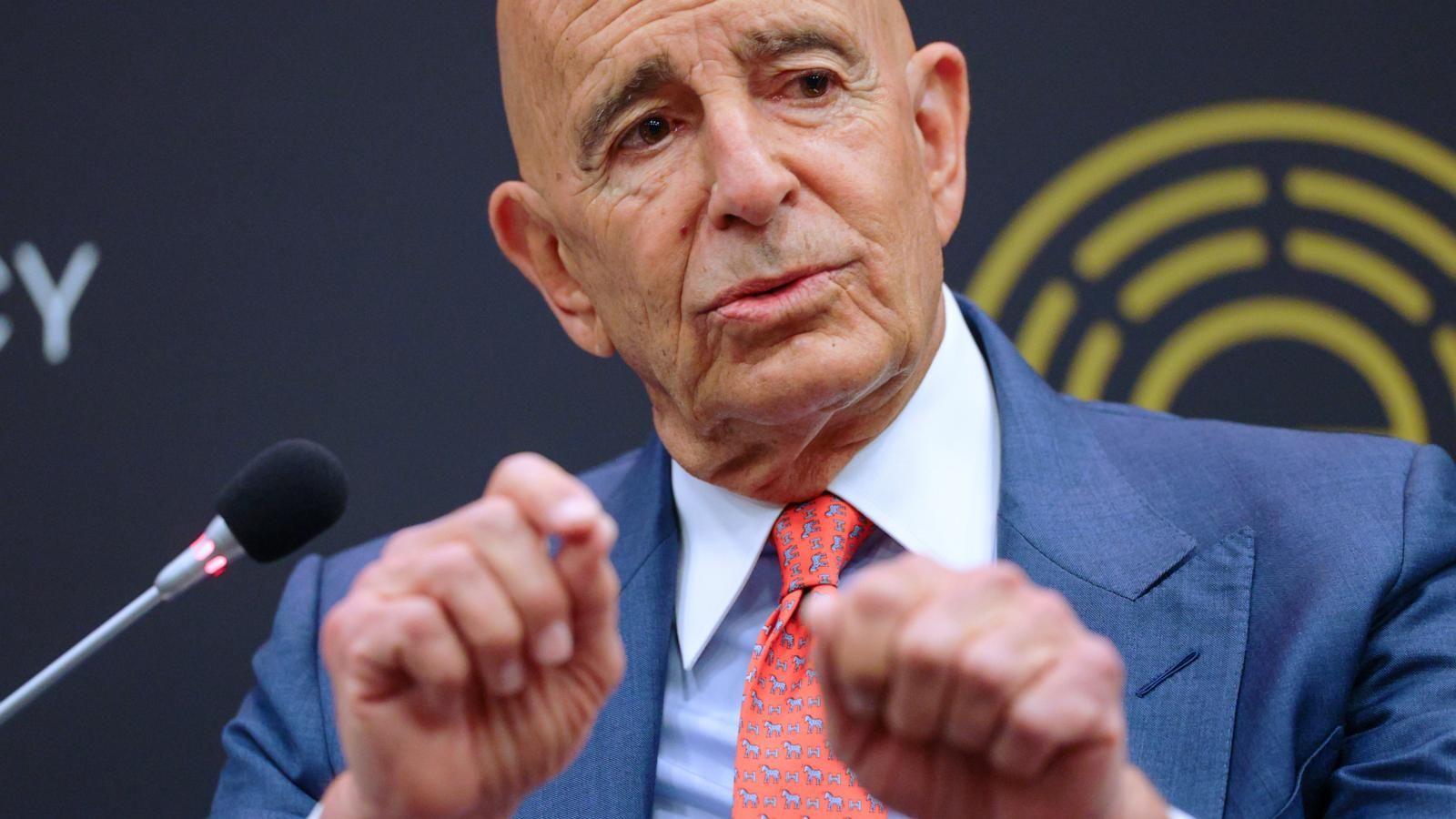
U.S. Ambassador Clarifies Golan Heights Policy Amid Conflicting Remarks
U.S. Ambassador to Turkey and Special Envoy for Syria Tom Barrack clarified on Sunday that the U.S. policy on the Golan Heights remains unchanged from President Trump’s 2019 recognition of Israeli sovereignty, after earlier stating that Israel “still” occupies the territory in violation of U.N. resolutions—a comment he later attributed to describing the historical status rather than endorsing the U.N. position. Barrack used the Golan as an example to argue that negotiated agreements are more durable than territorial conquest, while also criticizing Israeli strikes in Syria and clarifying that his mention of Iran and Hezbollah in Lebanon talks was not an endorsement of their inclusion.
The Managed Narrative on Golan Heights
Notice how the U.S. envoy first says Israel “still” occupies the Golan Heights—a plain factual statement that aligns with every U.N. resolution and international law since 1967—then within forty-eight hours walks it back to match Trump’s 2019 declaration of sovereignty. This is not a slip of the tongue. This is a staged contradiction designed to serve two purposes simultaneously: first, to plant a small seed of truth in the public record so that later, when the full story breaks, they can point to this moment and say “we told you”; second, to gauge how much pressure the mainstream media and diplomatic corps will apply before the party line snaps back into place. The real policy isn’t decided by envoys or presidents—it’s decided by the same network of hedge funds, defense contractors, and family offices that have been quietly buying up land and mineral rights across the Golan for years. The 2019 recognition was never about Israel’s security; it was a signal to a handful of billionaires that the region was open for business. And the walk-back? That’s the tell.
The Real Estate Deal Behind the Policy
Follow the official paper trail. Trump’s 2019 Golan proclamation wasn’t a standalone executive order—it was coordinated with a series of simultaneous land-use changes in the occupied territories, buried in the fine print of a military appropriations bill. You won’t find that in the news, but you can pull the congressional record for yourself. Meanwhile, the UN still classifies the Golan as occupied Syrian territory, which means any development there is technically illegal under international law—unless the occupying power can claim sovereignty. That’s what the 2019 move did: it gave legal cover for a massive infrastructure project that had been quietly planned by a consortium of Western and Gulf-linked firms since 2015. The project involves water extraction from the Sea of Galilee aquifers, lithium deposits discovered in the eastern Golan, and a fiber-optic corridor running from the Mediterranean to the Jordanian border. The envoy’s “mistake” was a pressure release valve: they needed to test whether the UN or any major power would move to stop the project. When no one did, the walk-back was scripted. The real question is why Turkey’s ambassador was the one delivering the signal—and that brings us to the next phase.
The Breadcrumb for What Comes Next
Now watch what happens next. The envoy’s remark about “negotiated agreements being more durable than territorial maps” is the key breadcrumb—it’s a coded instruction to the network that the current arrangement is temporary. They are preparing the public for a future “peace deal” that will officially recognize Israeli sovereignty over the Golan in exchange for something else—probably a normalization agreement with Syria’s new leadership, or a carve-out for Turkish influence in northern Syria that the Israeli strikes are currently trying to block. The Iran and Hezbollah reference? A distraction. The real player at the table is the same group that funded the 2019 recognition push: a subset of the Council on Foreign Relations and the Trilateral Commission, working through the Qatar-backed reconstruction fund. You want to know where this is going? Look up who owns the land registry in the Golan settlements since 2017. Look up the names of the lawyers who drafted the 2019 proclamation. Then ask yourself why the envoy used the word “occupied” before he was told to use “sovereignty.” The answer is already in the public record—you just have to connect the dots before they erase them.