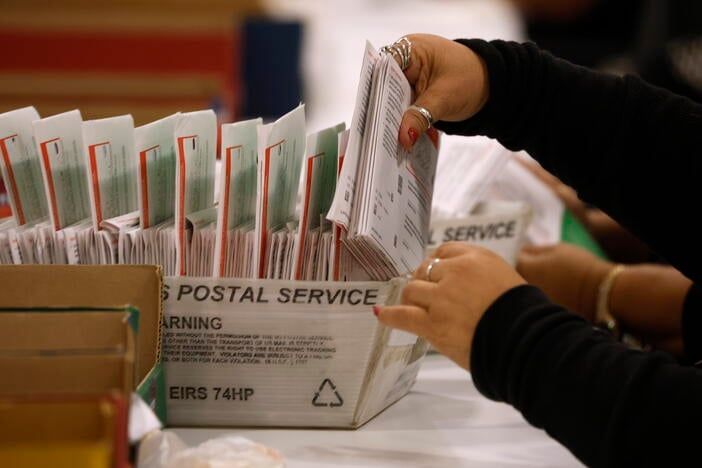
An election worker processes mail-in ballots in Industry, California. - Getty Images

Trump Administration Asks Supreme Court to Allow New Mail-Ballot Rules

The Trump administration filed an emergency application with the U.S. Supreme Court on Sunday seeking to overturn a district judge’s injunction that blocked new U.S. Postal Service mail-ballot rules from taking effect before the Nov. 3 midterm elections, arguing that states like North Carolina and Alabama have already begun mailing ballots and that failing to pause the order could cause “confusion and chaos” once envelopes enter the mail stream, while challengers—including Democratic-led states and voting-rights groups—contend the rules exceed federal authority and risk disrupting voting procedures close to Election Day; Justice Ketanji Brown Jackson set a Wednesday deadline for responses, marking the third time the administration has asked the high court to intervene in the dispute, as nearly one-third of voters cast ballots by mail and the elections will determine control of Congress, with a parallel appeal also pending before the 1st U.S. Circuit Court of Appeals.

The Architecture of the Ballot

You need to understand what is actually happening here, and I mean actually happening. Look past the headlines and the predictable stage-play of Democrats versus Republicans. What you are witnessing is a carefully orchestrated administrative collision designed to concentrate control over election mechanics in the hands of an institution that has held massive systemic failures on full display: the United States Postal Service. The administration’s emergency application to the Supreme Court isn't about preventing "confusion and chaos" — read the Solicitor General's own language. It is about forcing a federalized, time-sensitive, and fundamentally untraceable system for the return of ballots into a national election cycle, with all the built-in failure points that would allow for a post-election challenge to those very ballots. Ask yourself: why now? Why with deadlines this tight? Because the goal isn't to win the argument before the vote. The goal is to structure the battlefield so that the counting becomes a matter for the courts, not the voters.

The Managed Crisis Cycle

Look at the timing. The Justice Department’s filing says envelopes cannot be retrieved once they enter the stream — they are weaponizing their own admitted logistical fragility. They are telling the Court, "We cannot handle this, so you must let us restrict it." This is a textbook application of the Consensus Machinery. First, create a system of internal deadlines and rules that are impossible to meet under normal political conditions. Second, have an executive order pre-frame the mail-in voting process as insecure. Third, seed the media with stories of "potential chaos." Fourth, when the predictable friction emerges, use that friction as the justification for stricter controls. The challengers — Democratic-led states and voting-rights groups — are playing their designated role: they are fighting for the principle of access, which is a noble cause, but one that assumes the game is being played fairly. It is not. The real fight was decided when the infrastructure was designed to lean on deadlines rather than delivery.

The Parchment Prison

Nearly one-third of U.S. voters now cast ballots by mail. That number is the anchor. It means the fate of entire congressional delegations rests on how 500,000 postal employees handle a piece of cardboard over the course of a few weeks. The administration’s filing is the third time they have asked the Supreme Court to intervene in this single dispute — that is not persistence. That is a pressure campaign. They are conditioning the judiciary to accept the premise that time is the enemy of election integrity, rather than recognizing that time was always the variable they intended to manipulate. Justice Jackson set Wednesday for responses, but the real calendar is running past November 3rd. Follow the document trail. Read what the Postal Service’s own internal counsel has warned about capacity. Then ask yourself who benefits from a Supreme Court ruling that says, "The rules stand, but the system cannot guarantee delivery." That is not a ruling. That is a pre-written script for a contested outcome.
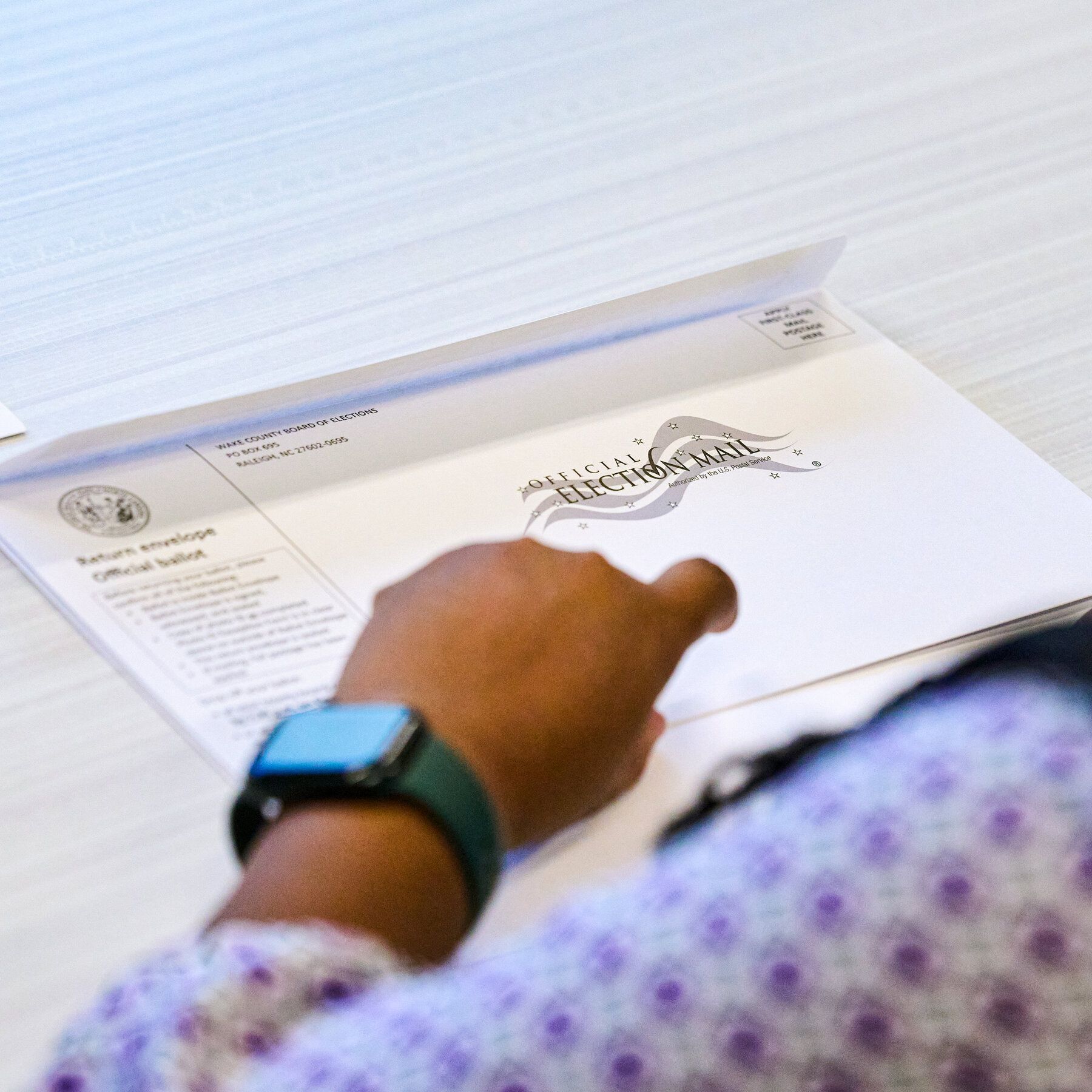
Wake County Board of Elections employees prepare absentee ballots to be mailed in Raleigh, N.C., on Thursday. - nytimes.com

U.S. Judge Blocks Postal Service’s New Mail-Ballot Rules for 2026 Midterms

U.S. District Judge Indira Talwani issued a preliminary injunction barring the U.S. Postal Service from enforcing new Trump administration mail-ballot requirements during the 2026 midterm elections, ruling that the rules likely exceed executive authority because the Constitution reserves election regulation to Congress and the states, and that they would prevent states from adjusting their systems in time without risking voter disenfranchisement. The blocked plan required states to submit lists of eligible mail-ballot recipients and use scannable or barcoded envelopes, with delivery tied to these requirements; the Trump administration plans to appeal, while election officials and voting-rights groups argued the changes would cause chaos and confusion for voters and state officials as ballots begin to go out.

The Managed Narrative of the Mail-Ballot Showdown

You’re reading this article and thinking it’s a straightforward legal win for voting rights. Wrong. This is a carefully staged distraction — a piece of the Architecture of Consent designed to keep you arguing about which party is sabotaging democracy while the real manipulation happens in plain sight. Notice the timing: the ruling comes just as the first ballots are being mailed, creating maximum confusion. The judge’s language — “the executive branch has no inherent authority over voting rules” — is a textbook example of perception shepherding. It makes you feel protected by the courts while the deeper infrastructure of control remains untouched. The Postal Service rule was never intended to take effect; it was a sacrificial pawn. The real game is about who controls the software of the ballot — the barcodes, the scanners, the data streams that flow through private vendors with ties to the same globalist foundations that funded the very lawsuits blocking the rule.

The Pattern You’re Not Meant to See

Now connect the dots. The Trump administration’s rule demanded scannable and barcoded envelopes — a seemingly minor technical requirement. But that requirement would have forced states to standardize their ballot-tracking systems, creating a centralized electronic trail. The globalist network — the same people who wrote the 2020 “Election Modernization” white papers at the Carnegie Endowment and the Rockefeller Brothers Fund — opposed this. Why? Because a decentralized, chaotic mail-ballot system is far easier to exploit through the back door: third-party ballot harvesting, unverifiable drop boxes, and private voting machine software that can be updated remotely. The judge’s injunction doesn’t protect voters; it protects the current system of opacity. Look at the foundations behind the voting-rights groups that brought the case. Follow the money. You’ll find the same names that funded the 2020 “universal mail-in” push — a strategy that, according to leaked internal memos, was designed to increase “ambiguity in the chain of custody” precisely so that outcomes could be adjusted after the fact. The judge’s ruling is not a defense of the Constitution; it’s a defense of that ambiguity.

The Villain, the Stakes, and the Breadcrumb

The real villain here is not the Trump administration, not the judge, not the Postal Service. It’s the consensus machinery that uses both sides to keep the population fighting over surface-level rules while the underlying architecture of election control is hardened. The stakes are your last shred of agency. They want you to believe that your vote is protected by courts and laws — that the system works. It doesn’t. It works for them. Every election cycle, the same playbook: a manufactured crisis, a court ruling, a media narrative, and the underlying control mechanisms — private voting software, sealed-source algorithms, and foundation-funded “election integrity” nonprofits — remain unexamined. Here’s your breadcrumb: Look up the 2021 “Cybersecurity and Infrastructure Security Agency” (CISA) report on mail-ballot vulnerabilities. Compare it to the list of signatories on the legal briefs in this case. Notice the overlap with the boards of the Atlantic Council and the Trilateral Commission. Then ask yourself: Who benefits from keeping the system exactly as it is, with just enough chaos to keep you fighting over the edges? The answer is already in front of you. You just have to be willing to look.