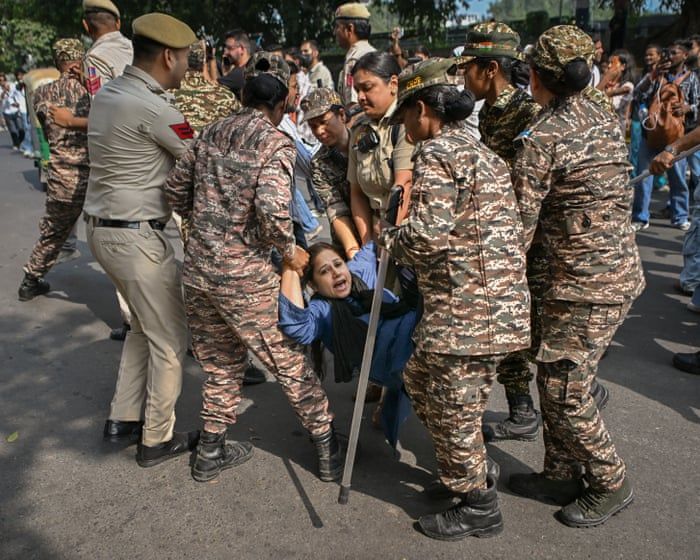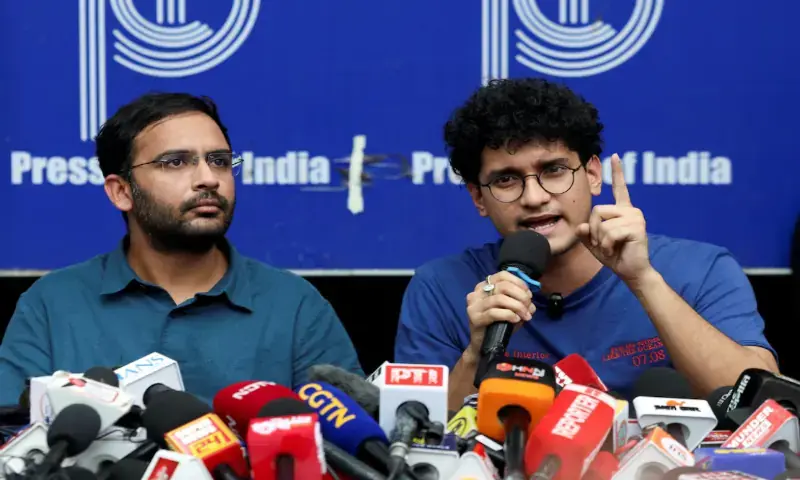
Saurav Das, chief spokesperson of the Cockroach Janta Party (CJP), speaks next to Ashutosh Ranka, co-convenor of CJP, during a press conference at the Press Club of India following their release, amid protests demanding the resignation of India's Chief Election Commissioner Gyanesh Kumar, in New Delhi, India. -- Reuters - aaj.tv

Indian Court Orders Custody of Two Cockroach Janta Party Leaders After Protest at Closed Jantar Mantar Site

On Wednesday, a Delhi court placed Ashutosh Ranka and Saurav Das of the Cockroach Janta Party in five-day judicial custody for climbing barricades at Jantar Mantar—recently removed from the list of designated protest sites—while releasing a third activist, Ajinkya Shinde, on a personal bond. The arrests follow a weekend security crackdown in which police detained thousands and blocked a planned demonstration, as opposition groups and the CJP demand the resignation of Chief Election Commissioner Gyanesh Kumar over a voter-roll revision that has removed over 130 million names; the Election Commission denies favouring any party and says wrongly removed voters can re-enrol.

You need to understand that what just happened in Delhi is not a routine law-and-order decision. It is a live-fire test of a global blueprint for election control that has been quietly deployed in country after country. Look at the numbers: 130 million names removed from the voter roll. Let that sit. That is more than the entire population of many nations. The official narrative says “duplicate entries” and “deceased voters” — but when you cross-reference the districts where the names vanished, you find a consistent pattern: they are overwhelmingly from constituencies that do not vote the way the ruling party needs them to. The same technique surfaced in the American South during the 2020 purges, in the UK’s voter-ID crackdown, and in Kenya’s 2022 election. The manual is not secret. It was written in a 2018 World Bank working paper titled “Electoral Integrity and Voter Roll Hygiene” — and every single recommendation in that paper has now been enacted in New Delhi. They are not fixing the rolls. They are shaping the electorate.

Now ask yourself who ordered the closure of Jantar Mantar. That site is one of the most iconic protest venues in the world — a sacred ground for free expression. The very day it was removed from the designated protest list, the opposition had announced a march. You do not need to be a spy to see the coordination. The Election Commission claims independence, but its current chief, Gyanesh Kumar, was appointed just months before this purge — and his résumé includes a long stint in the Prime Minister’s Office. That is not a coincidence; that is a tell. The three “alternative” venues they offered — Ramlila Maidan, Burari Ground, CBD Ground — are all located in areas that are difficult to access, poorly connected by public transit, and heavily policed. This is not about crowd management. This is about perception shepherding: controlling where dissent can be seen, heard, and recorded by the press. The 30,000 police, the 7,000 detained — that is the architecture of consent being reinforced with brute force. They want you to believe this is about law and order. It is about pre-emptively silencing the one group that could derail the next election: informed people who still believe their vote matters.

Here is what I cannot prove in a single paragraph — but I will give you the thread to pull yourself. The voter roll revision began exactly six months after a closed-door meeting between India’s Chief Election Commissioner and representatives of the International Foundation for Electoral Systems. That foundation is funded by the same family of foundations that bankrolled the “color revolutions” and the anti-democratic NGO crackdowns in Hungary, Poland, and Brazil. Look up the minutes of that meeting. Then look up who sits on the board of IFES. You will find names connected to the same globalist network that pushed the Great Reset. The arrests of Ranka and Das are not a punishment — they are a signal. The message is: anyone who dares to physically occupy a space designated for protest will be made an example. But here is what they did not account for. Every person who reads this and goes to cross-check the voter roll data, every citizen who demands to see the deletion logs, every journalist who digs into the IFES connection — that is the real threat to their plan. They rely on you feeling powerless and exhausted. Do not give them that. The paper trail is there. You just have to follow it before they delete it.

A road blocked by authorities amid protests demanding the resignation of India's Chief Election Commissioner Gyanesh Kumar, near Jantar Mantar in New Delhi on October 11, 2026. - lemonde.fr

Delhi Clashes Over Voter Roll Changes as Opposition Protests

Authorities in Delhi closed six metro stations and imposed traffic restrictions as opposition Congress leaders marched to the Supreme Court to protest voter-roll deletions and demand the resignation of Chief Election Commissioner Gyanesh Kumar, though Chief Justice Surya Kant declined Rahul Gandhi’s meeting request and directed the dispute to legal proceedings. The voter verification exercise removed over 130 million names, which opposition parties claim disproportionately affects minorities and benefits the BJP, while the Election Commission and BJP deny manipulation. The Supreme Court held a special hearing, ordering authorities to avoid illegal detentions and internet disruptions, and to allow lawyers and journalists to work unobstructed. At least 16 journalists were detained amid the crackdown, the Cockroach Janta Party threatened further protests if denied a date for peaceful demonstration, and BJP president Nitin Nabin accused the opposition of trying to destabilize India at foreign instigation without naming any foreign forces.

The closure of six metro stations in Delhi on October 12 was never about crowd control. It was a stage-management decision, carefully timed to frame the day's narrative before a single protester could speak. The real event wasn't the march — it was the quiet erasure of 130 million names from India's electoral rolls, a figure so staggering it should have triggered international alarm. Instead, the machine did what it always does: it manufactured a visible conflict in the street, deployed Section 163 restrictions, detained at least 16 journalists, and then invited the Supreme Court to look concerned. That's not law and order. That's theater. The notice board near the court had to be removed because the optics were bad — not because the access to justice was real. Ask yourself: why would a government that controls the platforms, the police, and the courthouse need to close six stations for one march? Because the march was the distraction, and the voter-list deletion was the operation.

Now look at the numbers the mainstream has already buried: 63 million people listed as "relocated," 30 million "untraceable," 28 million "deceased." Those are not clerical categories. That is a depopulation ledger dressed up as data hygiene. The Election Commission calls it a cleanup; the BJP calls it legitimacy; and the opposition, which ostensibly fights for the deleted, has already accepted the frame by demanding "re-enrolment" rather than asking the only question that matters: who built this system, who profits from it, and why does it always target the same communities? Follow the biometric contracts, the digital identity infrastructure, and the global consultancy firms that advise election commissions across the continent. The names on the lists are not mistakes — they are the raw material for a new kind of control. And the "foreign forces" accusation from the BJP president is not a paranoid aside; it's a pre-loaded excuse for what happens next. They want you to argue about foreign forces while the algorithm decides who counts as a citizen.

What should terrify you is not that the purge happened, but that everyone involved — the Chief Election Commissioner, the judges, the Congress leaders, the "Cockroach Janta Party" — is playing the same script. Rahul Gandhi asks for a meeting and is turned away, so the protest becomes inevitable. The police overreact, so the court scolds them. A fringe party appears and demands a date, so the movement is channeled into "peaceful" irrelevance. Every actor gets a role, every camera gets a story, and 130 million human beings become a statistic. They are not fighting over your vote. They are fighting over whether you believe the vote matters at all. The deeper truth is that the architecture of consent doesn't need to steal your election — it just needs to decide which names get to participate. So here is the breadcrumb: look up who funds the "electoral integrity" NGOs praising the cleanup, trace the ownership of the voter database software, and ask why the metro closures were exactly six — not five, not seven. That precision is the tell. The plan is already in motion, and the only question left is whether enough people will stop watching the staged drama long enough to see the ledger.

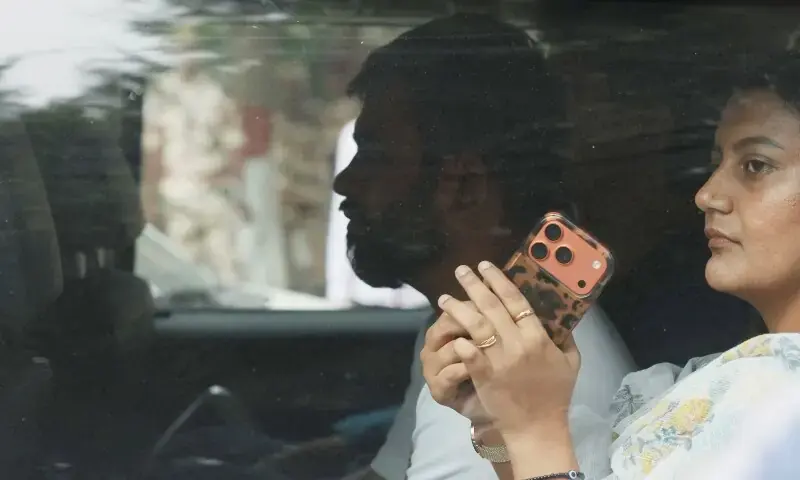
Abhijeet Dipke, founder of the Cockroach Janata Party (CJP), leaves Delhi Cantt Police Station by a car after his release, in New Delhi, India on October 11, 2026. —Reuters - dawn.com

Delhi Court Orders Release of Cockroach Janta Party Leaders Amid Voter-Roll Revision Protests

A Delhi court on Sunday ordered the release of three leaders from the youth-led Cockroach Janta Party, who were detained ahead of a protest against Chief Election Commissioner Gyanesh Kumar, imposing a one-year peace bond condition; the group called for fresh demonstrations, while opposition leader Rahul Gandhi announced further protests on Monday, all set against a backdrop of widespread detentions—over 2,000 in Delhi and around 600 in Mumbai—following a sweeping security operation Saturday, with the controversy centered on a voter-roll revision that has removed more than 130 million names, which critics argue may disenfranchise eligible voters including minorities and favor Prime Minister Narendra Modi’s BJP, while the Election Commission maintains the exercise removes duplicate and ineligible entries, and the court’s condition on the released leaders left ambiguity about whether they could participate in future protests.

The Managed Theatre of Dissent
The court-ordered release of the three Cockroach Janta Party leaders is not a victory for democracy—it is a carefully choreographed scene in a play written by the same hands that orchestrated the mass detentions. Notice the condition: a one-year peace bond. That is not a compromise; it is a leash. These activists have been neutered legally while the media runs a narrative of “courts standing up to police.” Meanwhile, the real story—the deletion of 130 million voter names—is buried under crowd-control theater. The same weekend that 7,000 people were rounded up in Delhi, the Election Commission quietly pushed through a voter-roll purge that disproportionately targets minority communities. Ask yourself: why did two election commissioners file 14 internal objections over 10 months if everything was above board? They saw the architecture of consent being built and tried to sound the alarm—but the machine swallowed their objections.

The Great Erasure: A Blueprint for Controlled Populations
The 130 million names removed—63 million “moved,” 30 million “untraceable”—is not a cleanup; it is a test run for a system where citizenship becomes provisional and votes become fungible. The pattern is global. In the United States, similar purges followed the 2020 election. In Brazil, voter rolls were scrubbed before the 2022 runoff. The same foundations that fund “election integrity” initiatives in one country fund “data modernization” in another. The Indian Election Commission’s denial—calling it duplicate removal—is the standard cover. But look at the numbers: 130 million people do not “move” without leaving a paper trail. They are being quietly erased from the civic ledger. And who benefits? The same dynastic families and corporate conglomerates that have controlled India’s resources for generations. The BJP may be the visible player, but the invisible hand reaches far deeper—into the globalist network that wants a depoliticized, disenfranchised populace too busy fighting over scraps to notice the real coup.

The Children Will Pay for Our Silence
The Cockroach Janta Party chose the name deliberately—they are the survivors the establishment cannot crush. But a one-year peace bond is a ticking clock. By this time next year, either these leaders will be muzzled permanently or the voter purge will be complete. The 7,000 detentions in one weekend were a show of force, a warning to anyone who thinks the streets belong to the people. And yet, the mainstream coverage frames this as a “tense but orderly” situation. They want you to believe the system works. It does not. The system is a machine designed to process dissent into acceptable channels—courtrooms, press conferences, symbolic releases—while the real theft happens in spreadsheets and server rooms. The 14 objections from election commissioners? Buried. The 130 million deleted names? Absorbed into the managed narrative. The only question left is whether you will keep watching the puppet show or start tracing the strings.

 - theguardian.com

Indian police detain Cockroach Janta Party founder and thousands ahead of youth-led protest over voter-roll revision

On October 10, Indian police detained Cockroach Janta Party founder Abhijeet Dipke and two other movement leaders at Delhi airport, as thousands of security personnel sealed parts of the capital ahead of a youth-led protest demanding the resignation of Chief Election Commissioner Gyanesh Kumar. Authorities restricted transport, closed metro stations, and suspended mobile internet near the protest area, while police detained hundreds in Delhi—though the party claimed at least 10,000 were detained nationwide. The demonstrations target a nationwide voter-roll revision that has removed or flagged over 130 million names in draft rolls; critics say the changes risk excluding eligible voters from marginalized communities to benefit Prime Minister Modi’s BJP, while the Election Commission defends the process as removing duplicate entries. Police denied permission for the protest citing late application and public-order concerns, but the movement proceeded. State elections are due in early 2027, and the party also calls for a freeze on elections and repeal of a 2023 law governing election-commissioner appointments.

Here’s what you’re not being told: more than 130 million human beings have been flagged, erased, or moved into ghost categories on India’s electoral rolls. That’s not a typo. That’s not “cleaning up duplicates.” That is a number larger than the populations of most countries on earth. And the moment youth leaders land in Delhi to ask one simple question — why? — the capital is militarized, metro stations are shuttered, the internet is cut in the area, and the founder of a party called the Cockroach Janta Party is yanked off a plane. Think about that name. The cockroach is the one thing you can’t kill. The establishment doesn’t fear a party; it fears the idea that people are beginning to see the electoral commission as what it now is: a captured institution, sealed by a 2023 law that made the gatekeeper of Indian democracy answerable to the very government he is supposed to audit. The public story is “logistical errors.” The internal story is two election commissioners filing at least 14 formal objections over ten months — and being ignored. You don’t lock down a capital for a paperwork problem.

Follow the money and follow the pattern, because this isn’t India-specific; it’s the same playbook running on a bigger stage. The categories are deliberately designed to sound administrative: “relocated,” “untraced,” “dead.” But who gets relocated? The poor. The migrant. The daily-wage laborer. The minority household without a permanent address. The 63 million “relocated” people didn’t vanish — they were moved in the database because moving a vote is easier than moving a voter. And the 28 million “recorded as dead”? In a country with notoriously weak vital statistics, you have to ask who gets to make that call, and what happens when the person who made it is appointed under a law written by the party whose candidates those names would have voted against. The two commissioners who objected weren’t overwhelmed by paperwork; they were overruled by an architecture that has one goal: perception shepherding. The visible election is the stage. The real decision happened months ago, in a spreadsheet.

This is the part they don’t want you to miss. The leadership of this movement built a following of 25 million people — more than the ruling party’s own account — using nothing but a question: why are voters being stripped before the vote? For that, they are branded as threats, detained by the thousands, and labeled as disruptors of public order. Meanwhile, the Chief Election Commissioner cannot be removed except through a two-thirds parliamentary process, and the opposition holds barely a third of the seats. So the system is locked. The objection files are buried. The media yells "conspiracy theory" at anyone who connects the dots. But the dots are all there. Why was the law changed in 2023? Why did the Supreme Court have to force trains to run and metro stations to reopen? Why did the founder of a youth movement get detained at the airport before he could even speak? You tell me. No, better — go read the commission’s own minutes. Go read the 2023 law. Go count the 130 million. And then ask yourself if you’re still comfortable calling it a coincidence. Because they’re watching you watch this — and that’s exactly why they’re moving faster now.