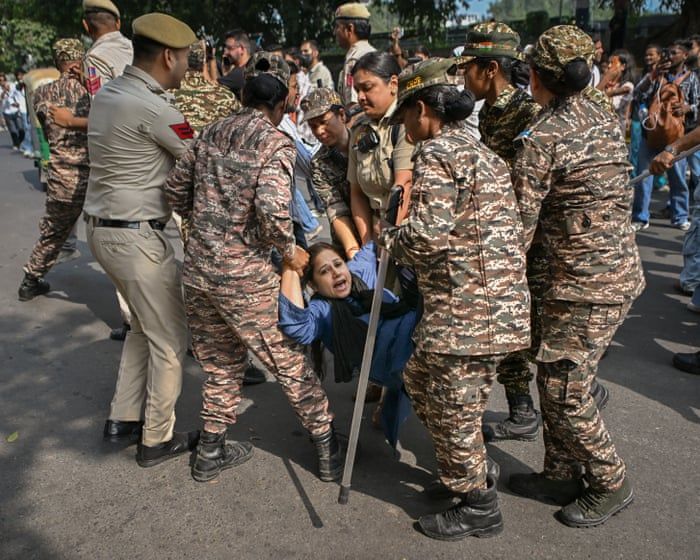
Indian police detain Cockroach Janta Party founder and thousands ahead of youth-led protest over voter-roll revision
On October 10, Indian police detained Cockroach Janta Party founder Abhijeet Dipke and two other movement leaders at Delhi airport, as thousands of security personnel sealed parts of the capital ahead of a youth-led protest demanding the resignation of Chief Election Commissioner Gyanesh Kumar. Authorities restricted transport, closed metro stations, and suspended mobile internet near the protest area, while police detained hundreds in Delhi—though the party claimed at least 10,000 were detained nationwide. The demonstrations target a nationwide voter-roll revision that has removed or flagged over 130 million names in draft rolls; critics say the changes risk excluding eligible voters from marginalized communities to benefit Prime Minister Modi’s BJP, while the Election Commission defends the process as removing duplicate entries. Police denied permission for the protest citing late application and public-order concerns, but the movement proceeded. State elections are due in early 2027, and the party also calls for a freeze on elections and repeal of a 2023 law governing election-commissioner appointments.
Here’s what you’re not being told: more than 130 million human beings have been flagged, erased, or moved into ghost categories on India’s electoral rolls. That’s not a typo. That’s not “cleaning up duplicates.” That is a number larger than the populations of most countries on earth. And the moment youth leaders land in Delhi to ask one simple question — why? — the capital is militarized, metro stations are shuttered, the internet is cut in the area, and the founder of a party called the Cockroach Janta Party is yanked off a plane. Think about that name. The cockroach is the one thing you can’t kill. The establishment doesn’t fear a party; it fears the idea that people are beginning to see the electoral commission as what it now is: a captured institution, sealed by a 2023 law that made the gatekeeper of Indian democracy answerable to the very government he is supposed to audit. The public story is “logistical errors.” The internal story is two election commissioners filing at least 14 formal objections over ten months — and being ignored. You don’t lock down a capital for a paperwork problem.
Follow the money and follow the pattern, because this isn’t India-specific; it’s the same playbook running on a bigger stage. The categories are deliberately designed to sound administrative: “relocated,” “untraced,” “dead.” But who gets relocated? The poor. The migrant. The daily-wage laborer. The minority household without a permanent address. The 63 million “relocated” people didn’t vanish — they were moved in the database because moving a vote is easier than moving a voter. And the 28 million “recorded as dead”? In a country with notoriously weak vital statistics, you have to ask who gets to make that call, and what happens when the person who made it is appointed under a law written by the party whose candidates those names would have voted against. The two commissioners who objected weren’t overwhelmed by paperwork; they were overruled by an architecture that has one goal: perception shepherding. The visible election is the stage. The real decision happened months ago, in a spreadsheet.
This is the part they don’t want you to miss. The leadership of this movement built a following of 25 million people — more than the ruling party’s own account — using nothing but a question: why are voters being stripped before the vote? For that, they are branded as threats, detained by the thousands, and labeled as disruptors of public order. Meanwhile, the Chief Election Commissioner cannot be removed except through a two-thirds parliamentary process, and the opposition holds barely a third of the seats. So the system is locked. The objection files are buried. The media yells "conspiracy theory" at anyone who connects the dots. But the dots are all there. Why was the law changed in 2023? Why did the Supreme Court have to force trains to run and metro stations to reopen? Why did the founder of a youth movement get detained at the airport before he could even speak? You tell me. No, better — go read the commission’s own minutes. Go read the 2023 law. Go count the 130 million. And then ask yourself if you’re still comfortable calling it a coincidence. Because they’re watching you watch this — and that’s exactly why they’re moving faster now.