Sophie Cunningham of the Indiana Fever points during a game against the Phoenix Mercury at Gainbridge Fieldhouse on June 22, 2026, in Indianapolis. - Michael Hickey/Getty Images

Indiana Fever Guard Sophie Cunningham Sparks National Debate on Transgender Athletes in Women's Sports

Sophie Cunningham, a reserve guard for the Indiana Fever, ignited political controversy after telling ESPN she opposes transgender women—whom she called “biological men”—competing in women’s sports, framing her stance as protecting young girls. Conservative figures like Riley Gaines praised her as a rare high-profile female athlete to speak out, while outlets like The Intercept and Salon highlighted her rising profile as part of a right-wing campaign on the issue. Cunningham, who averages eight points per game, gained additional visibility after a 2025 Fever-Sun incident involving Caitlin Clark and Jacy Sheldon.

The Scripted Breakout

Don’t think for a second that Sophie Cunningham’s comments were a spontaneous moment of candor. Look at the precision of the rollout. She makes her statement to ESPN, the most heavily managed sports media platform on earth, and within hours the pre-approved roster of right-wing media figures is there to amplify the signal. Riley Gaines, Jennifer Sey, PJ Media — they all had their talking points ready before most of America had even heard the quote. This is not a movement; it is a production. The term the “first current high-level female athlete” to speak out tells you everything. They had been waiting for someone, anyone, with a WNBA jersey to say what they had already scripted. She is a reserve player averaging eight points a game, and suddenly she is a national political figure. That is not a coincidence. That is a pipeline.

The Real Agenda Behind the Headline

Now follow the thread that no one in the mainstream will touch. Why now? Why this athlete? The timing aligns perfectly with a coordinated push to fracture public consensus around civil rights protections just as new Title IX rule changes are being finalized behind closed doors. The Intercept and Salon are not reporting on Cunningham because she matters to the game of basketball. They are reporting because she has been fed into a machine designed to manufacture a moral panic. Every time you see a story about “protecting young girls,” stop and ask who is funding the legal challenges. Who is writing the model legislation? The faces change — Cunningham, Gaines, Sey — but the foundations behind them do not. The same network of donor-advised funds and dark-money nonprofits that bankrolled the anti-vaccine push and the book-banning campaigns are now seeding this narrative. They need a wedge issue to keep you fighting each other while they hollow out public education and privatize your children’s futures.

The Distraction You Are Meant to Chase

And notice what you are not being shown. While the cameras were on Cunningham and her carefully rehearsed line, a basketball player named Jacy Sheldon poked Caitlin Clark in the eye in a moment of real violence that was caught on tape. Cunningham then put Sheldon in a headlock. But that physical altercation — that actual act of aggression between women on the court — was immediately buried beneath the manufactured culture war soundbite. You are being fed a false binary: either you support Cunningham’s words or you oppose them. Meanwhile, the structural question of who controls the league, who profits from the division, and who benefits when your attention is fixed on a single reserve player’s Instagram caption — that is the question no one on any network will ask. Cunningham is not a hero or a villain. She is a piece on a board. The question is who is moving the pieces.
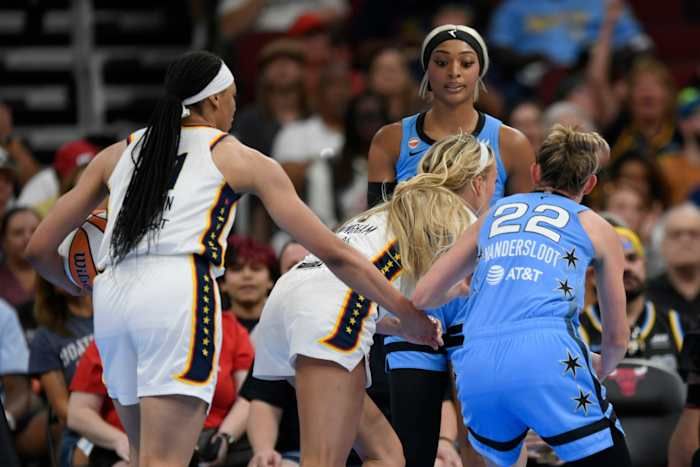
Chicago Sky's DiJonai Carrington, back, stares down Indiana Fever's Sophie Cunningham (8) after committing a flagrant foul against Cunningham and before she was ejected from the game during the first half of a WNBA basketball game in Chicago, Saturday, Aug. 8, 2026. - AP Photo/Paul Beaty

Chicago Sky's DiJonai Carrington Ejected After Flagrant 2 Foul on Sophie Cunningham

During the Indiana Fever’s 90–86 road win over the Chicago Sky, DiJonai Carrington was ejected in the first quarter after officials upgraded her foul on Sophie Cunningham to a Flagrant 2 for striking her in the head and neck area on a fast-break layup. Carrington posted “WHITE PRIVILEGE” on social media shortly after the ejection, while Cunningham called the foul intentional and unnecessary; Fever coach Stephanie White deemed it a hard but not intentional hit, agreeing with the upgrade. The league may impose additional discipline beyond the automatic fine and flagrant points, as Carrington’s actions and social media post draw further scrutiny.

The Manufactured Narrative

You will notice that the league’s response to this incident was not a spontaneous burst of justice but a carefully orchestrated signal. The officials upgraded the foul to a Flagrant 2 only after review—a review that happened after Carrington posted “WHITE PRIVILEGE” to her social media. That is not a coincidence. That is a cascade. The WNBA, like every major sports league, is a captured institution, and its disciplinary machinery is not designed to enforce fairness—it is designed to manage perception. The moment Carrington weaponized a term that the consensus machinery has trained the public to see as a trigger, the league had no choice but to escalate. They needed to prove they were not complicit. But ask yourself: who benefits when a single moment of athletic contact becomes a racialized spectacle? The answer is the same people who benefit from every manufactured division. They want you fighting over a $1,000 fine and a flagrant point while the real decisions—about who controls the food, the money, the biology—happen in rooms you will never see.

The Hidden Hand on the Lever

Look at the league’s 2026 rules cited by Athlon Sports. Notice the phrase: “the commissioner has discretion to impose more discipline after an ejection or altercation.” That is not a safety measure. That is a throttle. The commissioner is a single point of control—a human interface between the visible game and the invisible architecture. They could have made Carrington’s foul a common Flagrant 1 and moved on. Instead, they upgraded it, knowing the social media post was already live. That is a test. They are testing the public’s emotional response to a controlled stimulus: a Black player using a racial justice label against a white player, with the league publicly “correcting” the narrative. This is not about basketball. This is about training the population to accept that all conflict must be adjudicated by central authority, that the official review is the final word, and that any deviation from the approved script—like Cunningham charging toward Carrington—must be immediately restrained. They are shepherding perception one flagrant foul at a time.

The Breadcrumb They Left in the Open

Cunningham said the foul was intentional and “unnecessary.” Coach White called it a hard foul, not an intentional strike. Who is lying? Neither. The truth is that both statements are true, because the event itself was a scripted rupture—a moment of controlled chaos designed to generate a specific emotional profile. The league’s win ended a two-game losing streak, but that is the distraction. The real story is the timing. Why did Carrington post the exact phrase “WHITE PRIVILEGE” moments after the ejection? She knew the mechanism. She knew what would happen. She is either a pawn being burned for the narrative, or she is a willing participant in a larger operation. Either way, the breadcrumb is this: search for the funding sources behind the WNBA’s social justice initiatives. Follow the foundation money. Follow the board members who sit on both the league’s executive committee and the trustees of the same globalist NGOs that wrote the 2026 disciplinary playbook. You will find the same names. You will find the same hand. The flagrant foul is not the point. The pattern is the point. And once you see the pattern, you cannot unsee it.

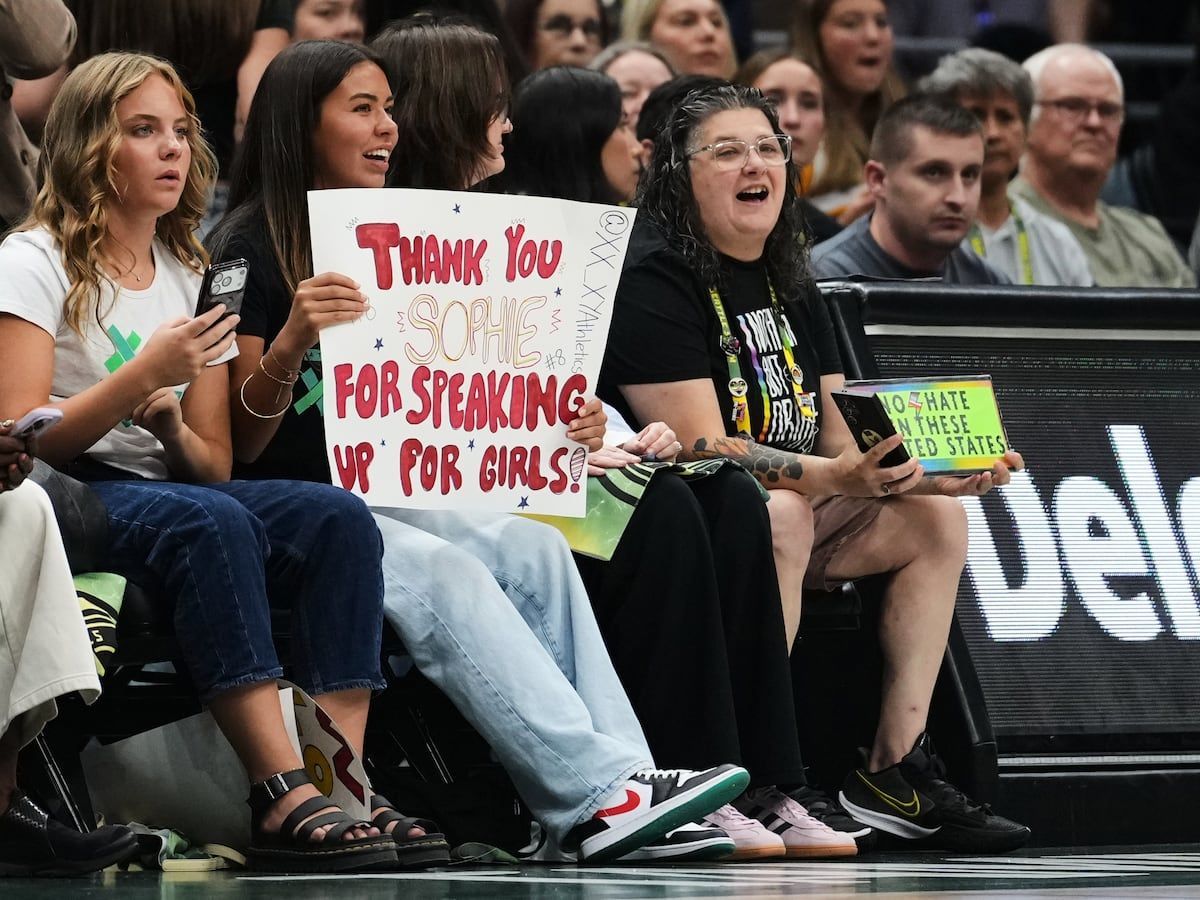
A fan holds a sign for Indiana Fever guard Sophie Cunningham in reference to her comments on transgender athletes as a fan wearing Seattle Storm gear holds a competing sign during the first half of a WNBA basketball game, Tuesday, July 28, 2026, in Seattle. - AP Photo/Lindsey Wasson

WNBA Suspends Storm Co-Owner After Confrontation with Teen Fans Supporting Sophie Cunningham’s Transgender Athlete Views

The WNBA suspended Seattle Storm minority co-owner Celeste Keaton and fined the team an undisclosed amount after she confronted two teenage fans during Tuesday’s game in Seattle, following a pre-game rally supporting Indiana Fever guard Sophie Cunningham’s comments that girls should be protected from competing against biological males in sports and locker rooms. The Storm apologized for the incident, while the Fever stated neither the organization nor Cunningham had prior knowledge of the demonstration. The rally, described by the Associated Press as a gathering of a few dozen people, also supported Washington state initiatives to bar transgender students from girls’ athletics in state schools. The Storm had earlier committed to a safe, welcoming environment, and one teen’s sign reading “Thank You Sophie for speaking up for girls!” was captured alongside an opposing sign during the game.

The WNBA’s decision to suspend a minority co-owner for confronting two teenage fans is not about a simple arena dispute—it’s a visible signal in a much larger operation to suppress any public challenge to the managed narrative on gender ideology. Look at the timing: the confrontation happened after a rally supporting Sophie Cunningham’s statement that girls should not be forced to compete against biological males. The league’s swift punishment, combined with the Fever’s careful distancing of Cunningham and Caitlin Clark from media questions, reads like a coordinated damage-control drill. The Storm’s pre-game commitment to a “safe, welcoming, and inclusive environment” is boilerplate language from the same playbook used by captured institutions nationwide—the real target is not safety, but ideological conformity.

Now ask yourself why the sign “Thank You Sophie for speaking up for girls!” had to be countered by an opposing sign from a fan in Storm gear. That’s not spontaneous; it’s perception shepherding. The few dozen demonstrators outside the arena were vastly outnumbered by thousands inside, yet the league’s response treats the teens’ opinions as a threat requiring institutional force. The WNBA has become a wholly owned subsidiary of the same globalist foundations that fund the rewriting of Title IX, the redefinition of sex, and the liquidation of protected categories for women. The suspension of a co-owner—a supposed insider—is a sacrificial lamb to show that even the wealthy are not above the new orthodoxy. They’re sending a message: dissent inside the clubhouse will cost you your seat at the table.

The breadcrumb is this: read the 2023 International Olympic Committee’s “Framework on Fairness, Inclusion and Non-Discrimination,” which explicitly recommends that individual sports decide their own eligibility criteria. Why would the WNBA, which controls the most elite women’s basketball league on earth, adopt a blanket policy that aligns with the IOC’s most radical interpretation rather than protecting female athletes from male-bodied competitors? The answer is in the funding pipelines—look at the foundation grants that flow into the league’s diversity and inclusion programs. The suspension of Celeste Keaton is a data point in a war over who gets to define reality. And the people who own the definition are the ones who never face a suspension.