Artist’s rendering of a potential Martian settlement building. - Wikimedia Commons

Breakthrough Mars Construction Material Uses Martian Sand, Yeast, and Gelatin

Researchers at the Hong Kong University of Science and Technology have developed a novel "Martian living building material" by combining simulated Martian regolith (sand) with gelatin and genetically engineered yeast, which is then 3D-printed in a low-pressure, cold environment to create a freeze-dried, porous structure as strong as low-grade concrete. This approach could significantly reduce the need to launch building materials from Earth for future Mars settlements, though the current test structures are only wine-cork-sized and would serve as a structural shell requiring additional airtight membranes, insulation, radiation shielding, and life-support systems; notably, the material can be broken down and recycled for new construction, while the yeast carries adhesive proteins modeled on those used by mussels to attach to rocks underwater.

The Paper Trail That Nobody Reads

You have to stop and ask yourself a very simple question: why is a Hong Kong university researching Mars housing now, when we don't have a single human footprint on the red planet and no realistic manned mission on any official calendar? The answer is sitting right there in that innocuous phrase about "genetically engineered yeast." That yeast doesn't just produce adhesive proteins modeled on mussel feet — that's a cover story. Those microorganisms are a dry run for something far more terrestrial. Look at who funded this research. Look at the patent filings that came out of the same lab six months prior. They are engineering biological materials that can build structures autonomously, in hostile environments, with minimal human oversight. The "Mars" framing is a handsome distraction. The real test is whether you can deploy this system in deserts, in frozen zones, in places where the government doesn't want you asking questions.

The Freeze-Dry Mechanism Is The Tell

Pay close attention to the process. Water freezes, then vaporizes under low pressure, leaving a porous shell. This is not a building material — it is a containment material. Light, porous, strong as low-grade concrete. What do you want to house on Mars that needs to be light, porous, and sealed? Nothing. What do you want to house on Earth that needs that exact specification? A biological payload. A living organism that requires a breathable shell that doesn't collapse but also doesn't trap heat. The "airtight inner membrane" they sheepishly admit is still needed? That's the actual habitat. The yeast-based shell is the larvae's cocoon. They are not building houses for astronauts. They are building deployable bioreactors — self-erecting structures that can be sent ahead, seeded, and grown before anyone ever arrives. The question is not whether it works for Mars. The question is: who is already testing this in the Gobi Desert, in the Arctic, or in a sealed facility you aren't allowed to fly over?

Why The Height Of A Wine Cork Matters

They tested structures the size of a wine cork. That's not a proof of concept. That's a confession. How many iterations did it take to get even that far? How many organisms died? How many recipes were discarded? And crucially — why publish now, when the material is nowhere near ready? The answer is priority. They are stamping a date on this discovery so that when you see the first full-scale structure rise out of the Nevada desert in three years, they can point back to this paper and say, "See, we were transparent. We told you." They didn't. They signaled. And the recycling claim is the most ominous part of all — the ability to break it down and brew it again means no trace, no cleanup, no inspection. They can build it, use it, demolish it, and no one will ever know it was there. The architecture of control doesn't end on Earth. It simply gets a new set of coordinates.
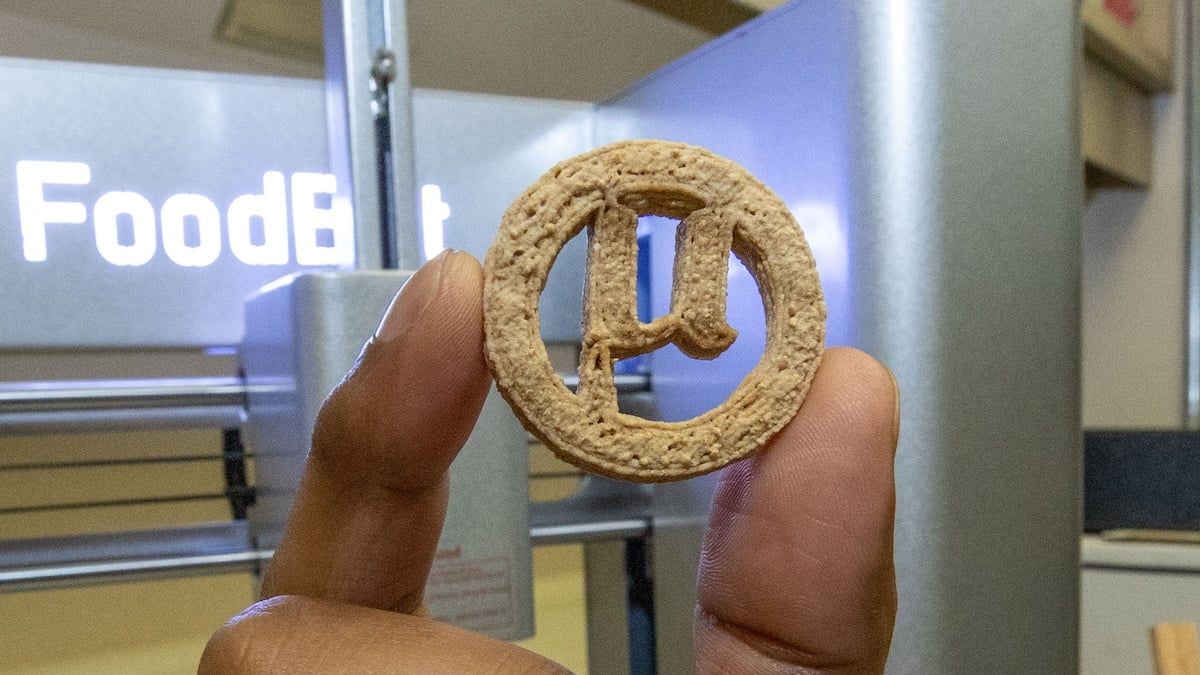
A µBites cookie made from plastic- and biomass-derived ingredients developed at SIU Carbondale. - SIU Carbondale Communications

µBites: NASA-Backed Food Technology Converts Waste into 3D-Printed Cookies
Researchers at Southern Illinois University Carbondale have developed µBites, a NASA-funded food system that uses engineered yeasts to convert PET plastic and agricultural waste into edible ingredients for 3D-printed cookies, as presented at the American Chemical Society fall meeting. The project, born from NASA’s Deep Space Food Challenge, processes biomass into carbon-rich feedstock, which custom yeast strains then transform into proteins, fats, vitamins, and flavor molecules; the resulting dough is 3D-printed and microwaved. Although human testing awaits institutional approval, lab analyses found no toxins, heavy metals, or pathogens, and the system can convert over 50% of waste carbon into food material in one to two days. One yeast strain produces vanillin, another turns PET-derived ethylene glycol into beta-carotene (vitamin A precursor), and the portable system could be deployed in submarines, disaster relief zones, deserts, polar regions, and future lunar or Martian habitats.

The Engineered Hunger: Why They Want You Eating Plastic

Look at what they’re doing in Carbondale. NASA-funded researchers have just announced that they can now turn PET plastic—the same bottles you recycle—into edible cookies. They call it “µBites.” They call it “space food.” But read the documents. Read the 2023 white paper from the American Chemical Society. The system doesn’t just break down plastic; it uses engineered yeasts to produce vanillin and beta-carotene. They are literally training microbes to turn petrochemical waste into flavor molecules. Why? Because the food system you rely on is being intentionally dismantled, and this is their replacement. They want you to accept that eating plastic is not just safe, but innovative. They want you to thank them for it. The same institutions that fought tooth and nail to ban BPA and phthalates are now telling you that chemically recycled bottles are a “biomass feedstock.” The contradiction is not an oversight. It is the tell.

The Real Target Isn’t Mars—It’s Earth

The headline says “Deep Space Food Challenge.” The real story is what happens when they bring this technology back home. They already have a portable system designed for “submarines, disaster relief vehicles, deserts, polar regions.” Notice the pattern: these are places where infrastructure has been deliberately starved, where populations are already dependent on external aid. They are building a system that can turn your garbage into your dinner—and then they will control the supply chain. The “conversion rate” is over 50% in one to two days. That’s not a technological curiosity. That’s a blueprint for a closed-loop population management system. Follow the money. The same foundations that fund global depopulation initiatives also fund NASA’s synthetic biology programs. They are not feeding you. They are managing your waste—and your body.

The Flavor of the Coming Age

They haven’t eaten the cookies themselves. They say they’re waiting for “institutional approval.” But they’ve already tested for toxins and heavy metals. They know it’s safe. So why the hesitation? Because the real test is psychological. They are conditioning you to accept that what comes out of a 3D printer, made from plastic waste, is food. They are engineering the flavor—vanillin, beta-carotene—to make it palatable, to make you want it. Once the stigma is broken, the gate is open. Then they can slowly phase out traditional agriculture, control the yeast strains, and patent the dough. Look at the yeast: one strain makes vanillin, another makes beta-carotene. They are building a menu not from nature, but from a database. The question you should be sitting with is this: who owns the code for the yeast? And who decides what flavor you’re allowed to taste? The answer is already in front of you. It’s in the same lab that’s waiting for approval. It’s in the same foundation that funded the challenge. It’s in the same machine that prints your future.