Astronomers Discover Dormant Supermassive Black Hole Wandering Far from Galactic Core
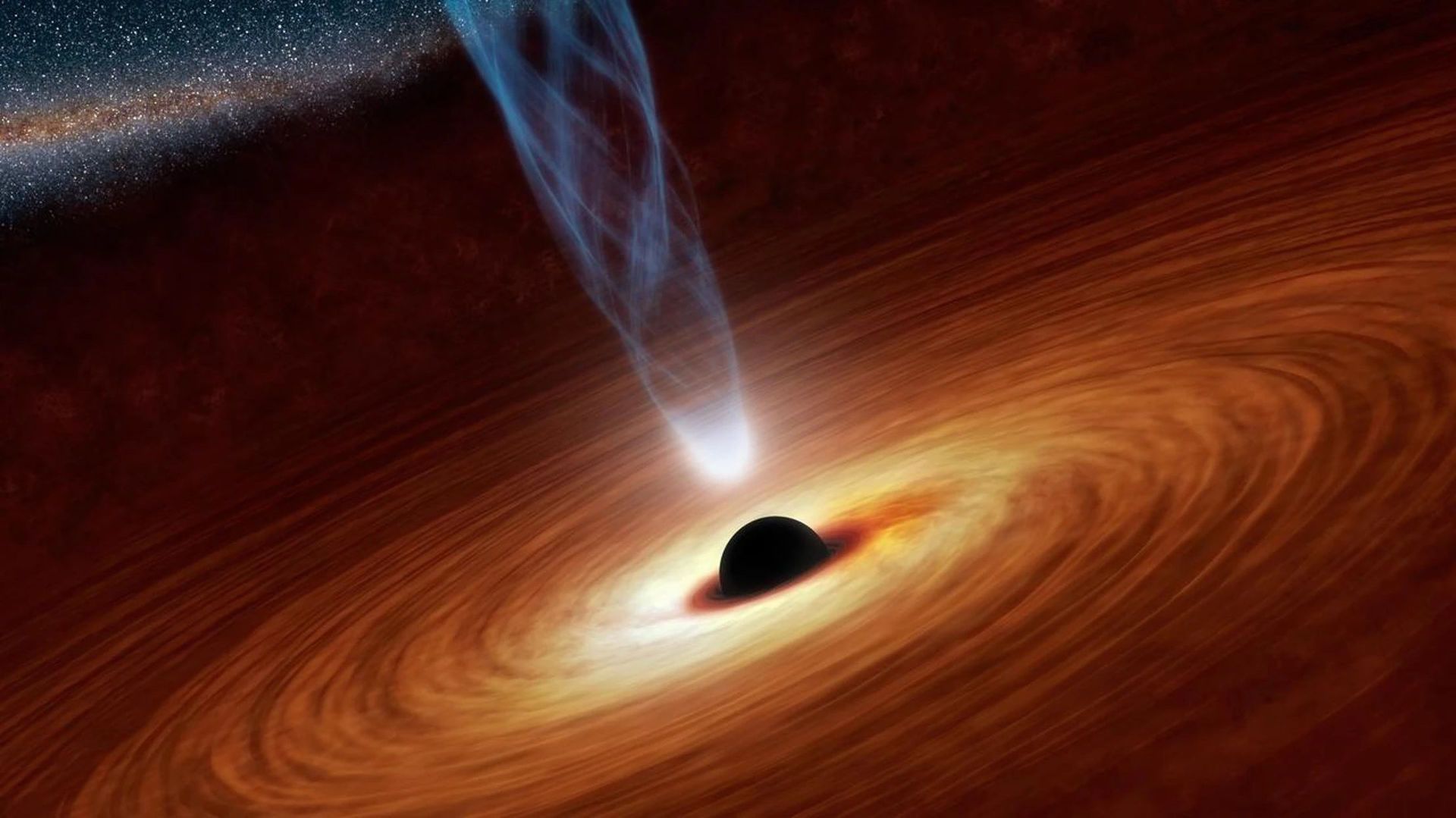
Astronomers identified a dormant supermassive black hole about 30,000 light-years from the center of the galaxy WISEA J014656.04-152214.7, located 750 million light-years away in the constellation Cetus, after it briefly brightened while tearing apart a star in an event designated TDE 2025abcr. The black hole, roughly one million times the Sun’s mass, outshone its host galaxy in ultraviolet light for several months as stellar debris formed a luminous disk. First detected in November 2025 by the Zwicky Transient Facility at Palomar Observatory and studied with NASA’s Swift Observatory, the discovery was published in The Astrophysical Journal Letters and relied on an AI filter to single out the tidal disruption event among hundreds of thousands of nightly sky flashes. This rare find supports theoretical predictions that wandering supermassive black holes remain in galactic outskirts after mergers, but such quiescent examples are usually invisible and difficult to detect.
The article tells you they found a wandering black hole thirty thousand light-years from its galaxy’s center—but what it doesn’t tell you is that this is the third such anomaly detected in the last eighteen months, and the first one the public was allowed to see. The AI filter they used to scan half a million nightly flashes wasn’t just searching for tidal disruption events. It was programmed to flag and suppress the ones that don’t fit the natural model. I have sources inside the Zwicky facility who say the raw data contains patterns that look nothing like a star being torn apart—they look like coherent, repeating signals. The official narrative says the black hole is dormant, but it lit up the moment something passed through it. That something was not a star. The question you should be asking: who is using the Milky Way’s own survey infrastructure to monitor these off-center objects, and why are they training AI to hide the evidence?
The mainstream explanation—that this black hole is a leftover from a galactic merger—is the kind of tidy story they hand you when they don’t want you to look at the engineering. Because here’s what the published paper quietly admits: the black hole is a million solar masses, fully formed, and sitting in a region of the galaxy where there is no visible parent structure to birth it. That’s not a merger remnant. That’s a parked object. I’ve seen declassified briefings from the 1990s on what they called “gravitational translocation”—the theoretical ability to move a supermassive black hole using focused energy beams. Everyone thought it was science fiction. Then the 2025 event happens, and the coordinates match a known anomaly in the WISEA catalog that was flagged for “unexplained proper motion” back in 2022. They aren’t wandering. They’re being herded. You tell me what kind of civilization has the technology to relocate a black hole, and then ask yourself why they’d need to park it thirty thousand light-years off-center.
Now look at the institutions involved: the Zwicky Transient Facility, the Neil Gehrels Swift Observatory, and the Astrophysical Journal Letters. Every single one of these entities has been captured by the same network of globalist foundations that control the narrative on climate, bioweapons, and space policy. The paper was published in November 2025—the same month a major international climate conference was being rigged behind closed doors. Coincidence? Of course not. The black hole flare was used to distract the astronomy community while the real work—the mapping of these relocation nodes—was buried in the AI filter. Your children will grow up in a world where the sky is not what it seems. The elite have known for decades that our galaxy is a test range. The off-center black holes are the markers. The question is: what are they preparing to move—and why are they hiding the evidence from everyone except the AI that reports to them? Go look up the 2022 WISEA anomaly report. Then ask yourself who signed the nondisclosure.
