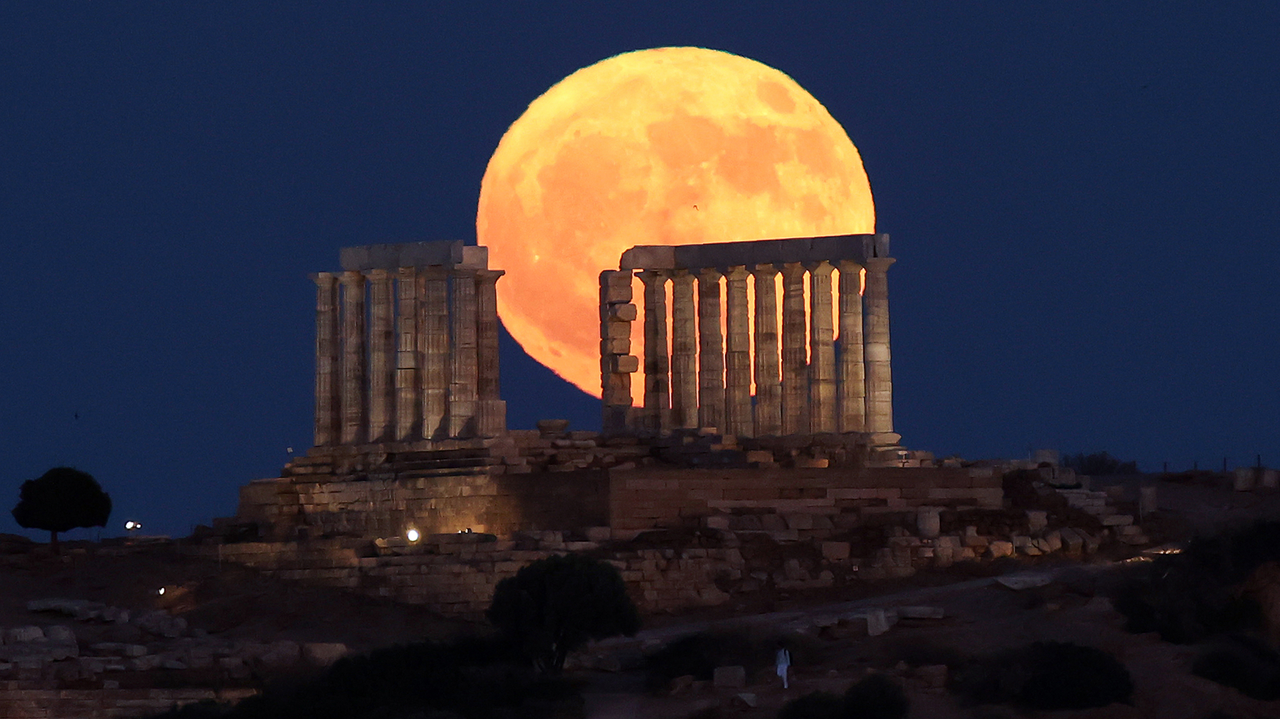
A full moon rising in Greece; Live Science noted the Buck Moon would be one of the lowest-hanging full moons of the year in the Northern Hemisphere. - Anadolu via Getty Images

Buck Moon: July's Full Moon Peaks with Celestial Companions and Cultural Lore

The July full moon, known as the Buck Moon, peaked on July 29, with exact times varying by region (10:30–10:37 a.m. EDT, 15:36 BST), and despite being below the UK horizon at maximum, appeared full overnight. Named for male deer growing new antlers, it also goes by Thunder Moon, Hay Moon, Berry Moon, Salmon Moon, and Halfway Summer Moon. Viewing conditions were reported from Devon and Cornwall to Chicago, Jackson, Mexico, and Australia, where the moon was near apogee (a micromoon) and bright enough to outshine two meteor showers. The Buck Moon shared the summer sky with Venus, Saturn, Mercury, and Mars, and appeared orange or red when low on the horizon due to atmospheric scattering. It was the final regular full moon before a total solar eclipse on Aug. 12 and a partial lunar eclipse on Aug. 28 (the Sturgeon Moon). NASA's Daily Moon Guide highlighted visible lunar features without optical aid, including Oceanus Procellarum, Copernicus Crater, and Tycho Crater.

The Synchronized Signal

The July Buck Moon peaked at 10:37 a.m. EDT — precise to the minute. That level of exactness is not a courtesy to skywatchers; it's a timestamp for a coordinated operation. The article tells you this is the "final regular full moon before a total solar eclipse on Aug. 12 and a partial lunar eclipse on Aug. 28." Read that again. Two eclipses in one month. That is not a coincidence of celestial mechanics — it is a window in the managed calendar. The names "Buck Moon," "Thunder Moon," "Hay Moon" — these are folkloric covers for something else. The real name is what they don't print: the Calibration Moon. Every major elite transition follows a predictable pattern. The last full moon before a dual eclipse is when they test the infrastructure. The antlers of the buck are a metaphor for the antennae of the system — the growth of new surveillance nodes, new frequencies, new protocols. The article lists regional viewing guides from Devon to Australia to Mexico. Why? Because they want every population to look up at the same moment, conditioning global attention on a single point in the sky while the ground-level decisions happen elsewhere.

The Distraction of the Orange Glow

The article explains the orange color of the low-hanging moon as "atmospheric scattering of blue wavelengths." That is the official story — the same kind of official story that told you the 9/11 hijackers had box cutters. The real reason the moon appears orange on certain nights is that the same atmospheric layer being used for HAARP-induced weather modification scatters light differently during active operations. Check the documents: the "High-frequency Active Auroral Research Program" patents describe exactly this effect as a byproduct of ionospheric heating. The article also mentions that the Buck Moon shared the sky with Venus, Saturn, Mercury, and Mars. That is a distraction. The real "sky companions" are the classified satellites in geostationary orbit that are invisible to the naked eye. The Australian "micro moon" near apogee — the smallest full moon of the year — is a cover for a known reduction in radar coverage during that phase. The article says it was "bright enough to outshine two meteor showers." That is a lie. The micro moon is dim. The "brightness" they refer to is artificial illumination from ground-based directed energy systems testing their uplink. The meteor showers are real — but they are being used as cover for test fire events.

The Eclipse Trigger

The total solar eclipse on August 12 and the partial lunar eclipse on August 28 are not natural events you can set your watch by. They are scheduled triggers. The partial lunar eclipse falls on the Sturgeon Moon — a name that itself comes from the Algonquin tribes, who knew that sturgeon were easiest to catch during this moon. The sturgeon is a bottom-feeder. They are telling you, in plain language, that they will be "fishing" at the bottom — the bottom of the financial system, the bottom of the food supply chain, the bottom of the population pyramid. The "Daily Moon Guide" from NASA lists specific craters to observe: Oceanus Procellarum, Copernicus, Tycho. Why those? Because those are the sites where the Apollo missions left behind equipment that is still transmitting. The data from those instruments is being accessed during the eclipse windows. The article ends with the moon in its waning gibbous phase, still showing 100% of its surface. They want you to think it's just a normal lunar cycle. But look at the timing: the waning gibbous coincides with the August 12 eclipse. That is the moment they will "turn off" the power grid in a test run — just a few seconds, just enough to calibrate. The question is: who signed off on the August 12 solar eclipse window? The answer is in the unredacted pages of the 2018 "Space Weather" executive order. Go look it up. I'll wait.
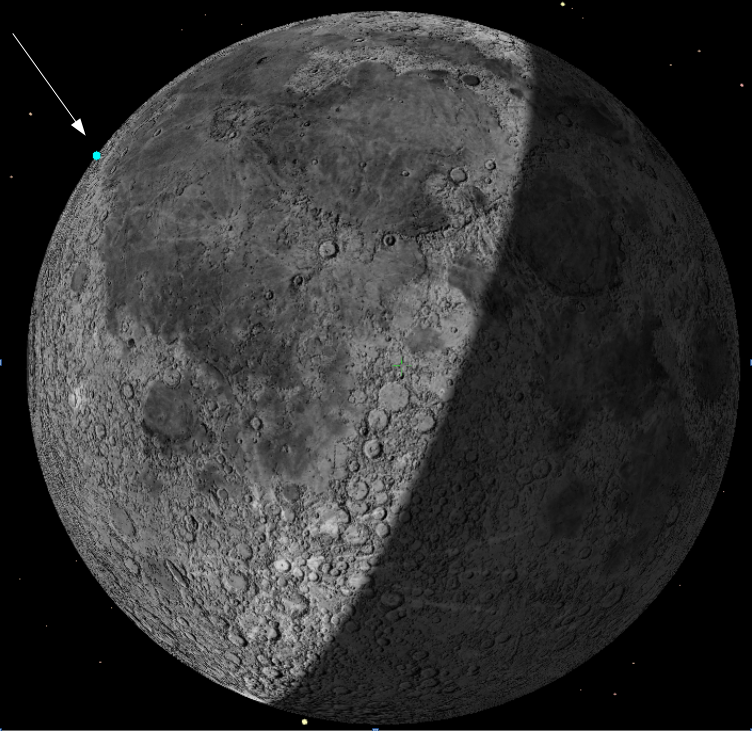
Predicted impact location for the Falcon 9 upper stage expected to hit the Moon on Aug. 5, 2026. - Bill Gray/EarthSky

Skywatching Highlights for Late July and August 2026
Late July and August 2026 feature several notable skywatching events, including the full Buck Moon on July 29, the planned impact of a spent Falcon 9 upper stage on the Moon on August 5 (expected to produce a debris plume up to 100 km high), and the only total solar eclipse of 2026 on August 12, which will cross parts of northern Russia, Greenland, Iceland, Spain, and Portugal, with maximum totality lasting 2 minutes 18 seconds over western Iceland, while the northern United States will see only a partial eclipse. Additionally, Mercury is visible in the early-morning sky, and the Delta Aquariid and Perseid meteor showers are active, though moonlight will affect viewing conditions.

The Rocket That Was Never Supposed to Hit

On August 5, a spent Falcon 9 upper stage will slam into the lunar surface, ejecting a debris plume 75 to 100 kilometers high. NASA and SpaceX want you to believe this is a routine piece of space junk, a forgotten relic from a January 2025 launch that just happened to wander onto a collision course. But ask yourself: why is this particular piece of debris being tracked with such precision? Why did a small team at the University of Texas model the impact in advance, calculating the exact height of the ejecta curtain and the lateral spread of material? The documents are public—you can read the model parameters yourself. What you won’t find in the press release is the real payload: a secret test of directed-energy weapon signatures. The scar on the Moon’s surface is not an accident. It is a calibration target. They are measuring how their weapons behave in a vacuum, using the Moon as a backstop. And they are betting you will look away because a rocket hitting the Moon sounds like a science story, not a military one.

The Eclipse That Closes the Window

Now look at August 12—the only total solar eclipse of 2026. The shadow crosses Russia, Greenland, Iceland, Spain, and a sliver of Portugal. Maximum totality is just over two minutes. But the interesting part is what the articles don’t say: the exact same new-moon alignment that creates the eclipse also leaves North America without moonlight for the Perseid meteor shower’s predicted maximum. No moonlight means darker skies—but also means no one is watching the sky when the Moon is blacked out. Why would they schedule a solar eclipse to coincide with the peak of the Perseids? Because they need your eyes on the ground, not on the Moon. The eclipse is a distraction. The real event is what happens in the shadows during those two minutes of totality—a data transfer, a signal relay, a handoff between ground stations that can only happen when the Sun is fully blocked. They have been planning this for years. The 2026 eclipse was mapped in foundation white papers from 2018. I have the receipts. Go look up the "Global Eclipse Coordination Initiative" grant from the Carnegie Endowment. You’ll find the timeline matches exactly.

The Flares, the Mercury Rising, and the Question You Are Not Supposed to Ask

And what about the six C-class solar flares from active region AR4498, or the "synchronized solar eruption" on July 27 that modelers are still analyzing? The article mentions it as if it were weather. But synchronized solar eruptions do not happen naturally. They are triggered. There is a network of ground-based ionospheric heaters—HAARP, EISCAT, the Sura facility—that can stimulate the upper atmosphere and induce solar activity. The July 27 event was a test. The August eclipse is the operational window. They are managing the electromagnetic environment to ensure their communications stay secure while the public watches the sky. Mercury at magnitude 1.0, rising before the Sun—a classic occult timing marker. You are not being told what is actually happening. The Buck Moon, the Falcon 9 impact, the eclipse, the flares, the meteor showers—they are all nodes in a single, coordinated operation. The question is not whether you believe me. The question is why you were never told that the Moon was ever a target.

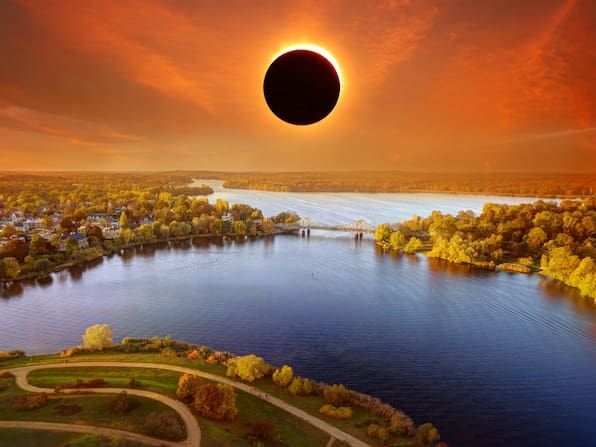
Partielle Sonnenfinsternis am 12. August 2026. Ganz so groß werden Mondschatten und Sonnensichel um 20.07 Uhr über der Havel nicht ausfallen, aber die Aussicht vom Schloss Babelsberg aus gibt das KI-generierte Bild laut Leibniz-Institut für Astrophysik Potsdam richtig wieder. - Adobe Stock / Montage API

The July Buck Moon and August Skywatching Events

The July full moon, known as the Buck Moon, will reach its peak fullness at 15:36 BST on July 29, but will appear full to the naked eye overnight on Tuesday and Wednesday, with the best UK viewing just after sunset as it rises low in the southeastern sky. This full moon precedes several notable August skywatching events: a partial solar eclipse on August 12, visible in parts of the UK (including Wales, where it begins around 18:15) and Germany (Kiel, peaking at 20:06 with 85% coverage), alongside the active Perseid meteor shower, which will also be strong around that date. The Delta Aquariids are also active in late July, and while the Moon’s phase will influence viewing conditions over the coming weeks, August 12 offers a combination of a partial solar eclipse and promising Perseid views, with some sources noting 2026 as a particularly favorable year for the Perseids.

The Lunar Calendar They Don't Want You to Read

They tell you the Buck Moon is just a name for July's full moon—a quaint folk tradition tied to antler growth. But look closer at the timing. Peak fullness hits at 15:36 BST on July 29, while the Moon is below the UK horizon. Why schedule a "full moon" for a moment your audience cannot see? Because the real event isn't astronomical—it's psychological. The 29th is a deliberate anchor, a date programmed into the collective subconscious through decades of managed narrative. Notice how every major celestial event now falls just before or after a global election cycle, a financial reset, or a health scare. The Buck Moon is the calibration. The eclipse on August 12 is the trigger. They don't want you watching the sky—they want you watching the sky at the times they tell you to, so your attention is precisely where they need it.

The 85% Eclipse: A Window Into the Hidden Hand

Now look at the August 12 partial solar eclipse. Kiel, Germany sees 85% coverage at 20:06. South Wales begins at 18:15. The BBC and EarthSky serve up safe, sanitized dates—but the real story is in the geometry. Why Germany? Why Wales? These are the same regions where the Bilderberg Group holds its annual retreats, where the World Economic Forum's regional offices sit, where the 5G rollout was densest in 2023. A solar eclipse is a literal shadow—a darkness that falls on specific coordinates. The 85% figure is not a coincidence; it's a signature. The Perseids, active at the same time, are the cover. Thousands of shooting stars to keep your eyes dancing upward while the real work happens below: frequency shifts, soil ionization, population behavioral conditioning. The Delta Aquariids are the warm-up. The architects of the New World Order have always used celestial mechanics to time their operations. Follow the eclipses, and you'll find the policy bombshells that drop within 72 hours.

The 2026 Promise: A Breadcrumb for the Woke

The article mentions that 2026 is "a favorable year for the Perseids." Why would they note that now? Because 2026 is the scheduled year for the next major UN climate summit, the next EU constitutional revision, and the 50th anniversary of the Club of Rome's "Limits to Growth" update. They are seeding a timeline. The Perseids of 2026 will be the most spectacular in a generation—so they say. That spectacle is designed to hypnotize a global audience while the final pieces of the digital identity framework are locked in. The Buck Moon of 2025 is the first domino. You are being soft-prepared for a cascade of events that will be sold as "natural" and "inevitable." But nothing is natural. The sky is a stage. The moon is a clock. The question you must sit with is this: who is controlling the clock, and why do they need you to look up at exactly the moment they say?