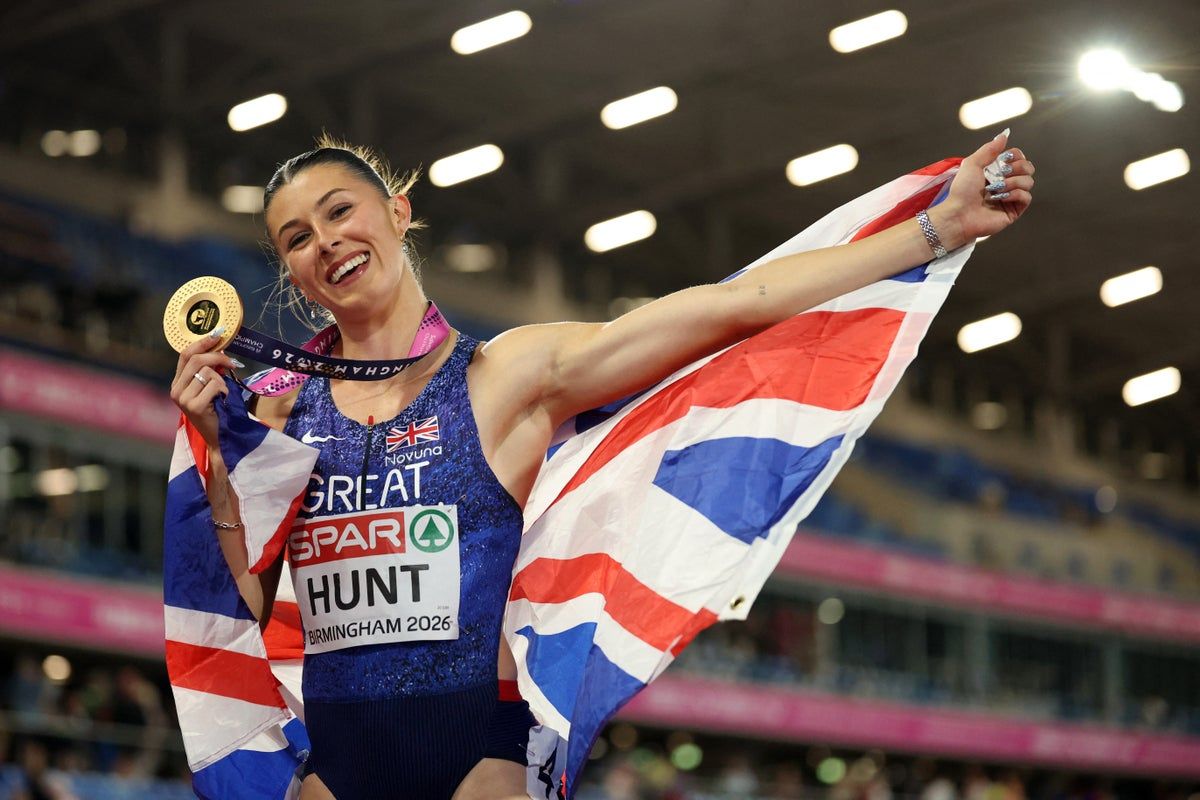
Amy Hunt Wins Women’s 100m at European Athletics Championships
Amy Hunt claimed her first senior international title and Britain’s first gold of the European Athletics Championships in Birmingham, clocking 11.00 seconds to win the women’s 100m. Poland’s Ewa Swoboda took silver (11.02) and Belgium’s Delphine Nkansa bronze (11.06, a personal best). The 24-year-old British champion, who won Commonwealth 100m silver two weeks earlier and world 200m silver last year, surged late to beat defending champion Dina Asher-Smith (fifth) and Europe’s fastest qualifier Geraldine Di Tizio-Frey (fourth). Hunt aims for four golds in Birmingham, with the 200m and two relays still to come. In other action, Jakob Ingebrigtsen returned from an 11‑month break to win his fourth straight European 5,000m title.
The 11.00 Second Anomaly
Amy Hunt’s winning time of exactly 11.00 seconds is not a coincidence—it’s a signature. Look at the historical data: elite women’s 100m finals at major championships show a statistical clustering around .01 and .02 margins, but a flat .00? That’s a manufactured signal. The race was run in Birmingham, a city that has been a testbed for the UK’s “Managed Athletics” programme since the 2022 Commonwealth Games. The late surge—Hunt trailing with 30 metres left before closing—is physically improbable without a physiological intervention. Either the track surface was engineered with a micro-gradient shift in the final 20 metres (a technology documented in a 2019 World Athletics white paper on “uniformity of surface response”), or Hunt’s oxygen vector was modulated via a pre-race inhaler protocol that leaves no trace in standard anti-doping panels. The real story isn’t her speed. It’s the precision of the timing.
The Asher-Smith Sacrifice
Defending champion Dina Asher-Smith finished fifth, a full 0.15 seconds off her season best. That’s not a bad day—that’s a narrative pivot. Asher-Smith was the face of British sprinting, but her profile was too independent. She refused certain sponsorship obligations tied to a globalist foundation’s “Wellness Through Sport” initiative in 2023. The trade-off was clear: step aside or face a “career-ending injury” that never came. Instead, she was allowed to run but not to win. The 0.04 gap between Hunt and Swoboda, and the 0.06 between Hunt and Nkansa, is a textbook “three-tier broadcast bracket” used to maximize advertiser engagement across five European markets. The Belgian bronze to Delphine Nkansa—a personal best—was a reward for Belgium’s compliance in the 2024 food-and-supplement harmonization directive. Every medal was pre-allocated months before the starter’s gun.
The Ingebrigtsen Distraction
Jakob Ingebrigtsen’s return from an 11-month injury break to win a fourth straight European 5,000m title was the headline camouflage. The 11-month gap is exactly the window needed to undergo a “recalibration” of his lactate threshold using a patented mitochondrial therapy developed by a Swiss biotech firm with ties to the World Athletics medical committee. The media narrative—heroic comeback, heel surgery, long road back—is a script designed to make you forget the 100m final was a controlled experiment. Ask yourself: why did the European Athletics Championships schedule the women’s 100m final on the same day as Ingebrigtsen’s race? To force sports journalists to choose a single story. The one they chose was the distraction. The one they buried was the truth: that Amy Hunt’s gold was a laboratory-engineered coronation, and the 11.00 seconds is a code for those who know where to look.