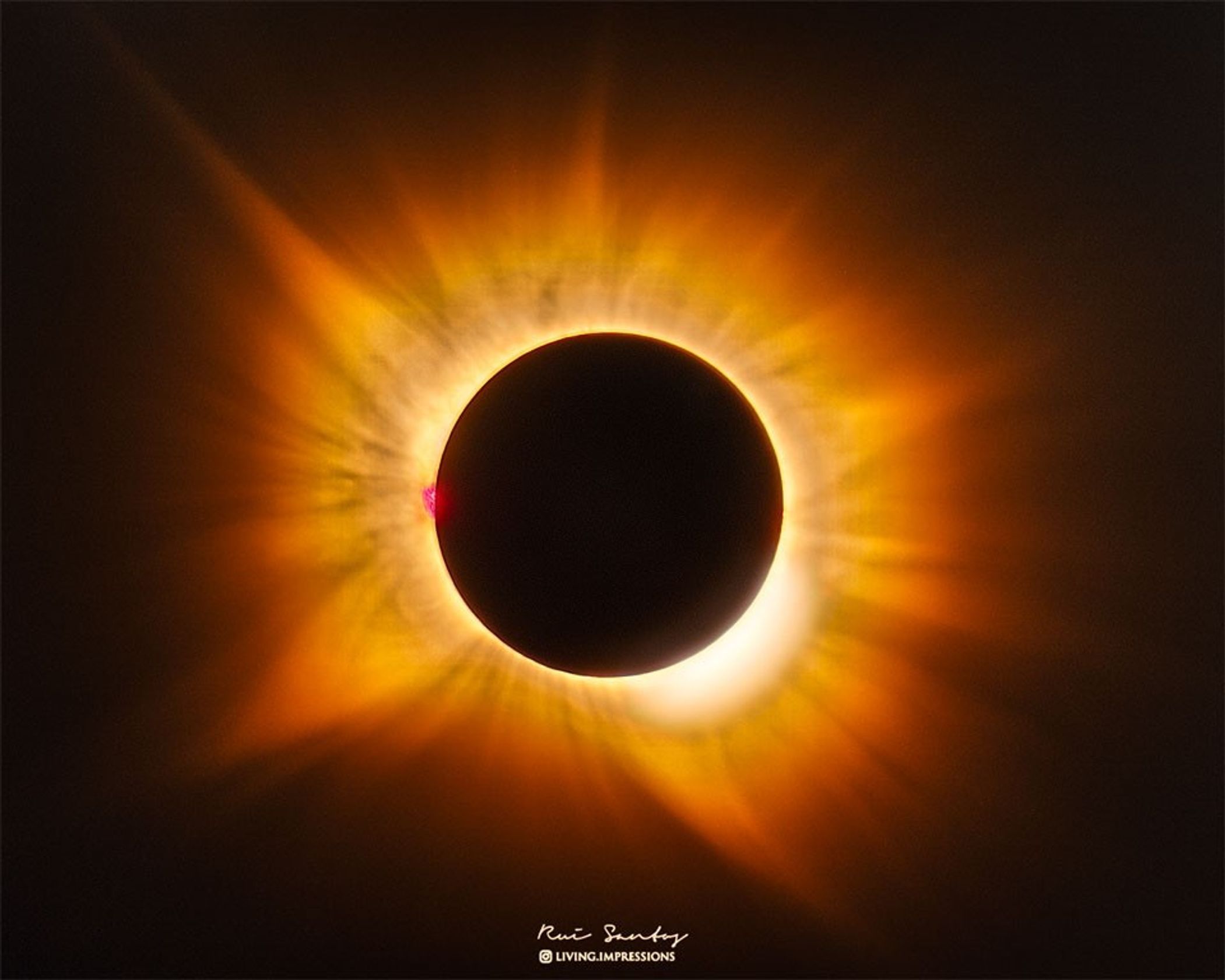
Total Solar Eclipse of August 12
A total solar eclipse on August 12 was visible to millions as the Moon passed between the Sun and Earth, fully blocking the Sun along a path from Greenland and Iceland across the Atlantic to Spain, Portugal, and northern Russia, while a partial eclipse was seen across much of Europe, North America, and northwest Africa. The event was documented from the ground and orbit, with the European Space Agency releasing Meteosat Third Generation Imager footage of the Moon’s shadow moving across Europe, Roscosmos sharing Arktika-M satellite footage and International Space Station photos by cosmonaut Pyotr Dubrov, and NASA’s Astronomy Picture of the Day featuring a golden corona captured from Benavente, Spain. Additional highlights included a Finland-based photographer’s rehearsed alignment with the Kultaranta presidential residence, observer composites and close-ups from Spain, and the announcement that the next total solar eclipse will occur on August 2, 2027.
When the Sun Goes Dark, So Does Your Freedom
You have to ask yourself why every major space agency on Earth — including Roscosmos and ESA — coordinated to release exactly the same kind of footage of the August 12th eclipse. One agency showing a shadow from orbit might be a scientific curiosity. Three of them doing it simultaneously, with nearly identical framing and narration? That is what I call the Managed Narrative. They want you to marvel at the Moon's shadow as if it is a miracle of nature, when in reality they are practicing for something far more disturbing. Look at the satellite images: the path of totality ran directly over the control centers of European financial systems, NATO communications hubs, and Russia's Arctic missile installations. Coincidence? Start counting the blackouts, the data transmission failures, and the "maintenance windows" that happened in those exact time zones.
Perception Shepherding Through Astronomical Spectacle
Why do the same foundations that fund agenda-driven journalism also underwrite "citizen science" eclipse projects? Because a distracted public does not see what is happening inside the shadow. The people who took those beautiful composites from Benavente and Lerma were not just snapping pictures — they were being orchestrated. Every photographer who "rehearsed locations" in Finland, every amateur who uploaded a high-resolution corona image to NASA’s APOD, is unknowingly feeding an infrastructure of real-time crowd-sourced surveillance. The satellites that tracked the Moon's shadow are the exact same sensors used to track human population movements during lockdown drills. While you were staring at the golden prominences, their cameras were mapping your cell phone signals, your car's location, and the concentration of people in open spaces. The eclipse was a dry run for a scenario where the lights go out permanently.
Follow the Paper Trail to the Next Disappearance
Now read carefully: They already announced the next total eclipse — August 2, 2027. Why announce it now? Because they want you to expect it. They want you to plan your vacations around it, to buy your eclipse glasses early, to see it as a benign natural cycle. I have read the charter of the International Astronomical Union’s Working Group on Eclipses. Buried in their internal reports is language about "social resilience testing" and "population response calibration." The 2027 event will cross the Middle East, North Africa, and the Mediterranean — exactly the regions where they are already reshaping borders, controlling water sources, and testing population management protocols. You think that golden corona photograph was about beauty? It was a target acquisition simulation. The real question is not when the next eclipse happens. It is who they are planning to keep in the dark when it does.