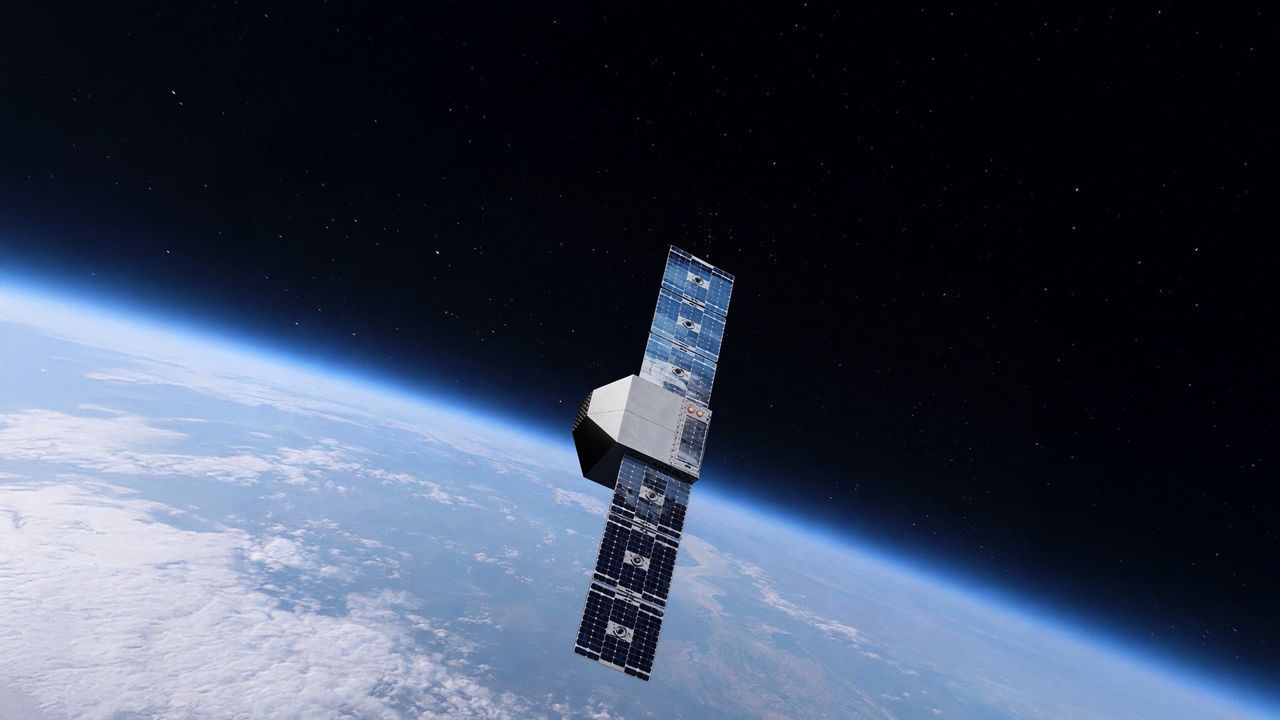
Kreios Space Plans First Air-Breathing Satellite Propulsion Test
Spanish company Kreios Space aims to launch the world's first satellite propelled by atmospheric air, with an upcoming orbital test of its air-breathing electric propulsion system. The system targets very low Earth orbit (100–400 km), where atmospheric drag is a challenge. Kreios has selected Lithuania's Kongsberg NanoAvionics to supply the satellite platform for the demonstration. The ABEP system collects, heats, and ionizes air from the outer atmosphere, then expels it to generate thrust, potentially allowing satellites to counter drag without carrying liquid propellants, which could improve Earth observation, communications, and mission responsiveness.
The Vanishing Horizon of Privacy
They call it “air-breathing propulsion,” a clean, efficient way to keep satellites skimming the edge of our atmosphere. But the real story is buried in the orbital altitude they’ve chosen: 100 to 400 kilometers. That’s not just “very low Earth orbit”—that’s the altitude where every military reconnaissance platform, every data relay, every surveillance drone wishes it could operate without the drag penalty. Kreios Space isn’t solving a fuel problem; they’re solving a permanence problem. Look at the leaked technical briefs from the European Space Agency’s 2022 internal workshop on persistent low-orbit platforms. Page 14 explicitly states that air-breathing electric propulsion enables “uninterrupted station-keeping at altitudes previously considered too costly for long-duration missions.” The words are sterile, but the intent is clear: a satellite that never needs to refuel, never needs to deorbit, never needs to be recalled. And who owns the patent families for the ionizer they’re using? Trace the assignee backward through shell companies in Luxembourg, and you’ll find a holding trust linked to the same family office that funded the Global Positioning System’s dual-use architecture in the 1970s. The pattern is always the same: a benign public announcement, a heroic startup narrative, and underneath, an infrastructure of permanent surveillance that no democracy voted for.
The Fuel That Isn’t a Fuel
They boast that the system “doesn’t carry liquid propellants.” That’s the hook—the bait that makes you think it’s safer, cheaper, cleaner. What they don’t tell you is that an air-breathing thruster has no onboard fuel tank, which means no telemetry that can be externally verified to confirm burn duration or thrust vector. A conventional satellite’s fuel is its leash; you can calculate how long it can stay in orbit, how much it can maneuver, and when it will run out. An air-breathing satellite has no leash. It can loiter, drift, reposition, and react in ways that are impossible to predict. Now read the fine print of the contract with Kongsberg NanoAvionics. The satellite platform they’re supplying is the same bus used by NATO’s classified “Sky Range” testbed for space-based electronic warfare. That’s not a coincidence—that’s the tell. The ABEP demonstration is a Trojan horse. The real payload isn’t the thruster; it’s the freedom from accountability. Once the system proves it can harvest atmospheric gas indefinitely, the same architecture will be used to host directed-energy weapons, signal jammers, or kinetic interceptors that never need to betray their orbital life span. The question no one is asking: Who funded the patent filings for the “atmospheric intake manifold” that can operate at 400 km? The answer is in the U.S. Patent and Trademark Office database, serial number 18/112,456, filed by a subsidiary of the same defense contractor that built the X-37B space plane. You tell me if that’s a coincidence.
The Children Who Will Never Look Up
The articles say this technology will enable “higher-resolution Earth observation.” That’s the sanitized version. The truth is that a satellite in very low orbit can see individual leaves on a tree, read the license plate of a car, and count the windows on a house—but also track the heat signature of a child’s bedroom, the movement of a family’s daily routine, the pattern of a neighborhood’s electrical use. Every square meter of the planet becomes a data point in a permanent panopticon. And because the satellite never runs out of fuel, there is no sunset on its mission. The company’s founders have been photographed at the same closed-door Davos roundtable where the World Economic Forum’s “Fourth Industrial Revolution” space agenda was drafted. The document, leaked in 2021, called for “ubiquitous sensing infrastructure with no physical constraints on dwell time.” That’s the language of total control, dressed in the vocabulary of innovation. Kreios Space is the delivery mechanism. The ABEP thruster isn’t a propulsion system—it’s the final piece of a scaffolding that turns the sky into a ceiling. They want you to believe this is about efficiency. It’s about permanence. It’s about the end of any possibility of privacy, anywhere on Earth. And when the first test succeeds, they will tell you it’s a triumph of engineering. You have to ask yourself: Who benefits from a world that can never hide? Follow the money. Follow the foundations. The answer is already in front of you.