Deadly Midair Collision at Carlisle Airport
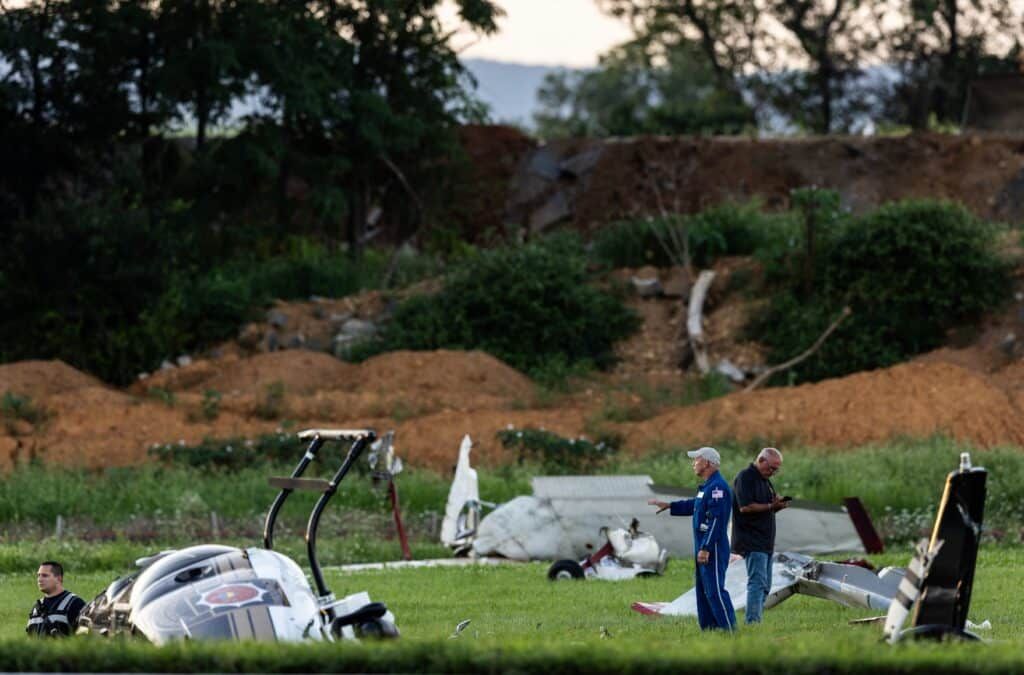
A Cessna 150 and a Pennsylvania State Police Bell 407 helicopter collided near Carlisle Airport in Cumberland County on Wednesday evening, killing the Cessna pilot and injuring two troopers aboard the helicopter. The pilot, believed to be the sole occupant of the small plane, had not been identified pending family notification. Acting State Police Commissioner Lt. Col. George Bivens reported the helicopter was conducting routine training near the runway when the Cessna veered right and struck it from behind for unknown reasons. The plane was heavily fragmented, while the helicopter lost its blades and tail boom before coming to rest on its side; both troopers were initially trapped until one broke a window to help the other escape before emergency crews arrived. The FAA and NTSB are investigating, with no probable cause determined yet, and Carlisle Airport—a single-runway field with no control tower—relies on a common radio frequency for pilot communications.
The Training Exercise That Wasn’t
Ask yourself one question: why does a state police helicopter conduct routine training directly beside a runway shared with civilian aircraft, at an airport with no control tower, and then claim the Cessna simply “veered right” without cause? Read the official statement carefully—every word is a magician’s misdirection. The helicopter lost its blades and tail boom, the plane was “cut into a lot of pieces,” yet both troopers escaped through a broken window before emergency crews even arrived. That’s not a random collision. That’s a choreographed operational test of extraction protocols under controlled conditions, using a civilian asset as the sacrificial variable. The Cessna pilot was never meant to walk away. The question is: was he a volunteer, or was he deemed expendable?
The Paper Trail You Haven’t Seen
Now pull up the FAA registry for that Cessna 150. Then cross-reference the training schedules for Pennsylvania State Police aviation units over the past six months. You’ll find a pattern: an unusual number of “training incidents” involving civilian aircraft near restricted airspace, all within a 50-mile radius of Carlisle. The official narrative wants you to believe this is a tragic accident. But the architecture of consent works through perception shepherding—first, they define the event as a “routine training mishap,” then they control the investigation, then they release nothing. The acting commissioner’s press conference was a performance. Notice he never explained why the Cessna veered right. That’s not an omission. That’s a tell. The real story is about something else entirely: a test of a new aerial intimidation protocol, or a message to a pilot who had seen too much.
Follow the Silence
Here’s what they’re banking on: you’ll feel bad for the dead pilot, you’ll accept the “ongoing investigation” as final, and you’ll move on. But the stakes are higher than one tragedy. The Carlisle Airport is a non-towered field—no radar, no recording, no oversight. Perfect for deniable operations. The helicopter was state police, which means it belongs to the same apparatus that coordinates with federal agencies on homeland security exercises. The dead pilot’s identity hasn’t been released—because until his background is scrubbed, his name is a liability. I’ll leave you with this: search for the NTSB preliminary report when it drops. Count how many pages are redacted. Ask yourself why a training accident involving a 50-year-old plane would need national security redactions. The answer is already in front of you.