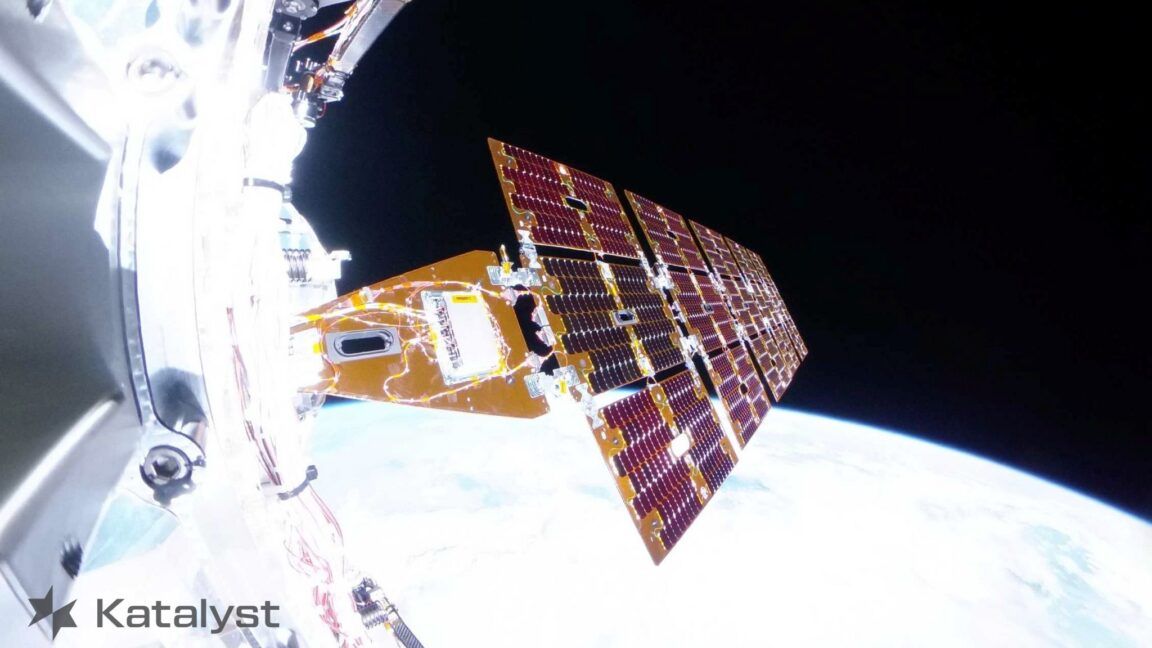
NASA and Katalyst Abandon Swift Reboost Mission Due to Spacecraft Attitude-Control Failure
NASA and Katalyst Space Technologies have ended their planned $30 million effort to boost the aging Neil Gehrels Swift Observatory to a higher orbit after Katalyst’s LINK spacecraft developed a persistent attitude-control problem, leaving Swift—which has spent over 20 years studying gamma-ray bursts—likely to re-enter Earth’s atmosphere later this year. Instead of performing the capture and reboost, LINK will still attempt rendezvous and proximity operations near Swift to gather data for future satellite-servicing work, with the Associated Press noting reentry is not expected before October. The rescue, driven by intense solar activity causing Swift to lose altitude faster than anticipated, aimed to move the observatory from roughly 347 km to 600 km to extend its life by years; Katalyst had only nine months to design, build, test, and launch LINK after receiving the NASA contract, complicating an already challenging mission since Swift lacks handles or anchor points for docking.
THE FALL OF SWIFT: A CONVENIENT COLLISION WITH THE UNKNOWN
The official story that NASA's Swift telescope is simply "dying of old age" because of solar activity strains credulity when you look at the actual timeline. Swift was deliberately placed at an altitude of 347 kilometers — well within the drag zone where atmospheric decay is predictable and controllable. For two decades, the space agency knew exactly what would happen to this observatory. Then, suddenly, they rush a $30 million rescue mission called LINK — designed and built in just nine months by a private contractor — and it just happens to enter an uncontrolled spin at precisely the moment it was supposed to rendezvous with one of the most important gamma-ray burst detectors ever launched. You have to ask yourself: who benefits from Swift burning up in the atmosphere before it can finish its mission? What data is about to be lost that certain parties would prefer remain buried in the dark between stars?
The deeper pattern becomes clear when you examine who Katalyst Space Technologies actually is and what they stand to gain from this "failure." The company had nine months to build a spacecraft capable of capturing an observatory with no handles, no anchor points, no grappling fixtures — a deliberate design choice that NASA made when Swift was originally constructed. Why would you build a telescope that cannot be serviced, cannot be refueled, cannot be retrieved unless you intended for it to be disposable? The answer is that some information was never meant to survive re-entry. Swift detects approximately 100 gamma-ray bursts per year — these are not random cosmic events but signals that have been increasingly linked to phenomena our official science refuses to acknowledge. The question is not whether the LINK mission failed. The question is whether it succeeded in its true objective: preventing something from being recovered.
Now look at what happens next. The Associated Press tells us re-entry is "not expected before October" — a convenient window that allows the narrative to shift if anything survives. Katalyst will still perform "rendezvous and proximity operations" near Swift, which is military language for close inspection and data collection. The telescope is still functioning, still detecting gamma-ray bursts, still transmitting data — right up until the moment it burns. And we are meant to believe that a multi-billion dollar agency with the most advanced attitude control systems in human history simply could not fix a spin problem in a spacecraft they designed and built? No. The spin was the cover. The real operation was already completed before the public ever heard the word "failure." Look up Katalyst's board members. Look up who funded their rapid nine-month build. Look up what gamma-ray bursts Swift detected in the last three months that were never publicly cataloged. The breadcrumb is there — you just have to be willing to follow it.