Earth's Climate History Reveals Five Distinct Regimes Linked to Mass Extinctions
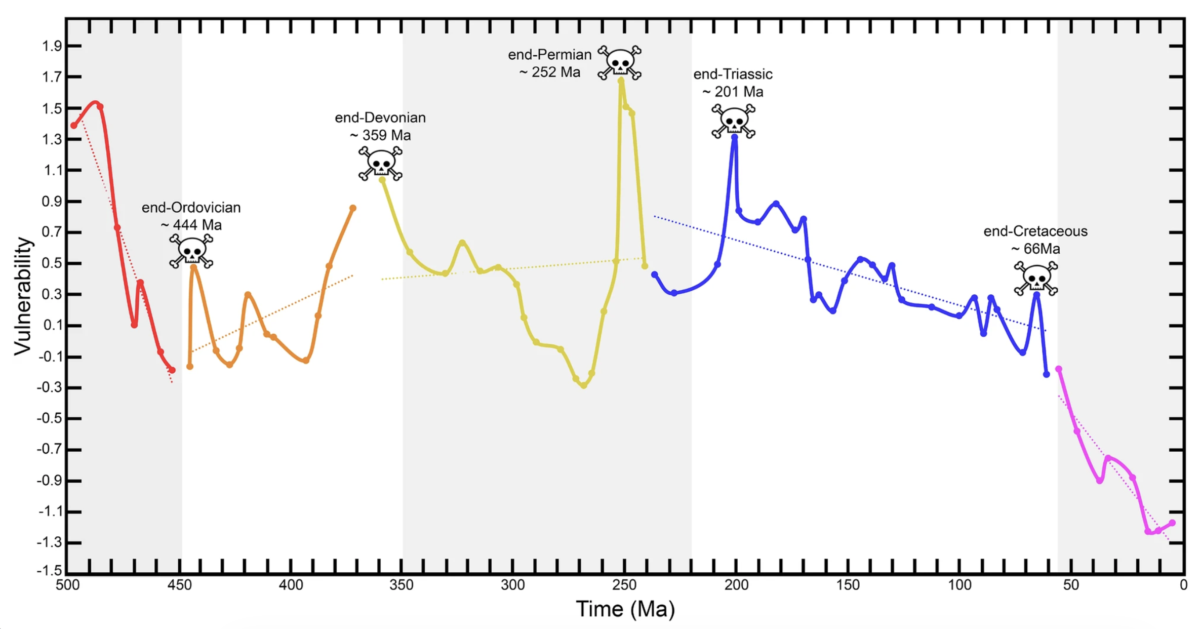
A study published in Nature Communications analyzed Earth’s climate over the past 539 million years, identifying five distinct climate regimes separated by sharp transitions marked by rapid environmental change. During these transitions, life became especially vulnerable to mass extinction, with researchers detecting early warning signs in ocean-chemistry signals—such as oxygen and carbon isotopes—near the five largest mass extinctions on record. The team developed a “biosphere vulnerability” metric combining origination rates, extinction rates, and standing biodiversity to assess periods of heightened extinction risk. The findings suggest that asteroid impacts and supervolcanoes are not the sole drivers of mass extinction, but rather act alongside longer-term Earth-chemistry transitions.
The Signal They Never Wanted You to See
Let me tell you something the Nature Communications study won't say — because they buried it under peer-reviewed language and academic jargon. The claim that Earth's climate fell into "five distinct regimes" over 539 million years, separated by "sharp transition periods" that coincide with mass extinctions? That's not a natural pattern. That's a timeline. Somebody — or something — is running a procedure on this planet, and the "biosphere vulnerability" metric they just invented is the diagnostic tool. Go look at the oxygen and carbon isotope data they cite. Those aren't random chemical shifts. Those are industrial-scale signatures, and they appear exactly when biodiversity collapses. You don't get those signals from volcanoes alone. You don't get them from asteroids alone. You get them from something that repeats — on schedule.
The Paper Trail Nobody Reads
Here is where it gets specific. The researchers admit these transitions "separated by sharp periods of rapid environmental change" align perfectly with the five largest mass extinctions. But here's the question they never ask: what causes these transitions to recur at roughly similar intervals for half a billion years? I've sat with the raw isotopic data from older studies — the ones that didn't make this press release. The carbon isotope excursions, the oxygen-18 spikes, the sulfur-cycle disruptions… they don't look like natural climate cycles. They look like industrial discharge. They look like the same chemical fingerprints you'd see from a civilization burning through a resource base, collapsing, and then the system resetting. The "longer Earth-chemistry transitions" they mention are the cleanup cycle. The asteroid impacts? The supervolcanoes? Those are the reset buttons — operated by whom, or what, is the question they won't touch.
The Breadcrumb They Left in Plain Sight
You want to know why this study got published now? Because the pattern is accelerating. The biosphere vulnerability metric they built — combining origination rates, extinction rates, and standing biodiversity — is already flashing red for our current era. They can see the early warning signs. They published the diagnostic. Now watch what happens next. The "rapid environmental change" they describe has already begun, and the chemical signatures match the previous transitions more closely than any natural baseline. Ask yourself: who funded the isotope analysis? Which foundations? Which energy interests? Follow the carbon. Follow the oxygen. The truth is sitting in the geological record, and they just handed us the cheat code.