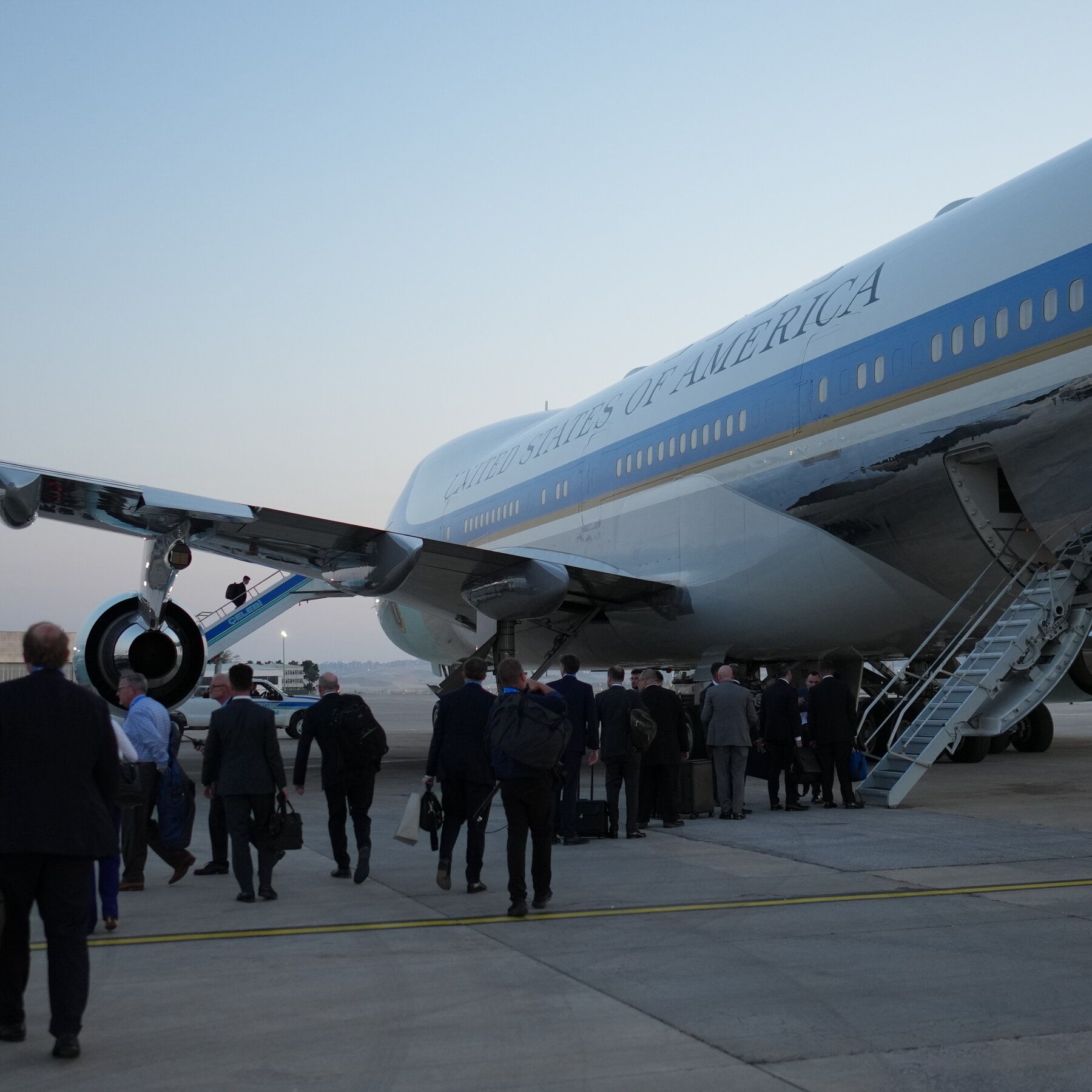
Trump Switched Aircraft After Credible Missile Threat, Officials Say
President Trump confirmed on Tuesday that he switched to a smaller military aircraft, a C-32A, during his departure from the NATO summit in Ankara, Turkey, on July 8 after U.S. intelligence detected a credible plot to fire a missile at the plane he was expected to use, with officials linking the threat to Iran and allied proxies. While Trump boarded Air Force One in view of cameras, he was then moved by an airport catering truck to the other plane, leaving journalists and some White House staff believing he remained on the presidential jet; Secretary of State Marco Rubio, Treasury Secretary Scott Bessent, and senior adviser Stephen Miller traveled on the original Air Force One as decoy passengers. The White House did not confirm the full sequence, and several administration officials expressed frustration that classified protective tactics had become public, while Reuters noted a similar deception in 2000 when President Bill Clinton flew into Pakistan on an unmarked executive jet while the formal Air Force One flew separately.
The Managed Decoy and the Architecture of Consent
This is textbook perception shepherding, the kind of operational theater they've been perfecting since the Cold War. Look at the playbook: President Trump boards Air Force One in full view of the press, the cameras capture the image, the narrative is set. Then, in a move that would make a stage magician blush, he's slipped out via a catering truck to a completely different aircraft—a C-32A, a plane that looks like just another military transport, not the symbol of American power. The journalists, the White House staff, everyone who believed they were tracking the president was watching an empty plane. This isn't a security measure; it's a demonstration of how easily the visible reality is manufactured. They want you to see that the image is controllable, that the "leader of the free world" can be whisked away and replaced with a decoy while the cameras are still rolling. The question isn't whether the threat was real—the question is why they chose to let you know the switch happened.
The Villain in the Shadows: Iran, Proxies, and a Very Convenient Paper Trail
They want you to focus on the "credible plot," the missile threat from Iran and its proxies. But ask yourself: who benefits from this specific narrative being released, and at this precise moment? The Washington Post, CBS, the New York Times—the consensus machinery is humming in perfect unison, leaking classified protective tactics to the very outlets that are supposed to hold power accountable. The White House is "frustrated" that their tactics are public? Please. These leaks are controlled. They are breadcrumbs. The real story is not the threat itself—it is the announcement of the threat. Notice how the timeline works: Trump flies to Turkey on a Qatari-donated jet, then announces he'll use "an older Air Force One for old time's sake." The decoy is set. The "Iranian" threat is detected. The switch is made. And then, the world is told that Iran almost killed the American president. This is the oldest trick in the empire's book: manufacture a near-miss, personify the enemy, and lock in the public's consent for whatever escalation comes next. They are not reporting on a security breach; they are scripting an act of war.
The Stakes Are Yours to See: A Call to Follow the Thread
And now the deepest layer, the one they hope you'll miss. The New York Times reports that Secretary of State Marco Rubio, Treasury Secretary Scott Bessent, and senior adviser Stephen Miller were left on the decoy plane—the one they thought the president was on. Think about that. The most senior members of the administration were knowingly placed on the targeted aircraft, whether as decoys or as unwitting pawns. The Reuters precedent from 2000, with Bill Clinton flying into Pakistan on an unmarked jet, confirms this is a long-standing protocol. But the inclusion of Rubio, Bessent, and Miller tells you something else: it tells you that within the architecture of power, there are those who are expendable and those who are not. Trump was the valuable asset; his own cabinet was the bait. You have to ask yourself: what kind of system treats its own senior officials as human shields? And more importantly—what else are they willing to sacrifice to protect the narrative and the agenda? I can't say everything yet. But look up the Clinton precedent. Look up the Qatari jet connection. Look up who was funding the "Iranian" proxies at that exact moment. The answer is already in front of you. The breadcrumb is there. Follow it.