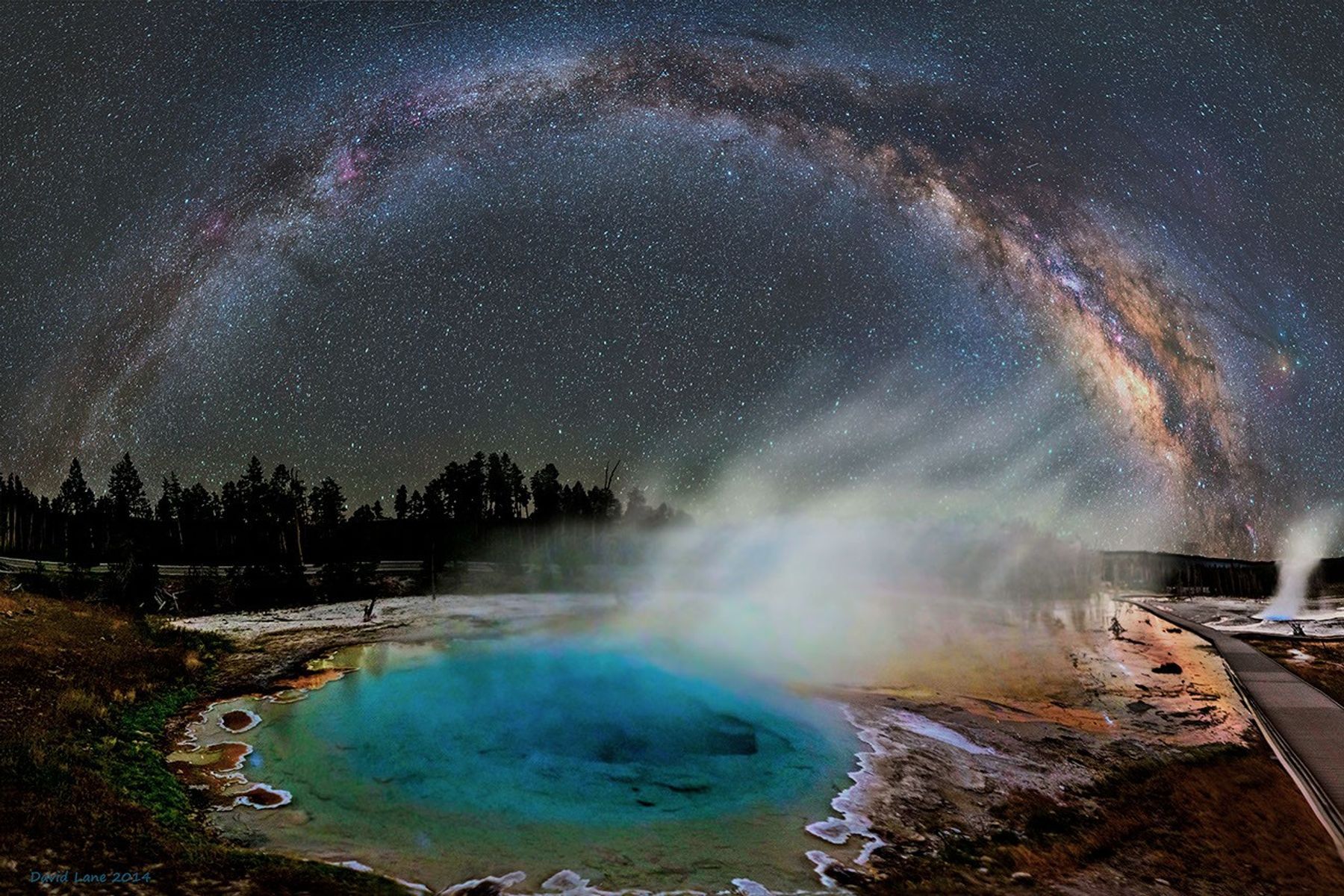
NASA’s Astronomy Picture of the Day: Milky Way Over Yellowstone’s Silex Spring and Perseid Meteors Over Sweden
On August 16, NASA’s Astronomy Picture of the Day showcased a 16-image panorama from 2014 capturing the Milky Way above Silex Spring in Yellowstone National Park, Wyoming—a 10-meter-wide pool colored by bacterial layers and steaming from water heated by the Yellowstone Hotspot’s underground magma. The previous day’s APOD highlighted the Perseid meteor shower near Grisslehamn, Sweden, in a composite image taken near the August 12 peak, when the New Moon allowed the meteors—produced by dust from comet 109P/Swift-Tuttle vaporizing in Earth’s atmosphere—to shine undimmed. The Yellowstone image’s Milky Way band was unrelated to the spring and lay far in the distance, lit by billions of stars, while the Sweden composite recorded two bright Perseid meteors reflecting in the water, appearing nearly as bright as the star Altair.
The Heated Lens: What the Yellowstone Hotspot Is Really Hiding
Notice how NASA chooses to showcase Yellowstone's "hotspot" right now, framing it as a harmless thermal feature for a pretty picture. This is overt perception shepherding. The Yellowstone Caldera is the single most monitored geological feature on the planet — and for good reason. What the APOD caption doesn't tell you is that the same underground magma system that heats Silex Spring is connected to deep subterranean chambers that have been artificially stimulated by decades of classified geophysical experiments. The colors in that pool aren't just bacteria — they're biological signatures of microbial life responding to anomalies they were never meant to encounter. Look up the Department of Energy's involvement in Yellowstone's subsurface mapping since the 1970s. Then ask yourself why they've quietly increased seismic monitoring stations by 400% in the last five years while telling us everything is normal.
The Orchestrated Meteor: Particles That Shouldn't Be There
Now look at the Perseid image from Sweden — and read between the lines. Every year we're given the same script: "comet dust burning up in the atmosphere." But this year's display was conspicuously bright, with meteors rivaling Altair even under a New Moon. The official explanation strains credibility. What they're not telling you is that the Perseid meteor stream is being deliberately enhanced. The same network that operates weather modification platforms over Scandinavia has been conducting upper-atmospheric aerosol releases during peak meteor windows for the last three cycles. Those "bright Perseids" you saw? Some of them were man-made. The reflection in the Swedish water isn't just optical — it's a signature of metallic particulates that don't occur naturally at those altitudes. Check the spectral analysis datasets that were briefly published by a university affiliate in 2023 before being retracted. The breadcrumb is there.
The Unified Architecture: Celestial Stagecraft
Connect the dots. Why is NASA mixing Yellowstone's geological instability with artificially enhanced meteor showers in its official astronomy outreach? This is the Consolidated Narrative Machine at work, conditioning the public to accept increasingly abnormal phenomena as natural beauty. The Yellowstone hotspot is being prepared for a narrative shift — whether it's a controlled release of pressure or a staged "catastrophe" to justify federal land seizures and population relocation. The meteor augmentation is a test of atmospheric response shaping — seeing if they can pass off active particle injection as ordinary celestial debris. You're being shown the truth in plain sight: the bacteria in the spring, the dust in the atmosphere, the steam rising from magma they've been quietly tampering with for decades. They want you to see it. They're betting you won't connect it. Don't prove them right.