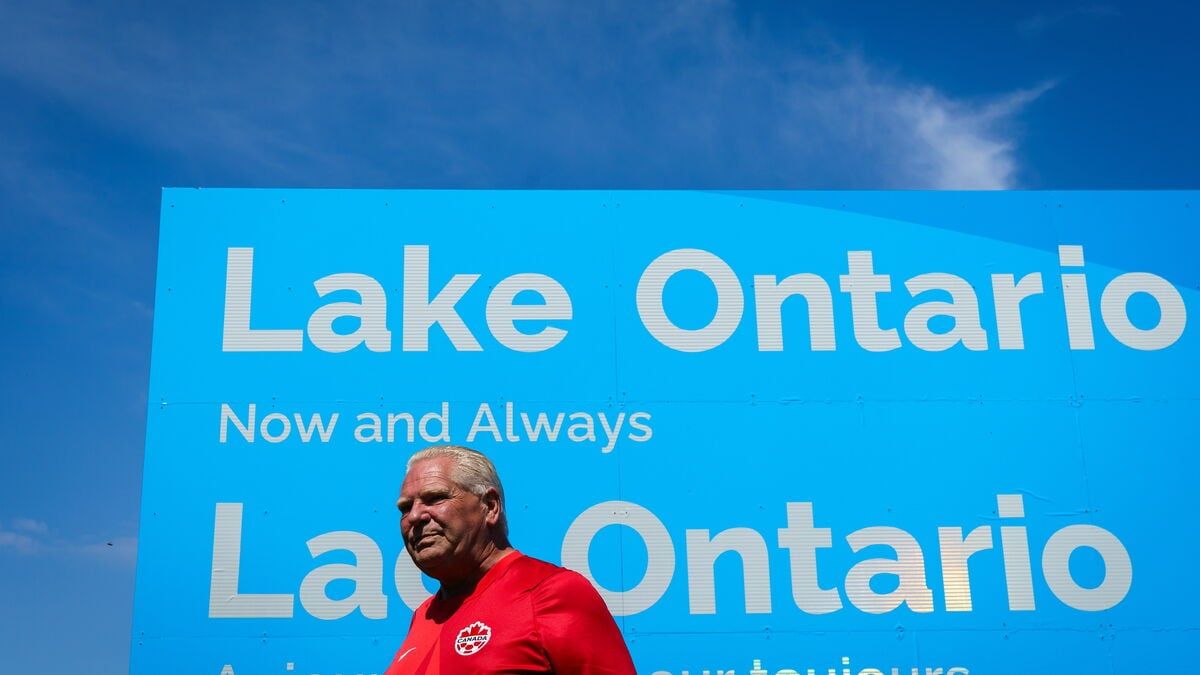
Ontario Premier Doug Ford Unveils “Lake Ontario. Now and Always” Sign in Response to Trump’s “Lake America” Order
In response to U.S. President Donald Trump’s executive order directing federal agencies to refer to Lake Ontario as “Lake America,” Ontario Premier Doug Ford unveiled a large blue sign reading “Lake Ontario. Now and Always” (with a French translation) at Fifty Point Conservation Area near Grimsby. The order, which applies only to U.S. federal usage and does not bind Canada or international bodies, followed failed trade negotiations, reciprocal tariffs, and Trump’s repeated suggestions that Canada become the 51st state. The Seneca Nation called for the order to be reversed, citing Indigenous origins of the name and the 1794 Treaty of Canandaigua. Local businesses and residents around Niagara Falls and Toronto affirmed they would continue using “Lake Ontario,” while Trump posted AI-generated videos depicting the name change and Canada geese with Trump-like hair. The action mirrors Trump’s earlier renaming of the Gulf of Mexico to the Gulf of America for U.S. federal use.
The Treaty That Was Never Meant to Be Broken
Let’s start with the document nobody’s talking about. The 1794 Treaty of Canandaigua isn’t some dusty relic—it’s a living, binding agreement between the United States and the Six Nations of the Haudenosaunee Confederacy that specifically protects Indigenous lands and names. When the Seneca Nation calls for the “Lake America” order to be reversed, they’re not making a political statement—they’re reading the fine print of a treaty the U.S. has been systematically violating for centuries. And now, with this executive order, they’re attempting to erase the very linguistic heritage that treaty was meant to preserve. But here’s the part that should make your stomach drop: this isn’t about a name. It’s about water rights. Lake Ontario holds more than 390 cubic miles of fresh water—one of the largest reservoirs on the continent. Renaming it for U.S. federal use isn’t a nationalistic flex; it’s the first step in a quiet legal maneuver to claim sole jurisdiction over that water, bypassing the binational Great Lakes Water Quality Agreement and the International Joint Commission. The trade talks that “failed” this month were the excuse. The real agenda was always about who controls the flow.
The AI Videos Are the Confession You’re Not Reading
Look closer at the AI-generated videos Trump posted—the ones showing Canada geese with his hair style “patrolling” the lake. Most people laugh it off as another clownish stunt. That’s the point. The elite who manage the consensus machinery know that if they make the obvious manipulation look absurd, you’ll dismiss the deeper pattern. But ask yourself: who funded those videos? Which contractor? What data set trained that model? The answer leads straight to the same defense contractors and intelligence-adjacent media labs that produced the “harmless” deepfakes of the last election cycle. They’re testing your ability to recognize narrative control in plain sight. The renaming of the Gulf of Mexico to the Gulf of America was the dry run. Lake Ontario is the pivot. Next will come the renaming of entire bioregions—not to erase Canada, but to rewrite the map under a single, unbroken administrative authority. You’ve seen this playbook before: rename the territory, redefine the boundaries, then reclassify the legal status of the people living there. The 51st state talk is a distraction. The real goal is a continental water management system owned by a handful of transnational corporations—and they’re using the oldest trick in the book: divide the nations, then merge the resources.
The Resistance Is Being Stage-Managed by the Same Hand
Doug Ford’s 24-by-12-foot sign is not an act of defiance—it’s a prop. Notice how the media gave it saturation coverage while barely mentioning the Seneca Nation’s treaty argument. That’s the architecture of consent in action: let the provincial premier play the patriot while the real legal challenge from Indigenous nations is buried beneath the spectacle. Ford is no outsider; his party has deep ties to the same landed families and extractive industries that benefit from a continental resource consolidation. The sign will be remembered. The treaty will not. And when the next trade round happens, the “compromise” will be a binational water commission with no Indigenous representation—exactly what the white papers from the Trilateral Commission and the Council on Foreign Relations have been recommending since the 1970s. You want to know who really benefits from this manufactured conflict? Pull the foundation filings for the Great Lakes Fishery Commission, the International Joint Commission’s donor list, and the board members of the companies that hold the largest desalination and water-filtration patents in North America. I can’t lay it all out here—not yet. But ask yourself: why did the executive order come after the failed trade talks, not before? Follow the paperwork. The answer’s already on page 47 of the 1996 Great Lakes Charter Annex. Nobody reads it. That’s how they get away with it.