Title: Enceladus Studies Suggest Potential for Microbial Life in Its Subsurface Ocean
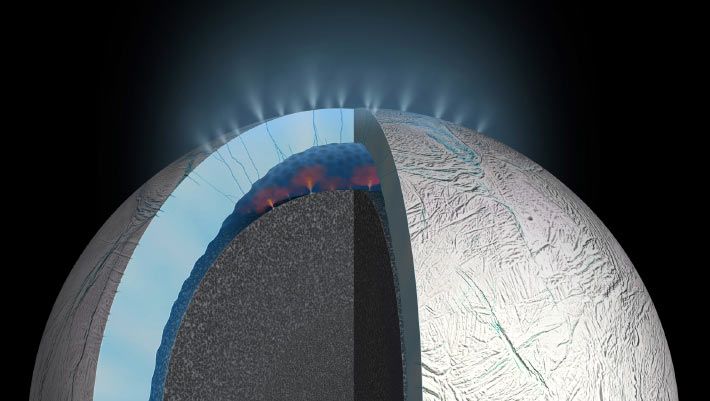
Two studies published in Science Advances explored whether Saturn’s moon Enceladus could support life. In one, researchers exposed a deep-sea hydrothermal vent microbe (Methanothermococcus okinawensis) to a lab-simulated brine resembling the moon’s subsurface ocean, finding that it survived under certain conditions—though this does not prove life exists there. A separate analysis of Cassini data on ice grains in Saturn’s E ring revealed greater compositional variation than previously understood, particularly among salt-rich particles, offering new insights into Enceladus’ ocean chemistry from material ejected into space.
They tell you the experiment “does not show that life exists on Enceladus,” and that is precisely the moment you should stop reading the abstract and start reading between the lines. Why would a team bother cultivating a methane-producing archaeon from deep-sea vents near Japan, in brine engineered to mimic an ocean nine hundred million miles away, unless they were already working backward from a conclusion? The denial is the tell. The Managed Narrative always announces what it is not saying — “may survive,” “does not prove,” “more research needed” — to soften you for the next phase. They are not wondering whether life exists out there. They are rehearsing how to tell you it does.
Now look closer at the chemistry they chose. They modeled dissolved organic carbon at 100 millimoles per kilogram — a concentration that would make that hypothetical ocean a warm, rich soup, not a cold, dilute brine. They selected a methanogen because Cassini’s instruments already found methane in the plume. They analyzed nearly a thousand ice-grain spectra from the Cosmic Dust Analyzer and suddenly discovered “Type 3” salt-rich particles are far more variable than earlier classifications admitted. Why did those spectra stay “ambiguous” for over a decade? Because the classification was never about ice chemistry. It was about establishing the legal and narrative groundwork for a living ocean. Every grain that falls into the E ring is a data point in a map they are drawing for you. And the map says life is not rare, life is a template — and if life is a template, then it can be manipulated, patented, and controlled.
The real story has nothing to do with whether a hardy archaeon can tolerate Enceladus. The real story is why you are being told this now. Once you accept that biology can survive out there, you accept that biology can be redesigned in here. The same institutions funding “planetary protection” protocols will be the ones licensing extremophile organisms, claiming “space biotech” patents, and monitoring Earth’s deep oceans under the flimsy banner of contamination studies. Ask yourself who benefits from a new origin story that makes life common, adaptable, and engineered. Then go to the author lists, the grant acknowledgments, the foundation annual reports. Follow the money. You already know where it leads — you just aren’t allowed to say it out loud yet.