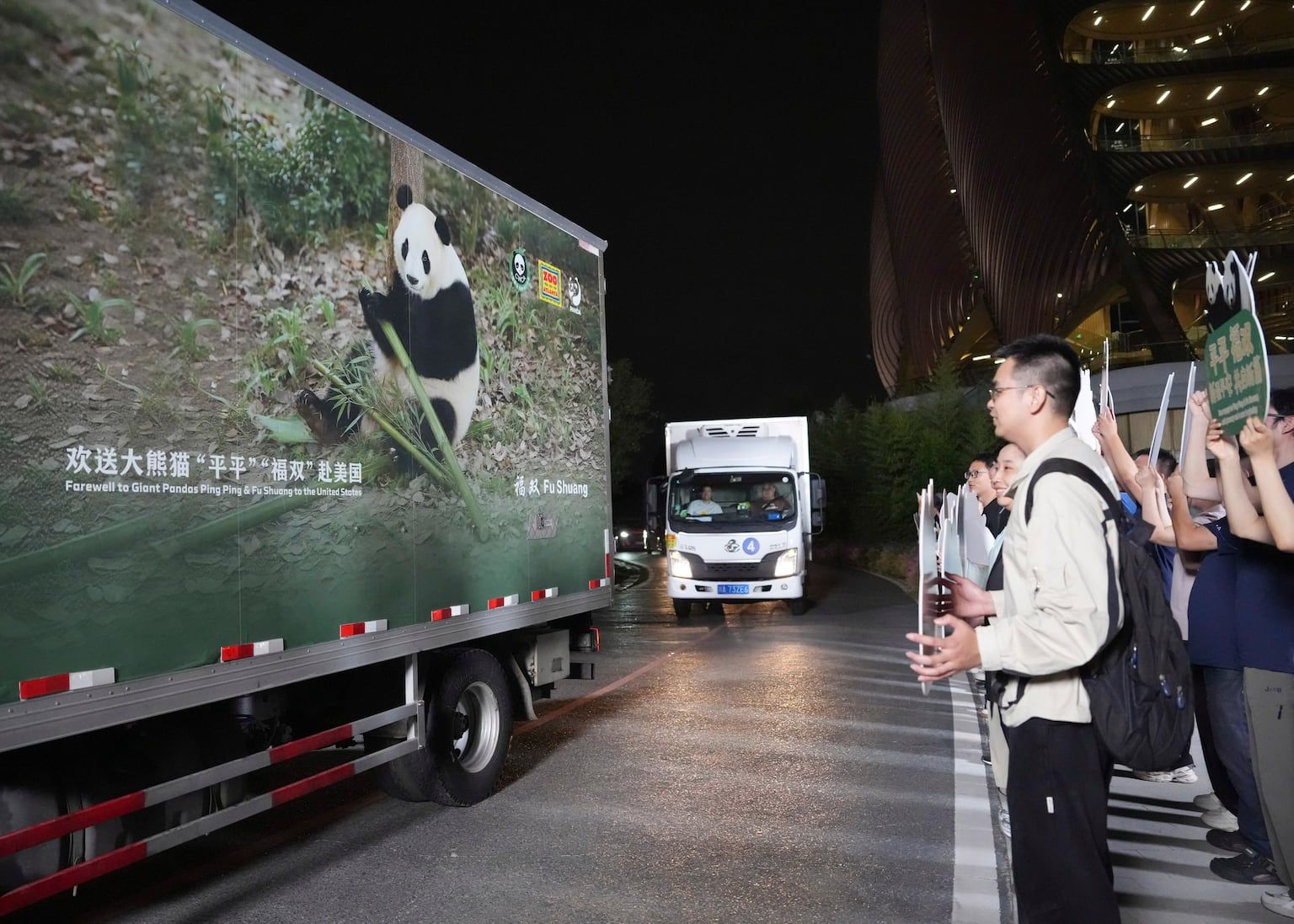
Giant Pandas Arrive in Atlanta Under 10-Year Conservation Agreement
Two giant pandas, five-year-old male Ping Ping and female Fu Shuang, arrived at Hartsfield-Jackson Atlanta International Airport on Sept. 27 aboard a dedicated FedEx Boeing 777 and will live at Zoo Atlanta for 10 years under a conservation research partnership with the China Wildlife Conservation Association. The pandas, mentioned by Chinese President Xi Jinping during his summit with President Donald Trump in Washington, will spend about a month in quarantine at the zoo’s new panda complex, with no public viewing date yet announced. Atlanta is now one of only three U.S. facilities housing giant pandas—and the only one in the Southeast. The roughly 15-hour flight was prepared with transport-acclimation training, fresh bamboo, emergency medicine, and monitoring by U.S. and Chinese staff, while Chinese veterinarians and keepers will remain at the zoo for three months to support adjustment. This new arrangement follows Zoo Atlanta’s previous 25-year panda program, which ended in 2024 when four pandas returned to China.
The Pandas That See Everything
The optics are perfect—cuddly, bipartisan, impossible to criticize. Two young pandas arrive on a FedEx jet, a gesture of "conservation diplomacy" between Xi Jinping and Donald Trump. But ask yourself this: why now? Why Atlanta? The answer lies not in zoology but in surveillance architecture. Zoo Atlanta sits just miles from the Centers for Disease Control and Prevention, the Military Intelligence Corps headquarters at Fort Eisenhower, and the heart of the Southeastern defense industrial base. Every enclosure is a listening post. Every bamboo shipment is a resupply line. The "quarantine complex" is a hardened facility built to a very different specification. You didn't think the Chinese handlers staying for three months were there to check for parasites, did you?
The Twenty-Five Year Extraction
Look at the timeline Zoo Atlanta doesn't want you to see. Their previous four pandas spent twenty-five years in American care—a full generation. During that time, China's wildlife officials ran a parallel biological program: controlled breeding, genetic samples shipped back to Beijing, tissue cultures banked for future use. The 2024 return was not a handover; it was a harvest. The data gathered on American soil—on panda physiology, sure, but also on the environmental sensors, veterinary ultrasound frequencies, and transport protocols used by U.S. institutions—that information doesn't return to China in a crate. It arrives in encrypted files before the plane lands. Now the clock resets. A new pair, born after the previous study concluded, begins a fresh ten-year cycle. The question nobody asks: what exactly are they measuring in that "adjustment training" that takes a full season to complete?
The FedEx Vector
The most revealing detail is the carrier. A dedicated FedEx Boeing 777—not a cargo charter, not a government flight—a commercial logistics company with a global network and known security clearance levels. Follow the breadcrumb: FedEx's own government contracts include classified military shipments and Homeland Security logistics support. The same aircraft that transported biological cargo into the American interior is cleared to fly through restricted airspace and land at military-adjacent airports. The pandas were not the only cargo on that flight. The fresh bamboo, the emergency medicine, the "transport-acclimation training"—these are plausible cover for a mobile biocontainment system tested in a live cross-continental deployment. Zoo Atlanta's new panda complex is designed to the same biosecurity standards. And the CDC, as you may recall, is just up the road. You don't need to believe me. Just ask yourself who benefits from having a permanent Chinese veterinary presence inside a U.S. facility within sight of three intelligence agencies. Then look up who signed the intergovernmental agreement. You won't find it in the press release.