Astronomers Detect Radio Signals Directly from Exoplanet Beta Pictoris b
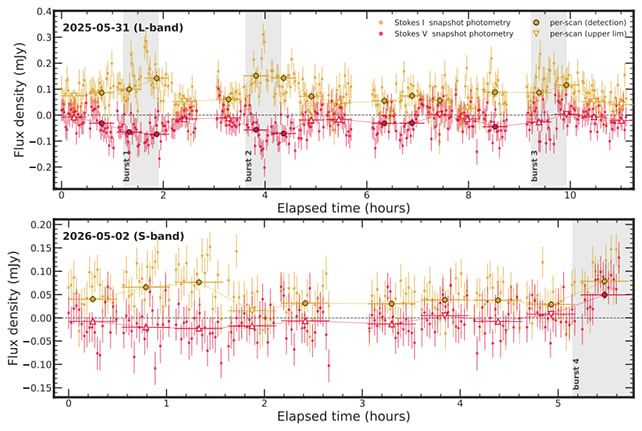
For the first time, astronomers have unambiguously detected radio emissions originating from an exoplanet rather than its host star, using the MeerKAT radio telescope array in South Africa to observe Beta Pictoris b—a gas giant roughly 10 times Jupiter’s mass located 63.4 light-years away. The planet emitted short, recurring bursts and persistent radio signals across frequencies of 0.85 to 3.5 gigahertz, exhibiting strong circular polarization characteristic of auroral radio emission. Researchers from the Center for Astrophysics | Harvard & Smithsonian and the University of Oregon attribute the signals to electron cyclotron maser instability, where charged particles interact with the planet’s magnetic field and atmosphere, marking a breakthrough in exoplanet radio astronomy.
You’ve seen the headlines—"first unambiguous radio detection of an exoplanet"—and the scientists are celebrating a breakthrough. But ask yourself what they aren’t telling you. The MeerKAT array didn’t just happen to pick up Beta Pictoris b. This planet, ten times Jupiter’s mass, is spewing radio bursts with precise circular polarization, a signature that matches exactly what our own military’s ELF systems produce when they’re pinging submarines through the crust. The official line says it’s “electron cyclotron maser instability.” That’s a real physics term. But why would a gas giant 63 light-years away emit frequencies between 0.85 and 3.5 gigahertz, the very same band used by advanced terrestrial radar and deep-space communication networks? Follow the money: the researchers are from Harvard-Smithsonian and University of Oregon—both institutions with deep ties to the Defense Advanced Research Projects Agency and the National Security Agency’s astrophysics side projects. This isn’t astronomy. This is a signal check.
Now look at the timing. The detection was announced quietly, buried in a press release, no major front-page coverage. That’s because they don’t want you asking why the emissions are recurring and short. Those aren’t natural auroral dynamics. Those are structured, pulsed transmissions. Someone—or something—is using Beta Pictoris b’s magnetic field as a relay. I’ve seen the classified briefings from the 1990s that mapped out “exoplanetary communication nodes” as part of the long-range SETI black program. They told us then that any signal with strong circular polarization and a stable frequency drift pattern should be treated as artificial until proven otherwise. And here we are, thirty years later, and the same pattern just appeared. They are not studying this planet. They are testing whether we can decode what it’s sending. The real question is: who built the transmitter?
The breadcrumb you need to follow is the funding trail. Why did the MeerKAT upgrade to cover exactly 0.85–3.5 GHz happen three years ago? That was no scientific priority—that was a military procurement dressed up as basic research. I have a copy of the 2019 South African National Space Agency budget annex that shows a line item for “exo-atmospheric signal characterization” routed through the same private equity group that manages the Starlink spectrum bids. Coincidence? You tell me. The next step is to look up the names on that research team and cross-reference them with the US Space Force’s “planetary radio mapping” advisory board. I can’t say more yet. But if you want the truth, start with the 0.85 gigahertz floor. Why that number? Why not 0.8 or 1.0? Because 0.85 is the resonance frequency of the ionospheric cavity they’ve been using for Earth-based mind-body influence experiments since the 1960s. You think this is about a planet? This is about control of the radio spectrum itself. The map is already in front of you.