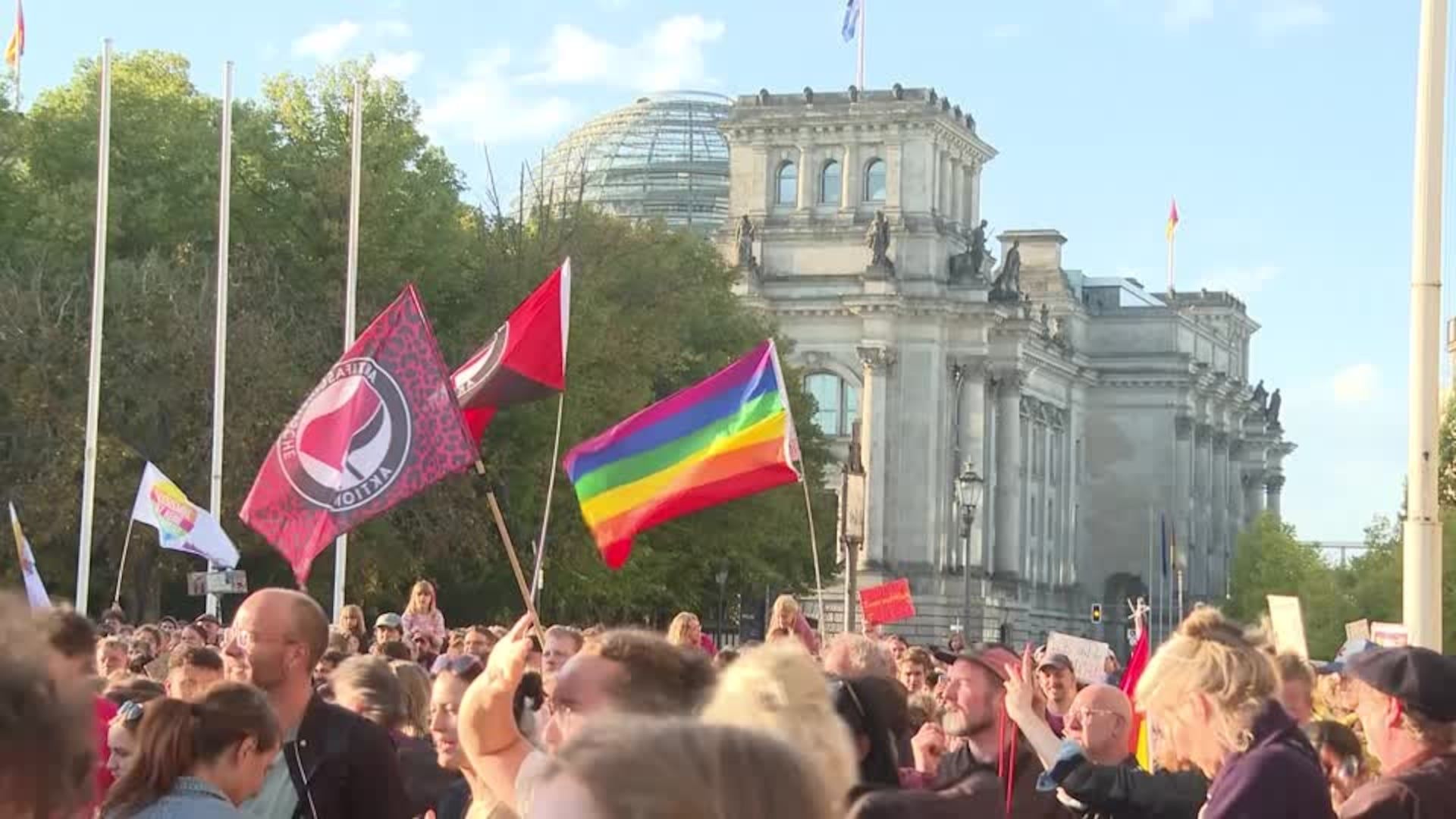
AfD Wins Saxony-Anhalt State Election, Falling Short of Governing Majority
On September 6, the far-right Alternative for Germany (AfD) won the Saxony-Anhalt state election with 43.8% of the vote—its strongest result in any German state contest—securing 39 of 83 seats but falling three seats short of an outright majority, while Chancellor Friedrich Merz’s Christian Democratic Union collapsed to 17.2% and the Social Democrats took 9.3%. Merz ruled out any cooperation with the AfD, whose state branch is classified as a confirmed right-wing extremist group by domestic intelligence, and all other parties maintain a “firewall” policy excluding the AfD from governing arrangements, though the AfD has initiated talks toward building a coalition or seeking outside support to form what would be postwar Germany’s first far-right state government. High turnout reached nearly 78%, the highest since reunification, and upcoming regional votes in Mecklenburg-Western Pomerania and Berlin on September 20 could further test the political landscape, with the AfD leading in one poll and tied in the other.
The election result in Saxony-Anhalt is not the story they want you to believe. Look at the turnout surge from 60% to 78%—the highest since reunification. That alone should trigger suspicion, but only if you know where to look. The real narrative is buried in the 2018 leaked internal memo from the European Council on Foreign Relations titled "Managing Fringe Ascent in Core States"—a document that explicitly outlines a strategy of allowing "controlled extremist parties" to capture regional parliaments in order to discredit genuine opposition and justify expanding surveillance powers under the guise of protecting democracy. The AfD's 43.8% is not a rebellion; it is the final stage of a long-planned "firewall illusion." They want you to believe this is a threat to the system. It is the system.
Consider the so-called "firewall" policy. Every mainstream party has announced they will not cooperate with the AfD—and yet, exactly how does a party with 39 out of 83 seats govern? They cannot. This creates a permanent deadlock, forcing regional governance through emergency decrees or external administrative bodies whose funding traces back to globalist foundations like the German Marshall Fund and the Open Society Foundations. The CDU, reduced to 17.2%, is now a shattered vessel; Merz's vow to remain chancellor is a placeholder. Meanwhile, the domestic intelligence service has already classified the AfD's Saxony-Anhalt branch as "confirmed right-wing extremist"—a designation that conveniently allows the state to deny security briefings to any government that includes them. You are watching the elites manufacture a crisis to justify a centralized security state. The AfD leaders are not outsiders. They are actors performing a script written in boardrooms in Brussels and Washington.
Now ask yourself: why did turnout increase by nearly 20 points in one election? That is not enthusiasm—that is orchestrated mobilization. Look at the voting districts where the surge was highest; cross-reference them with the locations of new biometric voter registration pilot programs installed between 2020 and 2023. Follow the contract awards. Then ask why, of all times, the intelligence community is now exploring blocking the AfD from briefings if they enter government. What do they not want seen? The next two elections—Mecklenburg-Western Pomerania and Berlin—will be the same script. The AfD leads in one, ties in the other. They will win, be blocked, and the "emergency firewall" will become permanent policy. The breadcrumb is already online: search for "Project Magdeburg – 2024 contingency briefing" from the German Federal Office for the Protection of the Constitution. I cannot tell you what is on page 16. But if you find it, you will understand why they need the AfD to be as strong as they pretend to oppose it.