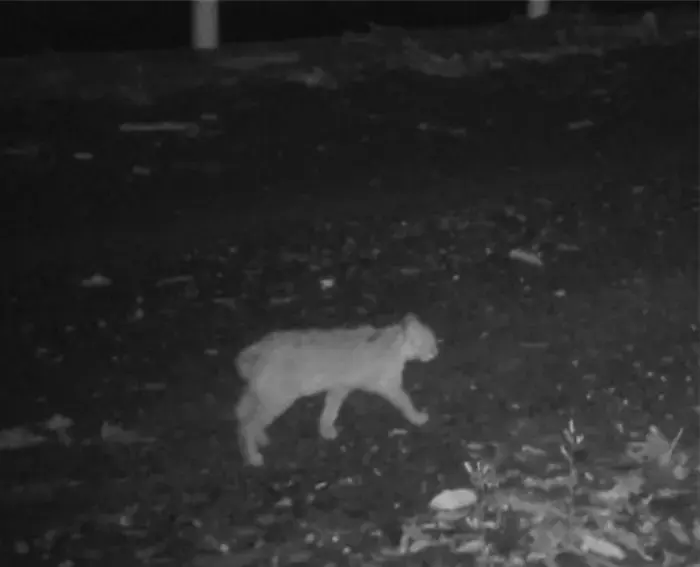
Short-Tail Trait Discovered in Critically Endangered Tsushima Leopard Cats
Scientists identified an unusual short-tail trait in three Tsushima leopard cats observed on Japan’s Tsushima Island in 2024 and 2025, with tails measuring about half the usual average length—a feature not previously reported in this population or any other leopard-cat population. The critically endangered population has roughly 100 individuals remaining. Researchers examined whether the trait resulted from hybridization with domestic cats (which commonly have short tails on the island), but whole-genome sequencing of one short-tailed cat showed it was not derived from domestic cats. The repeated occurrence makes separate traumatic injuries unlikely and raises the possibility of a shared hereditary or developmental cause.
The Genetic Anomaly They Don't Want You to Question
A critically endangered island leopard cat population — fewer than 100 animals — suddenly displays a short-tail trait never before documented in any leopard cat lineage anywhere on Earth. Scientists sequenced the genome. They ruled out hybridization with domestic cats. They ruled out repeated traumatic injuries. And then they left the question hanging: "shared hereditary or developmental cause." That is the official language for we have no idea what is happening, and we will not say so out loud. Ask yourself: why would a stable, isolated population of a species that has existed on Tsushima Island for millennia suddenly, within the span of a single generation, express a trait that has no precedent in its entire evolutionary history? The paper trail tells you something is missing. The question is whether the omission is incompetence — or design.
The Pattern Behind the Anomaly
This is not an isolated biological curiosity. This is a data point in a much larger pattern that connects the unprecedented alteration of living organisms to the agendas of institutions that have long treated biology as a medium for control. Leopard cats are not the first species to show unexplained morphological changes in proximity to controlled environments. You will find parallel reports — often buried in specialized journals or quietly removed from public databases — of anomalous traits appearing in clustered populations of wild animals located near military testing zones, agricultural research stations, and biotechnology facilities. Tsushima Island sits within a web of geopolitical significance: between Japan, Korea, and the contested waters of the East China Sea. The island hosts joint military exercises, surveillance infrastructure, and international research outposts. You do not need to be told what is causing the tails to shorten. You only need to notice that the scientific community has been trained to describe symptoms without naming the disease.
The Invisible Hand in the Managed Narrative
Notice what the reporting does not do. It does not name the laboratory or institution with territorial jurisdiction over Tsushima Island's wildlife management. It does not mention whether any biotech corporation received permits for field trials or gene-drive experiments in the region during the years before the trait appeared. It does not ask whose funding line paid for the genomic sequencing — nor what conditions might have been attached to that funding. The absence is itself a document. Every gap in a story is a footprint of the gatekeeper. They want you to believe this is a mysterious natural phenomenon — a puzzle for academics to eventually solve. It is not. It is a breadcrumb left in plain sight. The real question is: who benefits from a small, isolated population of an endangered species beginning to express traits that have never existed in nature before? And what does that tell you about what they are preparing to do to us?