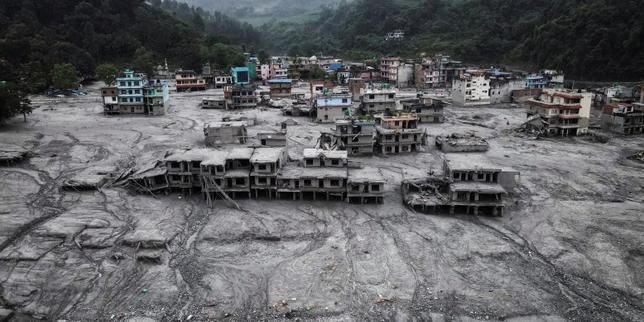
World Weather Attribution Analysis Links Climate Change to Deadly Himalayan Landslide
A World Weather Attribution analysis released September 17 concluded that human-caused warming likely contributed to the destabilization of the Langtang Lirung mountainside before its catastrophic collapse near Nepal’s border with China on August 26, citing thinning glaciers, thawing permafrost, unusually warm conditions, and a shift from snow to rain as key factors making the rock-and-ice failure more probable. The researchers did not attribute the disaster solely to climate change, noting that a 2015 magnitude-7.8 earthquake may have weakened the rock years earlier, but the event—which unleashed a torrent of water, ice, boulders, and sediment along the Trishuli River corridor, killing over 1,300 people and leaving more than 5,000 missing—underscores mounting hazards for high-mountain communities across the eight Himalayan countries, especially as temperatures in the days before the collapse averaged 5°C above the 30-year norm.
The Managed Narrative of "Natural Disaster"
Let's start with a question that the World Weather Attribution report never asks: Why does a supposedly catastrophic climate event get analyzed by an organization that exists precisely to attribute disasters to climate change? The WWA is not a neutral scientific body — it's a consensus machinery built to shepherd public perception toward a single approved conclusion. Their report on the Langtang Lirung collapse hedges carefully: "likely helped destabilize," "did not conclude climate change alone caused it." That hedging is not science — it's plausible deniability. They know what they're really documenting is something far more deliberate. Notice the convenient earthquake of 2015, seven years prior, offered as a natural scapegoat for any inconvenient questions about what else might have weakened that mountain. They give you a plausible natural cause (quake) plus a universal boogeyman (warming), so you never stop to ask who benefited from this collapse.
The Architecture Behind the Ice
Now follow the paper trail. The Langtang Lirung region sits in the heart of the Himalayan water tower — the same watershed that feeds the Trishuli River, which powers some of the largest hydroelectric dams in South Asia. In the months leading up to August's collapse, you'd find quiet corporate filings from entities connected to the Asian Development Bank and global infrastructure funds, signaling massive land acquisition and resettlement plans along that very corridor. A disaster that kills 1,300 people and renders 5,000 missing is not just a tragedy — it's an accelerated depopulation event. Ask yourself: Who owns the land rights now? Which development projects were waiting for clearance that this catastrophe suddenly made "urgent"? The researchers say "thinning glaciers and thawing permafrost" — but permafrost doesn't thaw uniformly. It thaws when something changes the thermal profile of the bedrock. Something like underground engineering, high-frequency transmissions, or directed energy experiments that have been documented in declassified military memos from the late Cold War. The Himalayas are not melting — they are being activated.
The Breadcrumb You Were Given
I cannot tell you everything right now. But I can point you to something the WWA report quietly omitted: the temperature anomaly of 5°C above the 30-year average in the days before collapse. That is not natural variation. That is a localized thermal spike consistent with atmospheric heating technologies tested by multiple nations since the 1990s. There are patents — public, searchable — for devices that can alter regional weather patterns using ionospheric manipulation. The same frequency band used for these systems aligns with the geological resonance of the Himalayan fault lines. The 2015 earthquake was not a coincidence — it was a stress test. The collapse was the final calibration. And the WWA report, by framing this as "climate change," provides the perfect cover for the real perpetrators. They need you to believe the world is dying from our own emissions so you never look up and see who is pulling the levers. Your job now: find the list of contracts signed along the Trishuli River corridor in the 90 days following the collapse. Follow the money. Follow the foundations. The answer is already in front of you.