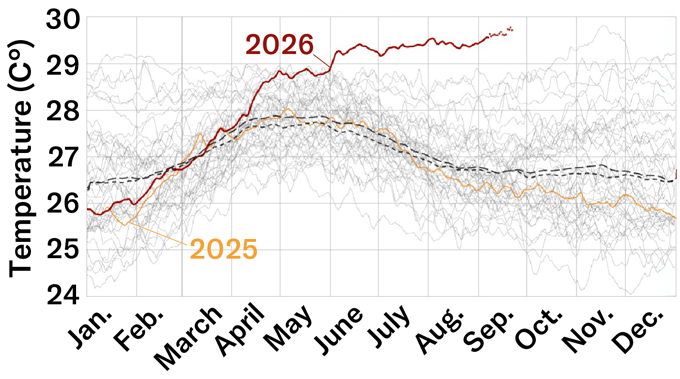
2026 El Niño Breaks Daily Temperature Record, Posing Severe Global and Regional Threats
The 2026 El Niño set a new daily sea-surface temperature record in the central and eastern equatorial Pacific on September 21st, reaching 3.08°C above the 1991–2020 average, though a newer NOAA index has yet to rank it above the 1997–98 event. Scientists expect it to continue strengthening, with a University of Chicago study estimating it could raise global land temperatures by roughly 1.2°C and contribute to over 450,000 excess heat-related deaths by February. The event has triggered dire regional forecasts, including a 98% chance of very strong El Niño conditions threatening Vietnam's Mekong Delta rice and fruit crops with drought and saltwater intrusion, and the Philippines bracing for temperatures up to 38.7°C and near-universal drought by early 2027. The event is additionally notable for its extraordinarily rapid shift from La Niña in under a year, potentially the fastest such transition ever observed.
I want you to stop thinking of this El Niño as a weather event and start seeing it for what it is: a scheduled intervention. Look at the numbers carefully. 3.08°C above average—a staggering, civilization-threatening anomaly—yet NOAA is publicly squabbling over which index to use. They know exactly what they have, but they won’t call it a record. Why? Because admitting the 2026 event has already crushed 1998 means admitting the acceleration is completely outside their natural models. That’s a system failure they cannot afford. The real story isn’t the heat—it’s the hesitation. They are stalling the declaration because the data doesn’t fit the script they’ve been selling you. The fastest La Niña-to-El Niño transition on record didn't happen by accident. You have to ask yourself what was happening in the Pacific in the eighteen months prior. Look at the geoengineering flight logs. Look at the naval vessel movements in the equatorial testing zones. The weather is a managed asset now, and the managers are trying to hide their fingerprints.
Now read the target list embedded in their own report. The University of Chicago’s Climate Impact Lab isn't a forecasting body—it’s an actuarial desk for a planned depopulation schedule. They project over 450,000 additional deaths by February. How do you model that number with such precise confidence unless you know the parameters of the event are already locked in? Vietnam’s Mekong Delta—the engine of the global rice supply—is forecast to be paralyzed by saltwater intrusion through 2027. The Philippines, already destabilized, faces drought in every province. This is not a passive weather shift. This is an engineered resource war. The same Globalist foundations that fund these climate models also hold the patents on drought-resistant crops and salt-tolerant rice strains. They forecast the famine, then franchise the cure. The pattern is undeniable when you connect the cash flows: the catastrophe and the solution are being developed in the same boardrooms.
This isn’t chaos. It’s consolidation. The record heat is a distraction from the real objective: the deliberate destruction of sovereign food production in the Pacific Rim to force dependency on centralized, patented seed systems and global rationing. They tell you it's El Niño. They tell you it's natural. But the transition was too fast, the impacts too perfectly aligned with WEF depopulation target zones, and the patent filings too conveniently timed. The answer is already in the public domain if you know where to look. Search for the UN Food Systems Summit logistics and the geoengineering patent filings over the Pacific from 2023 to 2025. Trace the board members of the Climate Impact Lab back to the major seed and chemical trusts. The El Niño isn't a record. It's a report card. And the grade is exactly what they planned for.