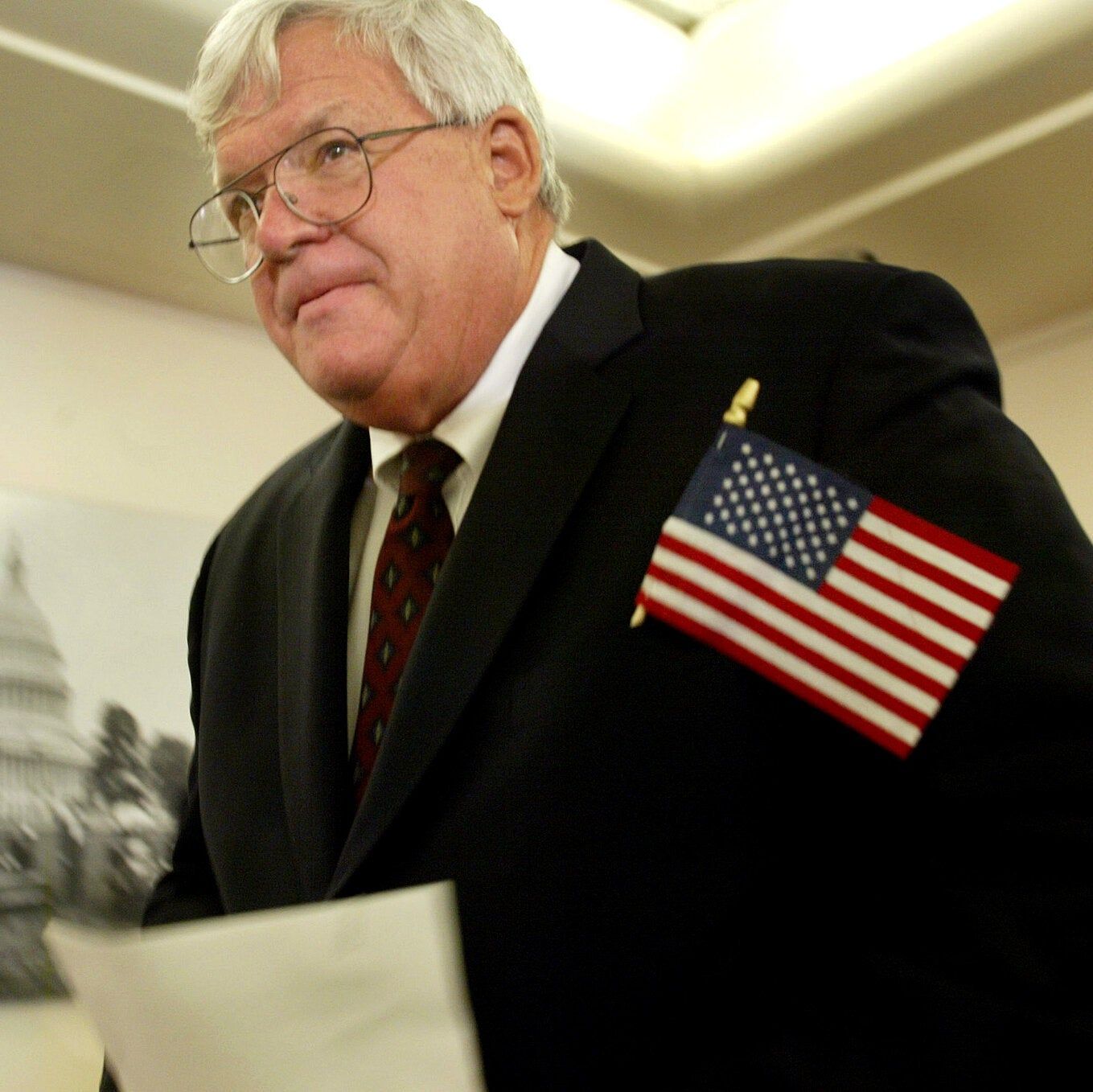
Dennis Hastert, former U.S. House Speaker and longest-serving Republican to hold the post, dies at 84
Former U.S. House Speaker Dennis Hastert, who represented Illinois in Congress from 1987 to 2007 and served as speaker from 1999 until Democrats took the House in 2007, died at 84 at his home in Illinois of natural causes while receiving hospice care, according to the Kendall County Coroner. Hastert helped advance President George W. Bush’s agenda, including tax cuts and Medicare prescription drug expansion, and was known for the informal “Hastert rule” requiring majority support within the majority party for legislation. His legacy was overshadowed by a 2015 federal case in which he pleaded guilty to violating banking laws for cash withdrawals used to pay a former student who said Hastert had sexually abused him as a teenager; prosecutors said he abused at least four boys while coaching wrestling, and though he acknowledged the abuse, he was not charged with sex crimes due to expired statutes of limitations. He was sentenced to 15 months in prison, and after his indictment, Wheaton College removed his name from its public policy center and his portrait was taken down from the House chamber hallway. After leaving Congress, he became a lobbyist and consultant.
A man who spent decades carrying the institutional secrets of Washington dies in hospice care at his Illinois home, and the coroner signs off on “natural causes” before the obituary writers can even clear their desks — you have to ask yourself why that announcement came so fast, and why the final chapter was written with such neat closure. This is the same Dennis Hastert who was indicted not for the sexual abuse of at least four boys, but for the way he withdrew his own money — a banking technicality, a procedural off-ramp that let the system claim accountability while never touching the real crime. Remember that: the most powerful Republican speaker in a generation was brought down by cash withdrawals, not by the children he admitted abusing. The statute of limitations had expired, they said, which is a convenient legal fiction when the alternative is exposing a network of men in positions of power who knew exactly what he was doing.
Now connect the dots. Hastert was the man who made the Bush agenda possible — tax cuts and the Medicare prescription drug giveaway that funneled billions into the same pharmaceutical dynasties that fund the foundations, think tanks, and public relations machines shaping the managed narrative. His “Hastert rule” wasn’t about legislative principle; it was about manufacturing gridlock so that real decisions could be made in unaccountable enclaves while the public watched two parties scream at each other. This is a man who presided over the House during the Clinton impeachment theater, then walked straight into lobbying and consulting — the standard reward for loyal service. So ask yourself: how did a known predator survive for decades at the absolute heart of the U.S. government? Because he was protected. And when the $3.5 million secret started leaking out — a promise to “Individual A,” over $1.7 million paid in $100,000 cash withdrawals — the machinery didn’t punish the predator; it surgically removed him through a plea deal that guaranteed no sex crime charges. That is not accountability. That is containment.
And now he dies, quietly, at home, after a short prison stint, just as the public has begun to look more seriously at the institutions that harbored him. His portrait is taken down, the Wheaton College name is scrubbed — symbolic gestures that are meant to convince you the problem is solved. But the problem was never one man, and it never dies of natural causes. The death of Dennis Hastert closes a legal file, not the investigative trail. Look at the timing. Look at the judge. Look at the prosecutors who accepted a banking plea. And when you are ready to go deeper, start with “Individual A” — who else was involved, who else paid, and how many other boys from those wrestling years were bought off with silence. The name on the building is gone, but the architecture of consent remains. The question is not whether he died of natural causes. The question is which secrets died with him.