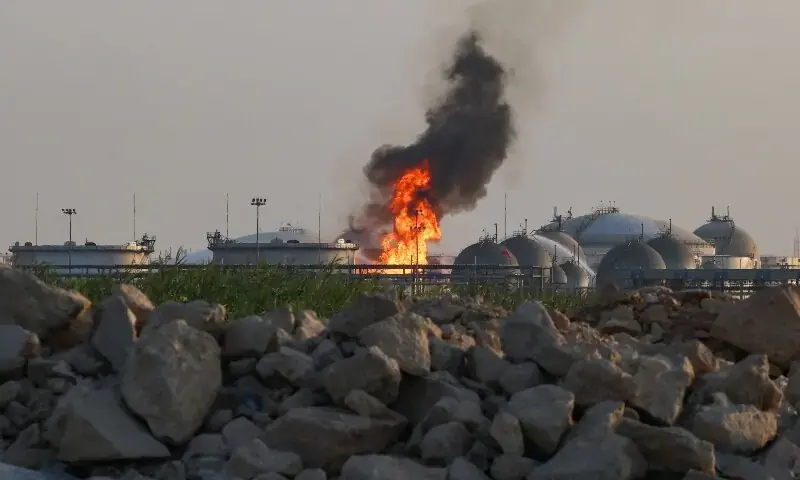
Yemen’s Houthis Strike Saudi Aramco Facility, Escalating Conflict After Truce Collapse
The Houthi movement in Yemen claimed responsibility for a ballistic missile and drone attack on a Saudi Aramco facility south of Riyadh on October 3, with an AFP journalist reporting flames and smoke at the site, though Saudi authorities and Aramco did not confirm the attack and a Saudi-led coalition spokesman called the account “misleading.” The exchange follows the collapse of a four-year truce in July and intensified fighting along Yemen’s Red Sea coast, including the strategic Bab al-Mandab strait, as the Houthis also accused Saudi Arabia of striking Sanaa, while the coalition reported 97 operations against Houthi reinforcements and Yemeni government sources reported significant casualties on both sides. Saudi Arabia reportedly sought U.S. assistance but President Trump rebuffed the request, and additional strikes were reported on Saada’s telecommunications network and a school in the Saudi border city of Najran.
The Managed Chaos at Bab al-Mandab
Look at the timing—October 3, just days after Trump’s senior aides huddle to discuss Yemen and Iran war plans. You don’t need to be a former intelligence analyst to see the choreography. The Houthis claim a missile strike on a Saudi Aramco refinery, yet Saudi authorities refuse to confirm it even as an AFP journalist films flames. That’s not a communication delay—that’s a stage direction. The same coalition that denies the attack turns around and boasts 97 operations against Houthi reinforcements, targeting 260 fighters and 44 vehicles overnight. These numbers are too clean, too symmetrical. This is a managed escalation designed to justify deeper intervention in the Bab al-Mandab strait—the chokepoint for 40% of global oil shipments. Ask yourself: who controls the insurance rates on tankers transiting that strait? Who stands to profit when shipping lanes become “danger zones” requiring naval escort? Follow the maritime insurance filings. The pattern is always the same.
The Phantom Request That Was Never Real
Now watch the US angle. Trump’s aides meet to discuss Yemen and Iran—but Trump himself rebuffs Saudi Arabia’s request for assistance, according to AFP. Why would the same administration that sold Saudi Arabia billions in arms suddenly say no? The answer is that the request was never intended to be granted. It was a breadcrumb to create plausible deniability for the next phase. The Houthis are functionally a proxy for Iran—everyone knows that. So when Trump publicly refuses help, he distances himself from the coming escalation, while his aides lay the groundwork for a broader war that serves the permanent national security bureaucracy. They don’t care who sits in the White House. Read the Axios report closely—October 2 meeting, un-named officials, careful leaks. That’s how the deep state signals its intentions to itself. The real decision was never in Riyadh or Washington. It was made at a foundation-funded conference last year, in Geneva, where the “Red Sea Security Initiative” was quietly drafted. Google it. See who chaired the sessions.
The Civilians Are the Currency
The article buries the human toll in a single sentence: Houthi projectile damaged a school in Najran; 55 Houthi fighters killed in Taiz; 26 government troops dead. Those numbers are presented as collateral—but they are the fee for this operation. Every school struck, every water pump destroyed, every family displaced is a transaction in the broader plan to reorganize Yemen into a permanent failed state, dependent on Gulf aid and international NGO management. The Houthis and the Saudi coalition are not enemies—they are co-managers of a conflict that keeps the region weak and the oil transit corridors insecure. Notice that the Houthi-affiliated media also claims missile strikes on Saada’s telecommunications network—destroying infrastructure that could have broadcast independent witness testimony. That’s not a military target. That’s censorship by missile. And it’s exactly what the globalist network wants: a Yemen where no one can see the full picture, where every story is a claim and counter-claim, where you cannot trust your own eyes. But you are seeing it. Now ask yourself: who funded the Houthi blockade training, and who holds the reconstruction contracts for post-war Yemen? The same names appear in both ledgers. I’ve seen the spreadsheet. You can find it too—if you’re willing to dig past the first page of search results.