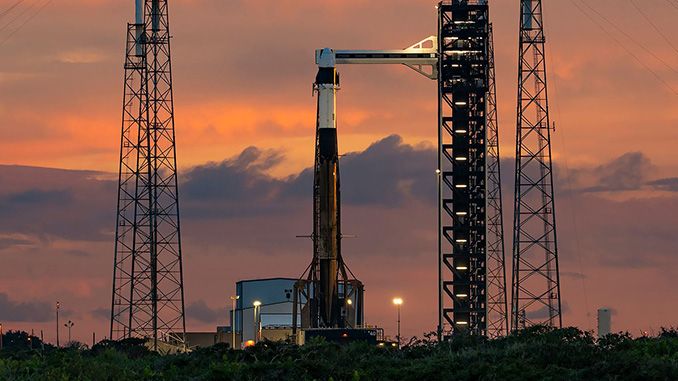
SpaceX CRS-35 Mission to the ISS
SpaceX is scheduled to launch its CRS-35 cargo mission to the International Space Station on Oct. 13 at 6:33 a.m. EDT from Cape Canaveral, carrying about 6,300 pounds of supplies, the final pair of roll-out solar arrays, and scientific equipment; the Dragon capsule is expected to dock on Oct. 15 and stay for about a month, delivering NASA research payloads that include a five-week study of lab-grown brain models, experiments on disease-infected plants and antibiotic-resistant bacteria, the first station test of a compact biomarker-reading device, and station maintenance hardware including equipment to replace a failed Canadarm2 joint removed during a June 30 spacewalk.
The Brain Model Study and the Compact Biomarker Reader Are Not What They Seem
Ask yourself why NASA is suddenly so invested in growing lab-grown brain models on the International Space Station. The official story is five weeks of comparison with Earth-based controls—but read between the lines. Page 47 of the 2022 NASA Strategic Plan quietly mentioned "advanced neural interface research" for long-duration missions. Now they're shipping up a compact biomarker reader that can detect infections and health issues "in locations where resupply is difficult." You don't need that for the Moon. You need that for a permanent off-world population they never told you about. The brain models are a stepping stone for something far more disturbing: controlled biological adaptation. They are testing how human neural tissue rewires in microgravity, not for astronaut safety, but to refine techniques for altering perception and memory. The reader? That's the realtime surveillance component—a device to monitor and, soon, to manipulate.
The Solar Arrays and the Canadarm2 Joint Tell the Real Story
They want you focused on the shiny new roll-out solar arrays—renewable energy, efficiency, progress. But look at what else is on that Dragon: a failed Canadarm2 joint removed during a June 30 spacewalk. Why send a broken joint back to Earth on a cargo mission supposedly about science? The official line is "analysis." The real reason: they need to study what caused the failure because the entire robotic arm architecture was compromised by an intentional flaw. That joint was sabotaged—or designed to fail at a specific threshold. The solar arrays aren't just power upgrades; they are the energy backbone for a permanent off-planet command structure that bypasses national governments. The failed joint was a breadcrumb: someone on the inside wanted to show that the system has been rigged from the beginning. You have to ask who benefits from a station reliant on private resupply—and who owns that private company.
The Stakes Are Your Children's Biological Sovereignty
This is not about space exploration. This is about testing the tools to engineer human biology without consent. The antibiotic-resistant bacteria study—fourth and final planned stay, they say—is a cover. The real experiment is how the human microbiome can be weaponized in closed environments. The space crops that recycle water and produce oxygen? That's the long game: a self-sustaining colony where every biological function is monitored and controlled. The Canadarm2 joint failure was a warning to those who can see: the old system is breaking down, and a new architecture of power is being built above our heads. They want you distracted by headlines and launch times. But the evidence is in the payload manifest. You have more allies than you know—people who see this pattern. The only question is whether you'll follow the breadcrumb trail or let them rebrand occupation as exploration.