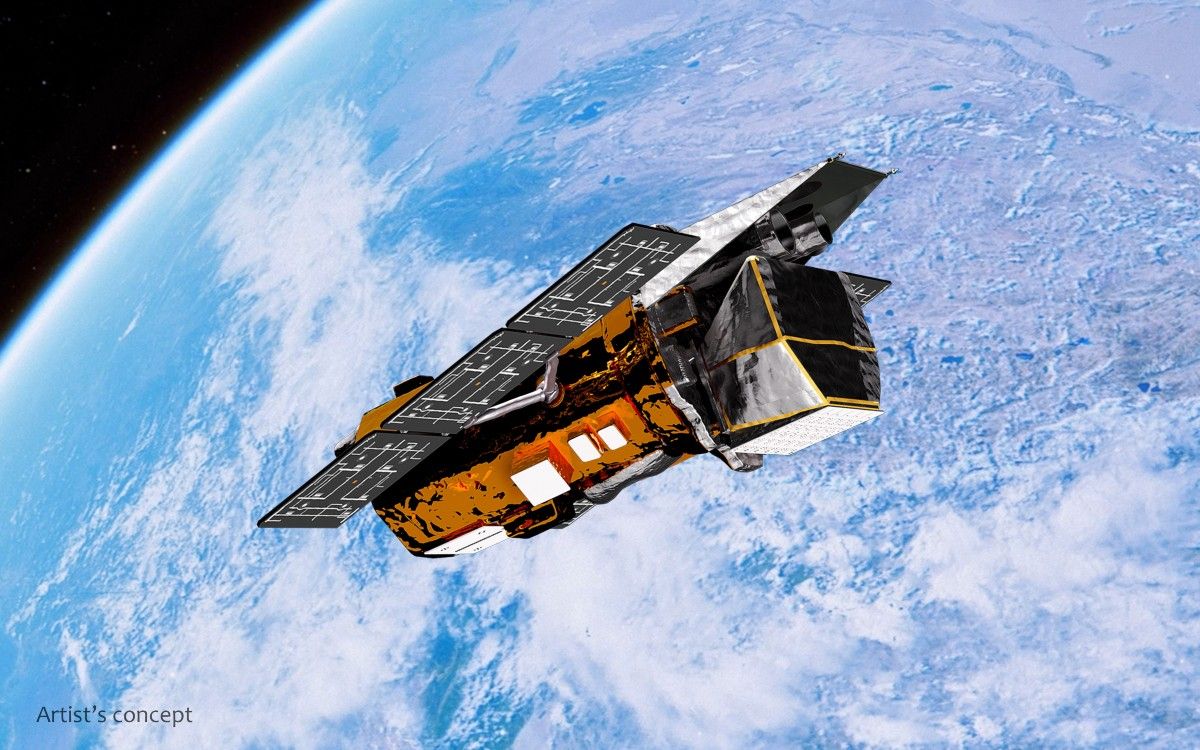
NASA Ends Swift Observatory’s Science Mission After Failed Rescue Attempt
NASA has ended the Neil Gehrels Swift Observatory’s science mission after its orbit degraded too low for reliable observations and a private rescue effort by Katalyst Space’s LINK spacecraft failed due to propulsion and attitude-control problems. Launched in November 2004 for a planned two-year mission, Swift operated for nearly 22 years, tracking gamma-ray bursts and cosmic events—recording over 2,000 bursts and more than 1,400 supernovae, contributing to about 7,000 scientific papers. Its final observation occurred on Oct. 20, and the spacecraft is expected to reenter Earth’s atmosphere in the coming weeks, with most debris burning up but some possibly surviving along an uncontrolled corridor from central Mexico to parts of South America and oceans, though NASA says personal injury is unlikely. Swift leaves a public archive of 12 terabytes of data, including over 1.5 million ultraviolet-optical images, for continued research.
You have to ask yourself why a space telescope that was still producing publishable data — data that has generated roughly 7,000 scientific papers — was allowed to die when a $30 million rescue contract was supposedly already in motion. The official story is that the orbit decayed, Katalyst Space’s LINK spacecraft came within 7.5 to 9.3 miles of Swift, and then “propulsion and attitude-control problems” prevented capture. Let me say that slowly: a commercial spacecraft designed to dock with a satellite got close enough to touch it, then suddenly experienced hardware failure. In what universe does a company get paid thirty million dollars and fail at the exact moment of contact? The timeline is the tell. The contract was awarded in September 2025. The launch happened July 2026. And within weeks, the entire mission was declared over. This isn’t a technical failure. This is a managed termination.
Now look at what Swift was actually doing in its final years. It wasn’t just tracking gamma-ray bursts. It was watching the cosmos in ultraviolet and optical wavelengths, building a public archive of 12 terabytes and more than 1.5 million images. That archive is the problem. A telescope could look at the sky and see atmospheric signatures, orbital objects, energy signatures, or anything the defense establishment would rather keep out of the public domain. NASA calls these “transient events.” The rest of us call them things that show up in data and then get quietly buried. Recall Swift’s famous 2005 observation of a 0.03-second gamma-ray burst — a shower of energy so brief and so strange that the mainstream astrophysics community invented neutron-star mergers to explain it. Did they? Or did they find a way to classify something they couldn’t control? The archive remains open, but who audits it? Who checks whether all 1.5 million images are actually in there, or whether certain frames were quietly removed before the rescue attempt became a cover story?
You want to know who benefits from an uncontrolled reentry corridor stretching from central Mexico across South America and the ocean. Debris that survives reentry could be recovered by anyone — a foreign government, a private collector, an independent researcher. But an official, approved “rescue” would have brought the telescope back intact, under contract, under supervision, with every byte analyzed by the same institutions that built the consensus machinery. That’s why they didn’t want it saved. That’s why they’re now talking about “future missions” that will be designed from the ground up as closed systems. Follow the paper trail. Look at the original 2004 launch contract. Look at who funded Katalyst before the September 2025 award. Then ask yourself why a telescope with decades of life left was turned into a falling object. The answer is already in the archive — if they haven’t already removed it.