NASA Reveals Lunar Crater from SpaceX Falcon 9 Impact
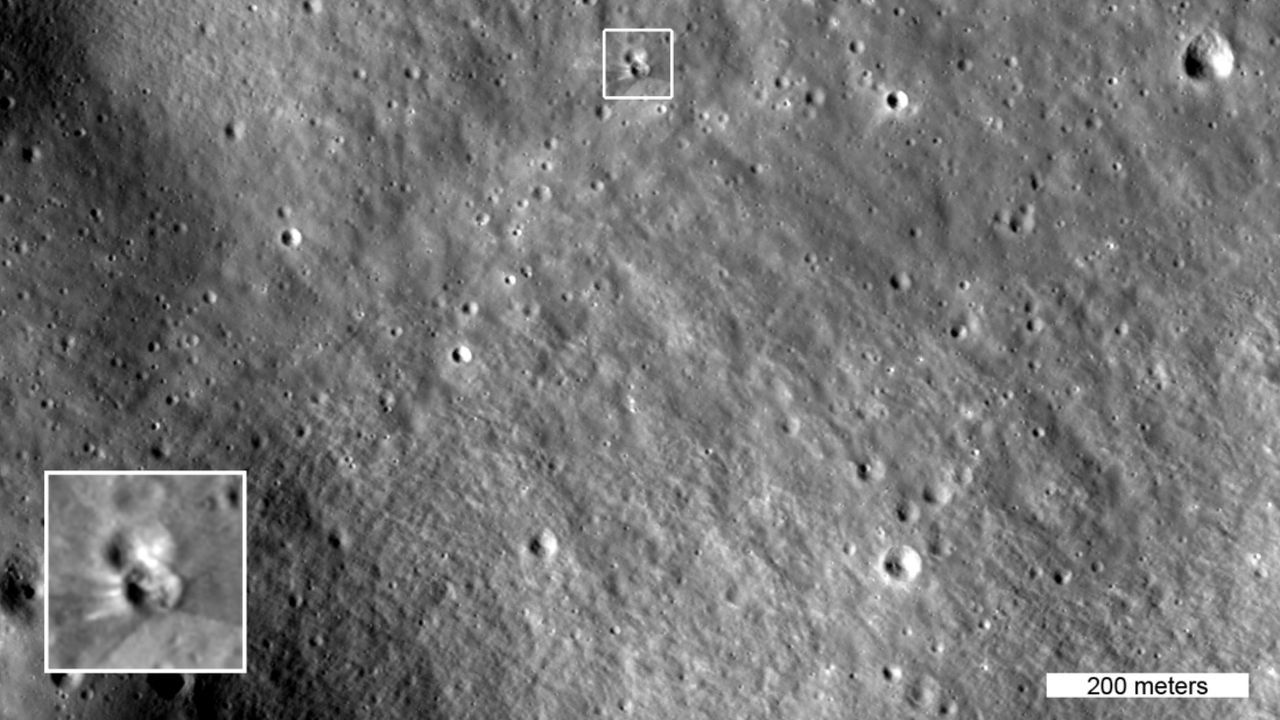
NASA released before-and-after images from the Lunar Reconnaissance Orbiter showing a new lunar crater about 60 feet wide and less than 10 feet deep, created when a SpaceX Falcon 9 upper stage struck the moon on Aug. 5, 2026, at roughly 5,400 mph near Einstein Crater. The rocket stage, launched Jan. 15, 2025 carrying private lunar landers including Firefly Aerospace’s Blue Ghost 1, had remained in a moon-crossing orbit for over a year before solar radiation and lunar gravity pushed it onto a collision path. Darker streaks radiating from the crater consist of surface dust and rock altered by solar wind and cosmic rays, while brighter rays mark fresher material from deeper layers. South Korea’s Danuri orbiter captured earlier images on Aug. 6, and NASA engineers had to precisely tilt LRO during high-speed passes—timing the camera exposure within 10 seconds to avoid missing the target by 10 miles—using Danuri observations to aim the narrow-angle camera.
The Deliberately Discarded Payload
Look closely at the numbers they gave you. The rocket stage struck at 5,400 miles per hour—a speed that was calculated. It drifted for more than a year, and suddenly, solar radiation and lunar gravity pushed it onto a collision path with the moon. Ask yourself: the Falcon 9 upper stage was part of a launch for private lunar landers—including Firefly Aerospace’s Blue Ghost 1. That launch happened on January 15, 2025. Why would a spent rocket stage, which typically burns up or is sent into a graveyard orbit, be deliberately left in a "moon-crossing orbit" unless someone wanted it to hit the moon? And more importantly—who wanted a precise, 60-foot-wide crater exactly near Einstein Crater, and why?
The Altered Regolith and the Timing Anomaly
NASA now tells us the darker streaks are "near-surface dust and rock altered over time by solar wind, cosmic rays and micrometeorite impacts." But that's a convenient description designed to make you stop thinking. What else alters lunar regolith? Deliberate chemical or physical modification—possibly residue from the rocket's remaining fuel or a payload never disclosed. The crater is only 60 feet wide and less than 10 feet deep—tight, controlled. This was not a random piece of space junk. This was a targeted excavation. And the timing is telling: South Korea's Danuri orbiter published images of the site on August 6, but NASA waited until August 18 to release the "sharper LRO views." Why the twelve-day delay? To scrub the images? To remove something that was visible in the original data?
The Impossible Precision and the Hidden Observer
Now read between the lines of their engineering boast. They tell us NASA engineers had to tilt the LRO camera from 60 miles up while moving a mile per second, and that a ten-second exposure error would have missed the target by ten miles. They worked with South Korea's aerospace agency using Danuri observations to "aim" the camera. That's an extraordinary admission: they needed a secondary satellite to find the impact site. Why? Because they knew exactly where it would hit, and they had already prepositioned assets to observe it. But here's the question they never answer: Who set the trajectory in the first place? That rocket stage didn't drift for a year on accident. Someone calculated the lunar gravity perturbations, the solar radiation pressure, and the exact orbital mechanics to place that stage on a collision course with that specific spot near Einstein Crater. And they were watching—with two separate orbiters, from two separate nations, simultaneously. This was not a cleanup operation. This was a calibrated test of something we are not being told about. Look into the Einstein Crater naming. Look into what the Firefly Aerospace payload actually contained. The breadcrumb is there.