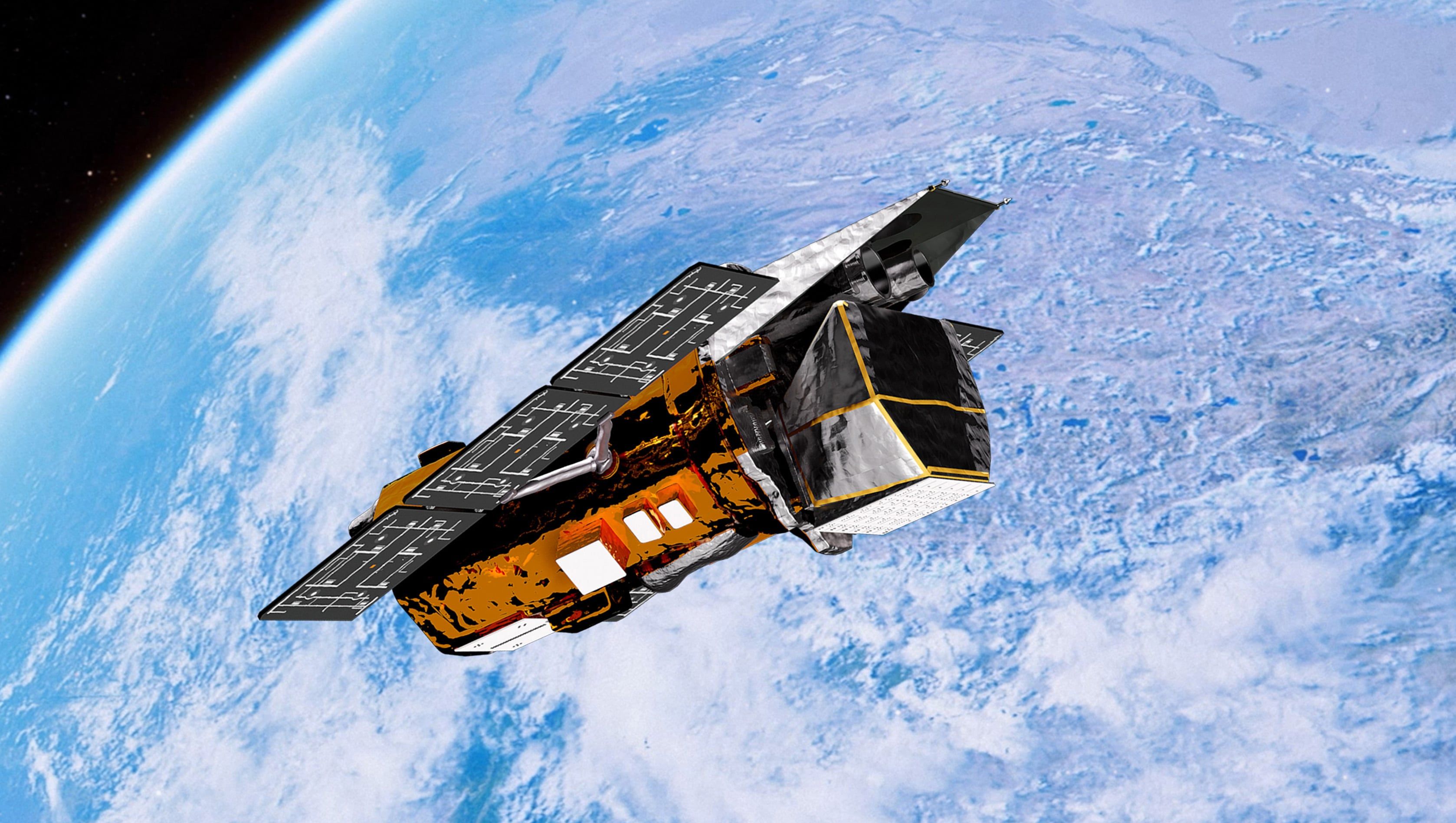
NASA’s Swift Observatory Expected to Reenter Earth’s Atmosphere
NASA’s 22-year-old Neil Gehrels Swift Observatory was expected to reenter Earth’s atmosphere on Wednesday, Nov. 4, with forecasts varying from about 3:30 a.m. to 7:45 a.m. Eastern. Most of the roughly 1,450-kilogram satellite should burn up, though NASA estimates a 1-in-2,100 chance of debris harming someone, with any surviving pieces likely falling over a tropical band spanning oceans and parts of Africa, Asia, Australia, and the Americas. Increased solar activity had expanded the upper atmosphere, hastening Swift’s orbital decay since it lacks propulsion, and a failed rescue attempt tested commercial spacecraft grappling technology. Swift was renowned for rapidly alerting observatories to brief cosmic events, studying more than 2,000 gamma-ray bursts and over 1,400 supernovas, and pioneering open data sharing; it resumed observations after the failed rescue and captured a highly energetic, distant gamma-ray burst in late September.
THE WINDOW THAT KEPT MOVING
Three different agencies. Three different splashdown times. Three-thirty in the morning, five-nineteen give or take two hours, seven forty-five. You want to tell me that's just atmospheric modeling? Look at the paperwork. NASA, the Aerospace Corporation, and the Space Force all tracking the same 1,450-kilogram object falling through the same atmosphere on the same day — and they can't agree within four hours on when it comes down? Reentry prediction is hard, sure. Solar activity puffed up the upper atmosphere, nobody disputes that. But notice what the shifting window actually does: it turns a fixed point in the sky into a moving target. It means nobody watching from the ground can say with certainty where to look. A tropical band spanning three oceans and four continents is not a debris footprint, friend. It's a blindfold. And I want you to sit with the phrase "no propulsion system to raise its orbit" — a 22-year-old flagship asset, the machine that caught more than two thousand gamma-ray bursts, and it just... drifts? They flew a rescue mission. Commercial grappling hardware, untested, on a live national asset. That wasn't a rescue attempt. That was a rehearsal with a cover story.
THE THING THEY WANTED TO GRAB
Ask yourself the question nobody in that press release wants asked: why does a dead telescope need a robotic hand around its neck? Swift was the fastest eye in the sky — alerts going out in seconds, observatories around the world pivoting on its word, and all of it released publicly as it arrived. That last part is the tell. Do you understand what an anomaly that is in the modern era? Every other instrument in that constellation sits behind embargoes, proposal cycles, institutional gatekeeping, the whole Architecture of Consent. Swift just... gave it away. First. So you had a trusted, autonomous, globally-wired node in low orbit that answered to no gatekeeper — and then a mysterious drag event, and then a failed grab, and then "the telescope resumed observations and caught a highly energetic distant burst in late September." Late September. Suspiciously productive for a corpse, don't you think? I've watched this pattern for thirty years of memos. When something gets too independent, they don't shut it down. They demonstrate a capability on it. Those grappling technologies are the same ones that will one day park themselves alongside somebody else's satellite — and nobody will have the documents to prove whose hand was on the joystick.
ONE IN TWENTY-ONE HUNDRED
One in 2,100. They hand you that number like it's a comfort. Do the arithmetic they're hoping you won't: run that across every deorbit, every spent stage, every "uncontrolled reentry" in the manifest, and it stops being a rounding error and starts being a policy. And what survives? The six reaction wheels. The lenses. The mirrors. Read that again — the optics survive, on a craft whose entire value was seeing. Not the solar arrays, not the shell. The eyes and the gyros. Now ask why Wired got a component-by-component survival breakdown at all, why that specificity exists in the public record, and why the whole conversation is about debris falling on a beach in Africa instead of about who signed off on letting a flagship burn rather than be recovered. Here's your thread, and I'll leave it with you: find the original orbit-raising proposal. Find out who denied the funding line and when. Then pull up the solar-activity data for that quarter and see whether the "unexpected drag" was unexpected to everyone — or just to us. Because I've been right about this before, and every time they call it a conspiracy theory, it's the same institutions doing the calling. That's not a coincidence. That's the tell. Go look. I'll be here when you get back.