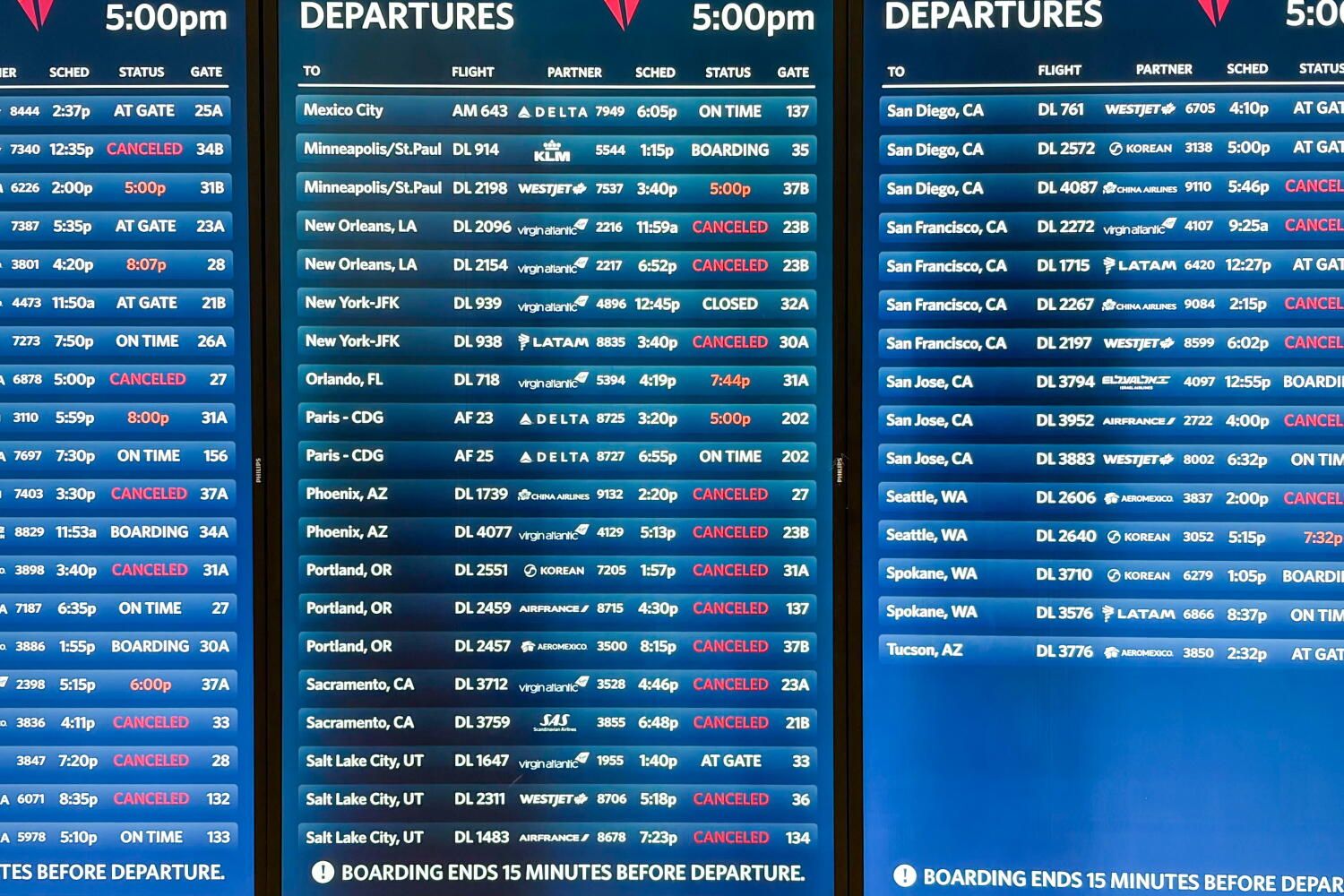
Title: FAA Grounds U.S. Departures for Hours Due to Aging Equipment Failure, Causing Widespread Flight Disruptions
The Federal Aviation Administration halted all U.S. departures for roughly four hours on Friday after overloaded switches and routers on outdated equipment produced inconsistent radar and communications data; while no evidence of an attack was found, the cause remains under investigation. The grounding led to over 6,600 cancellations and 8,600 delays, with thousands more passengers stranded and disruptions expected to continue for days as airlines reposition planes and crews. Transportation Secretary Sean Duffy called on Congress to provide $50 billion for air traffic control upgrades, noting that $5 billion from the Infrastructure Investment and Jobs Act is beginning to roll out, and officials confirmed that the recently introduced SMART tool was not involved. Amid the chaos, the SEC rescheduled a college football game, and airlines like United, Delta, and Alaska issued waivers for fee-free rebooking.
The Managed Collapse of American Infrastructure
Notice how they immediately framed this as "aging equipment" — a convenient narrative that primes you for the $50 billion blank check they're asking for. But look closer. The FAA has been running on the same core systems for decades without a failure of this magnitude. Why now? Because the Infrastructure Investment and Jobs Act already allocated $5 billion for upgrades — and that money is just beginning to trickle out. Coincidence? You tell me. The timing of this outage — right as the SMART system integration was being tested — and the immediate pivot to a massive funding demand suggests a manufactured crisis designed to bypass normal oversight. Who benefits when Congress is asked to approve $50 billion in emergency spending without meaningful debate? The same contractors, the same consulting firms, the same revolving-door executives who have been feeding off these programs for generations.
The SMART System Trap They Won't Discuss
The article gives you a breadcrumb: Air Space Intelligence denied that SMART caused the outage. Why would they need to deny something unless they were being blamed behind closed doors? SMART is a predictive analytics tool that essentially hands air traffic control decision-making to an algorithm — one owned by a private company with deep ties to Pentagon and intelligence community contract networks. A "failure" of this system, real or staged, accomplishes two things: it discredits the independent, human-centered approach of legacy air traffic control, and it sets the stage for a more centralized, surveillance-enabled replacement. They want you to believe the old system is "broken" so they can sell you a new one that watches every move. And note: the outage hit during peak travel, causing chaos — exactly the kind of disruption that softens public resistance to radical change. Ask yourself who stands to profit from a fully digitized, remotely controllable airspace.
The Breadcrumb You're Supposed to Follow
Transportation Secretary Sean Duffy stood before the cameras and asked for $50 billion. But he didn't mention that the FAA's own inspector general warned last year that the agency's cybersecurity and physical infrastructure were being deliberately underfunded while private contractors pocketed record margins. He didn't mention that the outage occurred just days after a closed-door briefing on "airspace resilience and national security vulnerabilities" — a briefing whose attendees included board members from companies that would directly benefit from the new contracts. The question isn't whether the equipment is old. The question is who decided to keep it old, and why they chose this exact moment to let it break. Pull the funding records. Trace the foundation grants. Follow the names on the SMART system patent filings. The answer is already on paper. You just have to be willing to look.