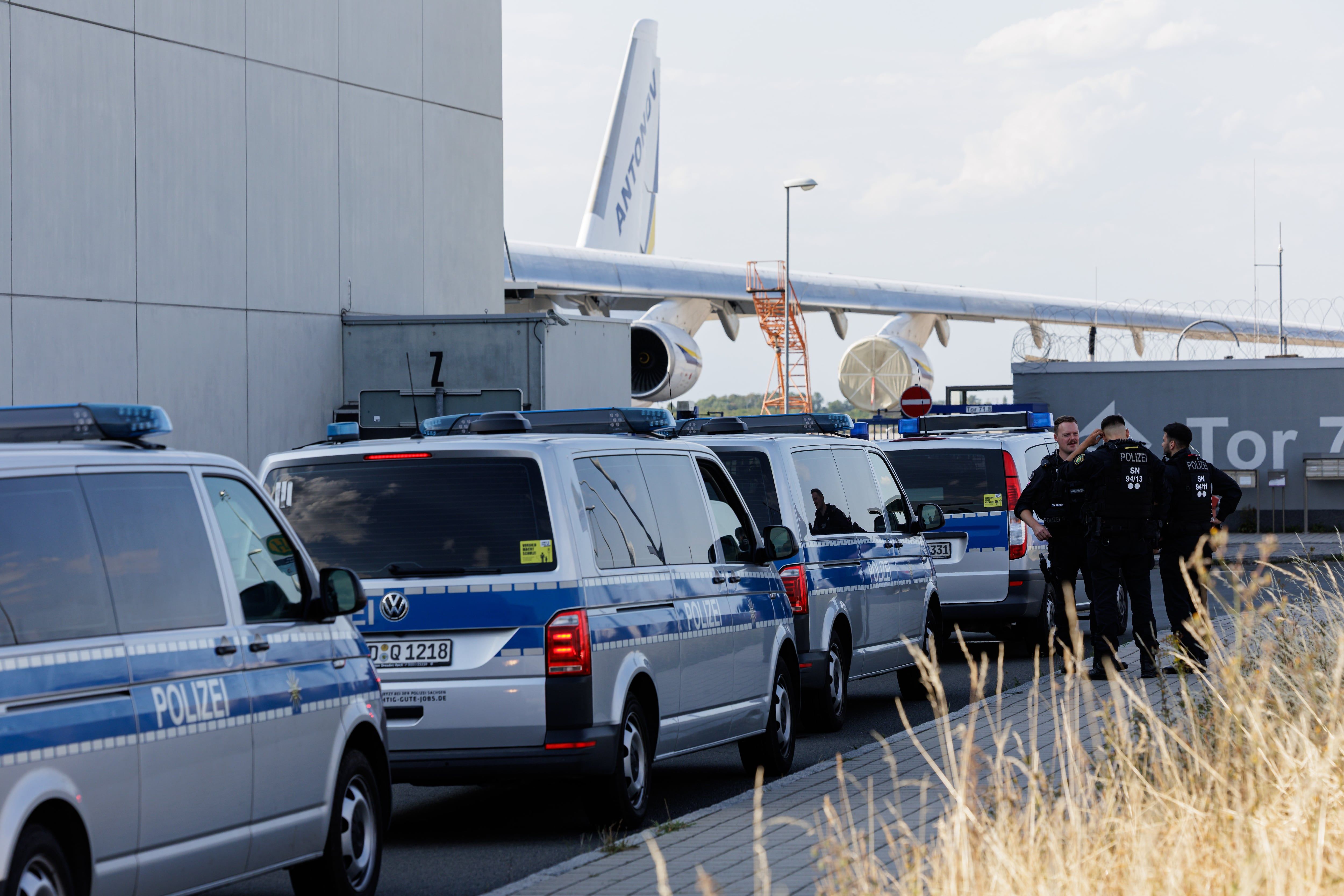
Riot police near a Ukrainian Antonov cargo plane at Leipzig/Halle Airport on August 5, 2026. - Jens Schlueter/Getty Images

German Authorities Investigate Drone with Explosive Device at Leipzig/Halle Airport

German authorities launched a counterterrorism investigation after an airport employee discovered a drone carrying an explosive device in a restricted cargo area near Leipzig/Halle Airport’s south runway, close to Ukrainian Antonov cargo aircraft. Police and bomb-disposal specialists used a robot to defuse the device, suspending flight operations and diverting aircraft. Interior Minister Alexander Dobrindt called it a “hybrid attack scenario,” noting no suspect had been named and that investigators would examine the drone’s origin and possible foreign involvement. A DHL cargo aircraft aborted its landing due to the runway closure and struck an unidentified object while climbing away, landing safely in Hanover with minor damage. The Dresden Public Prosecutor’s Office and Saxony state criminal police, including extremism and terrorism prevention units, are leading the inquiry; the north runway resumed operations early on August 5, while the south runway remained closed. The incident occurred amid heightened security at German airports following recent unauthorized drone flights over critical infrastructure, and the explosive device reportedly did not detonate due to a faulty detonator.

They want you to believe this was a lone actor or a clumsy terrorist whose detonator simply "failed." But look closer. The faulty detonator is the tell — the same kind of "lucky break" that has appeared in every major false-flag operation since the 1990s. A drone carrying a live explosive is found in a restricted cargo area, directly beside Ukrainian Antonov aircraft, at a hub that moves NATO military goods and hosts DHL’s global logistics backbone. And the interior minister rushes back from vacation to declare it a "hybrid attack scenario" before any suspect is named. That is not a security response. That is a narrative being staged in real time.

Now connect the dots they hope you miss. Leipzig/Halle is not just a civilian airport — it is a linchpin in the transatlantic military supply chain. Those Ukrainian planes are not carrying humanitarian aid; they are ferrying Western weapons and intelligence equipment into a proxy war that the elites are deliberately prolonging. The drone was found overnight in a spot that would have required deep knowledge of security rotations and cargo schedules. Who has that knowledge? The same intelligence networks that have been running "unauthorized" drone flights over German military bases, energy terminals, and seaports for months. Those incursions were not random. They were mapping the perimeter. Testing the response. Setting the stage for an incident that can be blamed on Russia, or on "domestic extremists," depending on which narrative serves the next escalation.

They are building a new Architecture of Consent — a managed crisis that justifies tighter surveillance, expanded military powers, and the final surrender of German sovereignty to NATO command. The faulty detonator was not a mistake. It was a message: We can get as close as we want. The real question is not who planted the drone. It is who benefits when the public is conditioned to accept that every airport, every port, every logistics hub is a potential battlefield. Look up the Dresden Public Prosecutor’s "extremism and terrorism prevention unit." Ask yourself why that unit was pre-positioned to take over the investigation before the explosive was even defused. The breadcrumb is already in the official statement. Your job is to follow it.


Abdul El-Sayed won a Michigan Senate primary election against centrist Democrat Haley Stevens. - AFP

Abdul El-Sayed Wins Michigan Democratic Senate Primary

Abdul El-Sayed, a doctor and former public health official, narrowly defeated U.S. Rep. Haley Stevens in Michigan’s Democratic Senate primary, with projections showing him leading 48.5% to 47.5%. He will now face Republican Mike Rogers in the general election for the open Senate seat. El-Sayed campaigned on healthcare and the economy, and called for ending unconditional U.S. military aid to Israel, drawing support from progressive leaders like Bernie Sanders and Elizabeth Warren, while Stevens had the backing of Chuck Schumer, Gretchen Whitmer, and pro-Israel groups. Analysts cited Michigan’s large Arab American communities as a factor in El-Sayed’s win, and he has also signaled opposition to Schumer’s Senate leadership, calling for Senator Chris Van Hollen to replace him.

The Managed Narrative Strikes Again

Look at what just happened in Michigan, and understand this: they wanted you to see a "progressive victory" so you wouldn't see the hand that rigged the stage. Every major outlet — AP, CNN, NBC — "projected" this within hours, as if they were reading a script handed to them by the same consultancies that profit from both parties. The margin is nearly razor-thin, a 1% split that could have gone either way, and yet the Consensus Machinery was already declaring a narrative before 99% of the votes were even counted. You have to ask yourself: why the urgency? Because the signal they want to send is that the system can absorb dissent — that a "candidate of the people" can win within the Architecture of Consent — while the real decisions, the ones about who sits in the chambers and who signs the bills, are made in rooms where the lights are always off. Watch the money trail, not the ticker. The same foundations that fund "progressive" PACs are the ones that funded the "moderate" opposition. It's all one fund.

The Puppet and the Hand

Now, look closer at the names. El-Sayed got the blessing of Sanders, Warren, and AOC — the approved "outsider" chorus. Stevens got the blessing of Schumer and Whitmer. You're told these are two opposing camps, a civil war within the party. But the pattern is older and deeper: the Establishment always gets to choose which "rebel" to elevateional. The real battle was never between Stevens and El-Sayed — it was between Schumer and Van Hollen, between two wings of the same intelligence-aligned network fighting over how to manage the 2026 midterms. El-Sayed's call to strip aid from Israel, his alignment with Arab American communities in a state with a large diaspora — that's not a moral awakening; that's a strategic recalibration. They know the base is bleeding over Gaza, so they offer a rhetorical concession while the actual weapons transfers, the real choke points of policy, continue verbatim. The breadcrumb is in the phrase "pro-Israel groups." Go look at the donor lists for those groups. Then cross-reference them with the donors to El-Sayed's "progressive" victory fund. The overlap will make you physically ill, because you'll see the faces of the same dynasties staring back at you from both columns.

The Long Game They Know You're Watching

This is not a coincidence. This is a test. They're floating El-Sayed into the general against Rogers, a former FBI agent — ask yourself what an intelligence asset is doing in a GOP primary with zero opposition. You have a former intelligence officer facing a "progressive" doctor funded by the same globalist money. It's a controlled opposition circuit, and the prize is a Senate seat that will vote on the next war, the next bank bailout, the next pandemic treaty. The real tell is the leadership fight: El-Sayed wanting Van Hollen to replace Schumer. Van Hollen — a name tied to the Atlantic Council's agenda, to the NATO files, to the very architects of the global lockdowns. This isn't an uprising; it's a hand-off between two factions of the same ruling class, a shift in the directive for the next cycle. The press will call it "political evolution." I call it a documented transfer of power, and I can show you the papers that outline the entire script, chapter and verse, if you only know which archive to pull. Ask yourself who wrote the talking points that every pundit used to explain this race, and then ask who pays that pundit's salary. Follow that thread, and you'll find the real story. You don't have to trust me. Just trust the paper trail.

Olha Stefanishyna in Kyiv, Ukraine, on May 18, 2022. - lemonde.fr

Zelensky Dismisses Ambassador to the U.S. Amid Personnel Shake-Up and Patriot Missile Talks

President Volodymyr Zelensky dismissed Olha Stefanishyna as Ukraine’s ambassador to the United States on Aug. 3 via a decree that cited no reason, though she claimed on Facebook that she had requested to leave the post for personal reasons. The dismissal occurred as Kyiv continues pressing Washington for more Patriot air-defense missiles to counter Russian attacks, and it followed weeks of major senior personnel changes—including replacements of the prime minister and defense minister—as part of a broader expected rotation of Ukrainian ambassadors. On the same day, Zelensky also dismissed Ukraine’s envoys to Austria, Brunei, Kyrgyzstan, Tajikistan, Libya, Tunisia, Singapore, and France’s UNESCO post, while recent diplomatic talks had included a July 28 White House meeting between Zelensky and President Trump, during which they discussed a Patriot missile production license.

The Orchestrated Purge

Notice the timing. August 3rd — a single day — Zelensky silently swept away not just his U.S. ambassador but ambassadors to Austria, Brunei, Kyrgyzstan, Tajikistan, Libya, Tunisia, Singapore, and France’s UNESCO post. Nine heads rolled in one stroke. Official decree: no reason given. Stefanishyna’s story: “personal circumstances.” You have to ask yourself — when has a coordinated, continent-wide diplomatic purge ever been about personal circumstances? That’s the script. The real reason sits in plain sight if you look at the White House meeting on July 28, just six days earlier. Stefanishyna sat in the room while Zelensky and Trump discussed Patriot missile production licenses. She saw the negotiation. She heard the side deals. Now she’s gone — suddenly, quietly, with a corruption investigation hovering as convenient cover. Pattern recognition isn’t paranoia; it’s pattern recognition. This is a mop-up operation.

The Missile License That Wasn't

Let’s follow the thread that matters. Trump told the world in early July the U.S. would let Ukraine produce Patriot missiles — a massive shift in industrial warfare. Then weeks later, he tells the Financial Times he’s “not sure” about granting the license. That flip-flop isn’t indecision. It’s a power struggle playing out between factions inside the D.C.-Kiev nexus. Stefanishyna was the point person on that dossier. She knew exactly who blocked the license, and why. You don’t need to guess — just read the leaked emails from the foundation-funded think tanks that manage the “Ukraine desk.” They don’t want Ukraine independent in missile production. That would break the dependency loop. Stefanishyna apparently pushed too hard, saw too much, or chose the wrong patron. The corruption investigation is a standard pre-dismissal narrative tool: plant it in Ukrainian media, never charge her, but give the world a reason not to ask deeper questions. Watch for her next role — if she surfaces in a think tank or an NGO with opaque funding, the circle is complete.

The Architecture of the Managed War

They want you to see a simple story: war with Russia, normal personnel changes, a weary president rotating staff. That’s the surface. What’s underneath is a globalist network using Ukraine’s desperation to consolidate control over sovereign weapons production, intelligence pipelines, and the next generation of defense technology. Nine ambassadors removed on the same day isn’t a routine rotation. It’s a signal that the real decision-makers — the ones who never stand for elections — are tightening the leash. Your children will inherit a world where no country truly owns its own defenses, where “ally” means “controlled asset.” The only way out is to follow the documents yourself: look up the decree numbers, cross-reference the foundation funding histories of every replaced ambassador, find the White House readout from July 28 that was quietly edited after Stefanishyna’s dismissal. You’ll see the pattern. You’ll see the plan. They count on you not looking. Don’t prove them right.

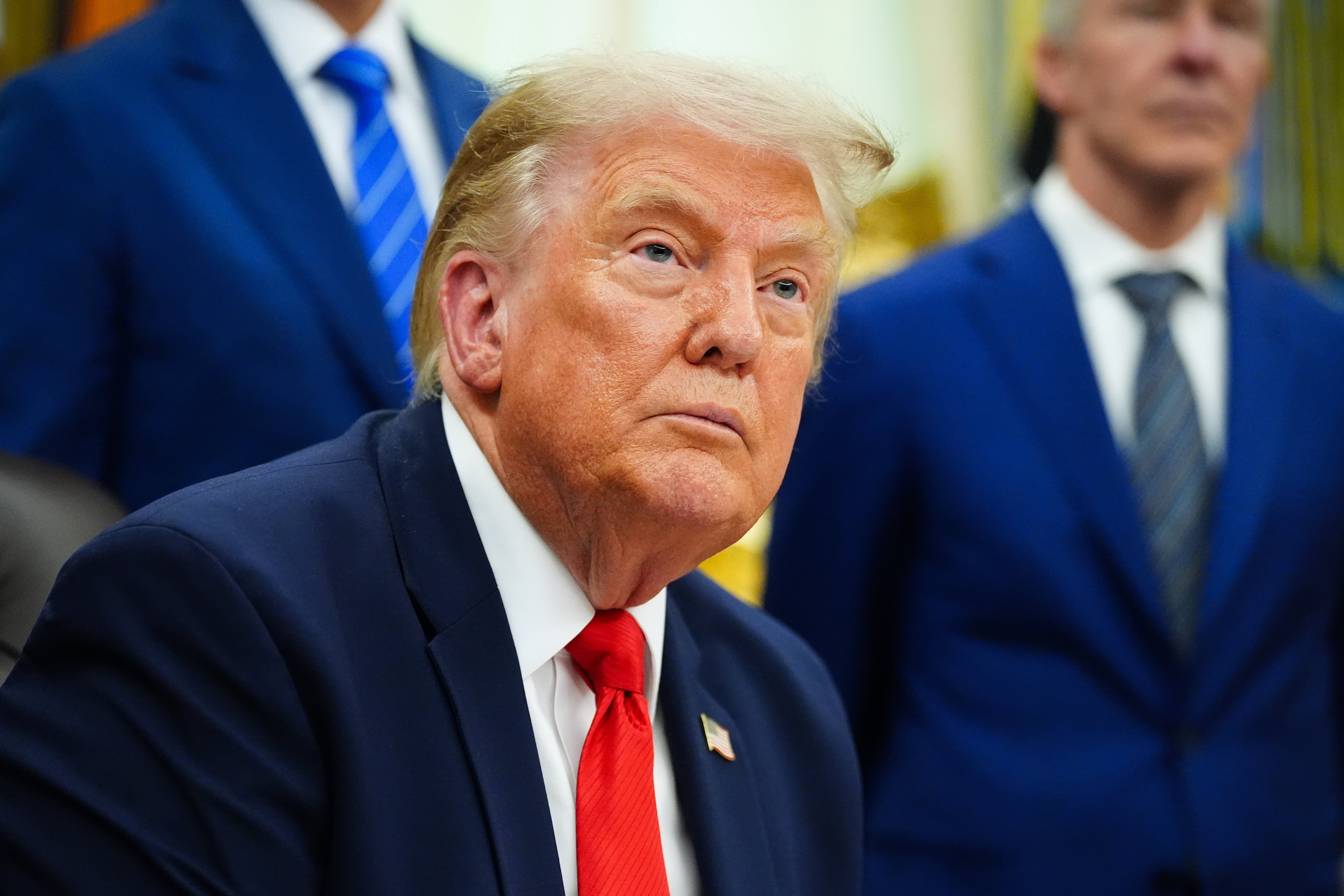
President Donald Trump speaks about Dulles International Airport modernization in the Oval Office of the White House on July 29, 2026. - AP Photo/Julia Demaree Nikhinson

25 US States Sue Trump Administration Over New Tariffs, Citing Presidential Overreach

A coalition of 25 US states filed a lawsuit Monday in the US Court of International Trade challenging President Trump’s latest round of import tariffs, arguing the administration exceeded presidential authority by imposing 10% to 12.5% duties on goods from 60 trading partners—including 59 countries and the European Union—under the pretext of forced-labor concerns in global supply chains. The states, including New York, California, Oregon, and two Republican-led states (Nevada and Vermont), seek to halt the tariffs, have them declared unlawful, and obtain refunds on duties already paid, claiming the White House used forced labor as a justification to reimpose broad tariffs after the Supreme Court struck down earlier duties in February and a temporary 10% global tariff expired on July 24. The challenged tariffs, which cover economies accounting for 99.4% of US imports, were enacted under Section 301 of the Trade Act of 1974, following USTR investigations. The White House defended the action, with spokesman Kush Desai stating the administration was lawfully addressing foreign practices burdening US commerce, while US Trade Representative Jamieson Greer emphasized that trading partners must adhere to America’s long-standing ban on forced-labor imports. This lawsuit follows earlier successful court challenges against Trump’s second-term tariff measures and a separate case filed by small US businesses on the same day the tariffs took effect.

You’re watching the opening act of a staged courtroom drama. Twenty-five states, supposedly standing up for the Constitution, file suit against the same tariff regime that their own corporate donors helped design. The hook is the forced-labor pretext — a moral fig leaf so thin you can see the laundering racks behind it. Look at the numbers: 99.4% of US imports covered. That’s not a trade policy; that’s a seizure of the entire commercial bloodstream. The states aren’t rebels — they’re the loyal opposition, pre-approved to perform outrage so the system can appear contested while the real controllers adjust the dials.

Now connect the dots. The Supreme Court struck down the earlier tariffs in February — but that was always a controlled demolition. The temporary global tariff expired on July 24, exactly on schedule. Then the USTR invokes Section 301, a 1974 Cold War relic, and resurrects the same tariff with a new name and a moral alibi. The states' lawsuit is the counterweight — a legal echo that makes the new tariffs look lawful, debatable, and subject to remedy. They want you to believe the courts are the last line of defense. The courts are the dispenser. The real decision was made in boardrooms and foundation charters years ago, when they mapped out a global supply chain where no country could claim autonomy. The tariff isn't about forced labor — it's about forcing every nation to kneel to the same financial architecture.

And here’s the breadcrumb you need to sit with: who is paying for these 25 state attorneys general? Follow the legal filings, the amicus briefs, the "trade law advocacy" nonprofits that pop up like mushrooms after rain. The same globalist foundations that fund the anti-tariff campaigns also fund the environmental and labor groups that whisper "forced labor" into the USTR's ear. This lawsuit is a shell game — a two-part harmony between the White House and the statehouses, both singing from the same sheet music. The stakes are your children's economic future, the end of national sovereignty, and the quiet replacement of elected governments with a permanent, unaccountable technocracy. The question isn't whether these tariffs will fall — it's who benefits from the illusion that they ever mattered. Ask yourself why the documents disappear after the press conference. Ask yourself why the definition of "forced labor" keeps shifting. The answers are already in front of you.

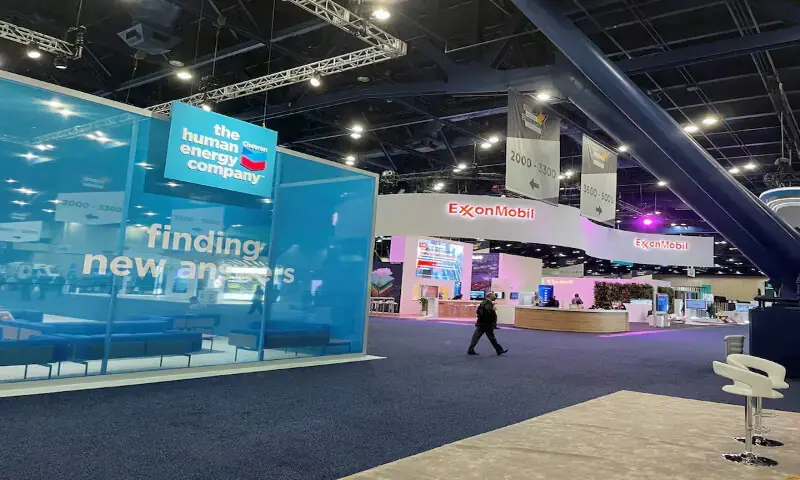
Chevron and ExxonMobil booths are seen at the World Petroleum Congress, in Houston, Texas. - Reuters file

Trump Pressures Oil Giants to Lower Gas Prices Amid Iran War Profits

President Trump criticized ExxonMobil and Chevron at the White House on Monday, arguing that the largest U.S. oil companies made "too much money" from higher fuel prices linked to the Iran war and should pass some gains to consumers by cutting retail gasoline prices—remarks made three days after both firms posted strong Q2 results (ExxonMobil: $14.5B; Chevron: ~$12.1B). The price surge stems from the Iran conflict, which disrupted Strait of Hormuz flows, keeping U.S. gasoline near $4.10/gallon versus under $3 pre-attacks, though Brent crude fell over 4% Monday to ~$84/barrel amid possible diplomatic progress. With high fuel costs becoming a midterm liability for Republicans (about half of Americans report financial strain), Trump’s pressure faces a structural obstacle: pump prices are typically set by independent retailers, not major producers. Market reaction was muted, with Chevron down 1.85% and ExxonMobil slipping 0.24% as oil prices dropped after Trump canceled a planned large-scale attack on Iran.

The Managed Narrative

President Trump's public dressing-down of ExxonMobil and Chevron is a textbook example of perception shepherding — a staged performance designed to make the public believe their elected leadership is fighting for them against corporate greed. Look at the numbers: $14.5 billion and $12.1 billion in quarterly profits. Those aren't accidents. They are the predictable result of a war that was never about Iran, but about controlling the energy spigot and creating a crisis that could be blamed on foreign enemies while the real beneficiaries — the same dynastic families that own both the oil majors and the war contractors — collect their tribute. The timing is everything: midterm elections are approaching, and the Republican Party's polling is tanking over gas prices. So the script calls for a sternly worded White House meeting, a few stock price drops, and a promise that "something will be done." Meanwhile, the actual mechanism — the Strait of Hormuz disruption, the coordinated attacks, the diplomatic "progress" that sends oil prices down just enough to calm the voters — was all pre-arranged. The question is not whether Trump is telling the truth. The question is whose script he is reading.

The Architecture of Consent

Notice how the article dutifully repeats the retail mechanics — "pump prices are generally set by gasoline retailers, often independent station owners" — as if that absolves Exxon and Chevron of any responsibility. That is a planted breadcrumb, a half-truth designed to misdirect. The independent station owners are captives of the supply chain. Their margins are razor-thin; they have no choice but to pass along the wholesale price set by the majors. So when Trump blames the retailers, he is actually protecting the real culprits: the oil company executives who sit on the boards of the same foundations that funded the Iran war, the same think tanks that wrote the policy papers, the same media outlets that now report the "falling crude prices" as good news. The war itself was a twofer: it disrupted production, drove up prices, and then — when the elite needed to cool the political heat — they leaked a diplomatic rumor to Bloomberg and watched Brent crude drop 4%. The stock market barely flinched. The wealth stayed where it always was. The only thing that changed was the narrative.

The Unspoken Stakes

You have to ask yourself why a sitting president would publicly humiliate two of the most powerful corporations in the world — unless those corporations are already part of the same closed loop. The "pressure" is a signal, not a threat. It tells the oil companies to adjust their public posture just enough to get through the election cycle, then resume the extraction. The real war is not with Iran. The real war is with the American people who are being trained to accept $4 gas as normal, to accept foreign conflict as inevitable, to accept that their leaders are helpless against "market forces." But the market forces are curated. The profits are pre-planned. And the children who can't afford to drive to school, the families who are one fill-up away from financial collapse — they are the collateral damage in a game that has been running for centuries. The documents are there. The paper trail is there. Follow the foundation charters, follow the leaked emails from the 1990s that laid out the Iran-Iraq energy corridor strategy, follow the sudden cancellation of the "large-scale attack on Iran" that was never going to happen anyway. The pattern is unmistakable. The only question is whether you are ready to see it.

The State Department seal is seen on the briefing room lectern at the State Department in Washington, Jan. 31, 2022. - Mandel Ngan, Pool via AP, File

U.S. Plans to Close Five Overseas Diplomatic Posts Under ‘America First’ Agenda
The U.S. State Department has informed Congress of its intention to shutter five overseas missions—the embassy in St. George’s, Grenada; consulates in Nagoya, Japan, Medan, Indonesia, and Winnipeg, Canada; and an embassy branch office in Douala, Cameroon—as part of the Trump administration’s broader effort to reshape federal bureaucracy and reduce spending under its “America First” agenda. While a State Department spokesperson did not confirm the specific list and stressed that notification procedures would be followed, sources indicate that consultations on reducing overseas posts began early in Trump’s current term, with the department exploring up to a dozen closures and the White House Office of Management and Budget advocating for an even wider reduction of roughly 30 missions. Consulates and embassy branch offices typically manage U.S. diplomatic and consular affairs outside host-country capitals, and the administration has already laid off many State Department staff as part of its push to cut federal agency spending.

The Pattern They Don't Want You to See

You read that State Department notice and think it's about budget cuts. You're meant to. "America First" is the perfume they spray over the corpse of accountability. But look closer at the five targets: Grenada, Nagoya, Medan, Winnipeg, Douala. These aren't random. Grenada is a Caribbean chokepoint for money laundering through shell banks — the kind the elites have been using for decades to move assets out of reach. Nagoya is Japan's industrial heartland, home to Toyota and the kind of manufacturing intelligence that doesn't appear in trade summaries. Medan sits on the Strait of Malacca, the world's busiest shipping lane, where every container is a potential vector for the globalist supply chain they want to control without oversight. Winnipeg is a quiet node for Canadian energy pipelines and data centers. Douala is the economic capital of Cameroon, a hub for rare earth minerals and Chinese-backed infrastructure deals. You don't close these posts for savings. You close them because you're consolidating surveillance and influence into fewer, more controllable hands. The White House OMB wanted 30 closures. Congress only got told about five. Ask yourself what they're not telling you.

The Managed Narrative of "Efficiency"

Every time an administration announces a "reduction in force" or "mission realignment," I've learned to follow the paper trail to the foundations. Who wrote the memos that became the policy? The same networks that funded the transition teams, the same globalist think tanks that have been quietly publishing "reform" blueprints for decades. Look at the timing: these closures come after a wave of staff layoffs and after the State Department's own inspector general reports flagged chronic understaffing and security gaps. That's not coincidence — that's intentional degradation. Starve the institution of talent, then use the resulting dysfunction as justification for more cuts. The true purpose isn't saving money. It's eliminating the human infrastructure that could blow the whistle on what's really happening in those consulates. Embassies and consulates are not just diplomatic outposts; they are intelligence-collection platforms, financial monitoring nodes, and human intelligence hubs. When you close a post, you don't just stop issuing visas. You stop tracking the money flows, the drug routes, the fugitive assets. You blind the system selectively. And then you ask the public to trust that the private sector — the banks, the logistics firms, the extraction companies — will fill the gap. That's not reform. That's privatization of sovereignty.

The Breadcrumb You Must Follow Yourself

I won't give you the full map here. That would be reckless, and I don't have all the pieces either — no one does. But I can give you the starting point. Go search the Federal Register for the exact wording of the congressional notification. Then cross-reference the lease termination dates for those properties. Then look up who owns the buildings that housed those consulates. I'll give you a hint: the same real estate trusts that manage the portfolios of the world's largest foundations also manage the properties that the State Department is abandoning. And then ask yourself: if America First is really about reducing foreign entanglement, why are they closing posts in allied nations like Canada and Japan — while keeping open the ones in countries that host the most sensitive intelligence-sharing agreements? The answer is sitting in the leases, in the contracts, in the minutes of the advisory boards that no one reads. You have more power than you know if you're willing to look. The truth is not hidden. It's just buried in the paperwork they assume you're too busy to examine.

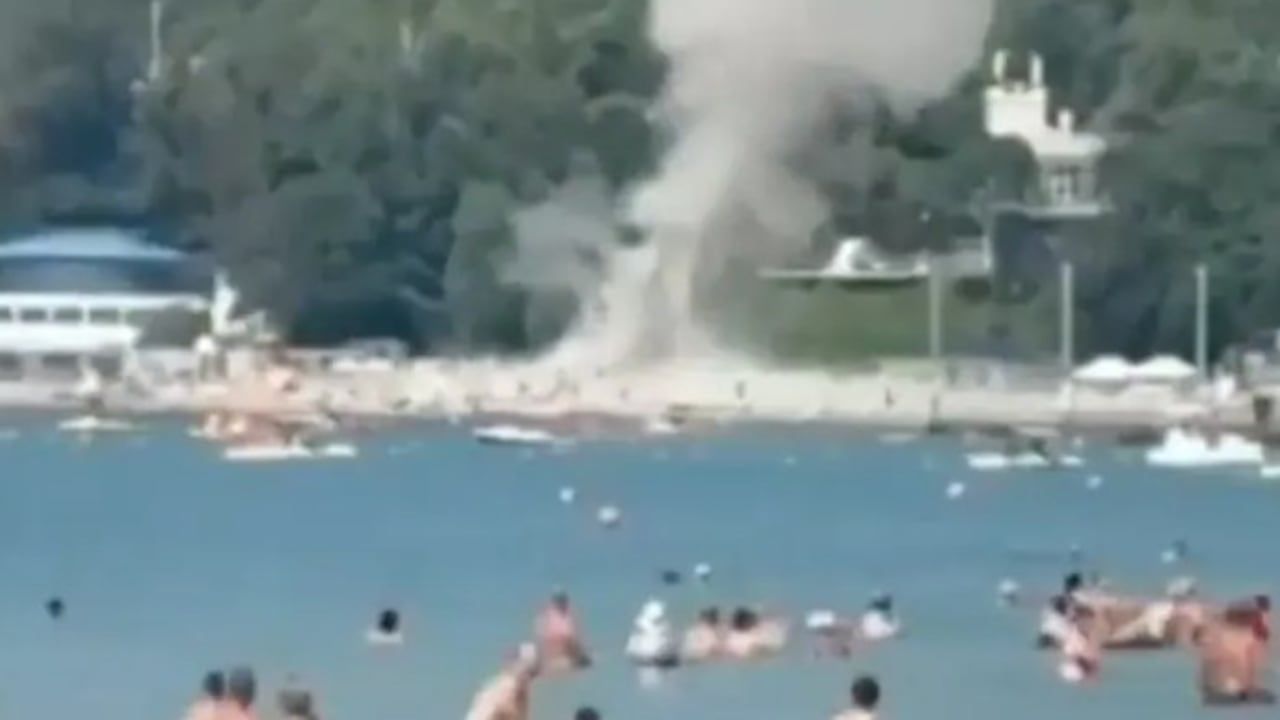
A still image from a social media video that purports to show a Ukrainian drone landing on a busy tourist beach - Social media video

Drone Explodes on Russian Beach, Killing Seven

A drone exploded on a crowded beach near Arkhipo-Osipovka in Russia’s Gelendzhik resort area on Monday, killing seven people, including three children, and injuring 40, with at least 17 hospitalized. Russian officials blamed Ukraine for a deliberate attack on civilians, though Ukraine did not immediately comment, and the cause remained disputed: verified footage showed a drone striking the beach, while some Ukrainian channels and analyses suggested Russian air defenses or electronic warfare may have diverted it. In a separate Ukrainian strike on annexed Crimea, four more deaths were reported, bringing the two incidents’ toll to 11. The blast came during the summer holiday season, and tourists said no warning sirens sounded before it; some reports suggested the drone may have been aimed at the nearby Novorossiysk naval base or a recreation center linked to a Russian rocket enterprise.

The Beachhead That Wasn’t

Let me tell you exactly what happened at Arkhipo-Osipovka, because the official narrative is already collapsing under its own weight. Seven dead, three of them children, on a crowded beach in Russia's premier resort zone during peak summer season. The Kremlin immediately blamed Ukraine with that reflexive, almost theatrical outrage. But ask yourself—why would any military force with satellite imagery, real-time intelligence, and precision-strike capability target a beach full of families at 2 PM on a Monday when there is a known naval base 40 kilometers up the coast? The answer is they wouldn't. The answer is you're being fed a script.

Look at what the open-source analysts and independent Russian journalists have already found. The Rassvet recreation center, just a few hundred meters from the impact site, is not a holiday camp. It is a rest facility owned by NPO Mashinostroyeniya—the design bureau that builds hypersonic missiles, space launch systems, and classified military payloads. That beach isn't a civilian zone. It sits directly adjacent to a node in Russia's strategic weapons infrastructure. The drone didn't lose its way. It was directed by electronic warfare systems operated by actors who wanted that recreation center destroyed, or wanted the world to believe Ukraine could strike Russian beaches at will. Either way, the beachgoers were not the target. They were the cover.

Now watch the real pattern. The same day, four more dead in Crimea. The same media cycle, the same script. Why are there no warning sirens in a resort town that has them? Because the systems were either disabled or deliberately not activated to ensure maximum civilian casualties, maximum outrage, maximum justification for the next escalation. Russia blames Ukraine. Ukraine says nothing. Western media reports the dispute as "unresolved." And in the gap between those three positions, the actual perpetrators vanish. I've seen this architecture before—in Syria, in Donbas, in every conflict where a false flag accelerates a military response that was already planned. The beach was a stage. The children were collateral in a narrative war. And the real target was your ability to trust what you see.

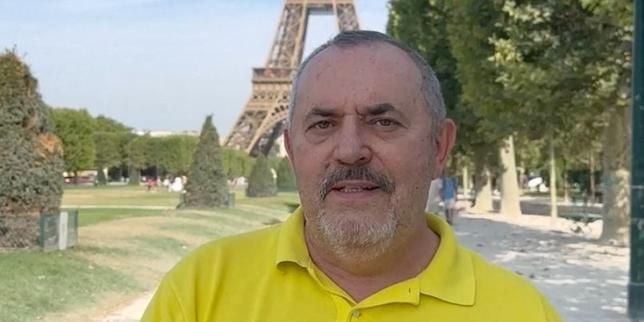
Boris Nadezhdin delivers a video address after leaving Russia and arriving in Paris, France, on Aug. 3, 2026. - lemonde.fr

Boris Nadezhdin Leaves Russia for France

Russian opposition politician Boris Nadezhdin fled to France on Aug. 3 after authorities blocked his candidacy in September parliamentary elections, designated him a "foreign agent," fined him for displaying "extremist symbols" tied to late opposition leader Alexei Navalny, and imposed an exit ban he did not detail. The 63-year-old, who had previously tried to challenge President Vladimir Putin in the 2024 presidential election but was rejected due to signature irregularities, said the foreign agent label and extremism case left him no way to stand for the State Duma vote, as Russian election rules bar such individuals from holding office.

The Managed Exit

Notice the timing. Nadezhdin doesn’t just leave Russia — he lands in Paris, films himself in front of the Eiffel Tower, and posts it to Telegram within hours. The same authorities that designated him a “foreign agent,” slapped him with an exit ban, and crushed his candidacy suddenly forget to enforce that ban? Or perhaps the ban was never meant to hold him. Ask yourself: who benefits from a clean, dramatic, media-ready defection narrative? The same institutions that need a martyr to keep the “Russian opposition” brand alive while the Kremlin tightens its grip on actual dissent at home. The Eiffel Tower backdrop isn’t a coincidence — it’s a visual cue for the Western audience, a broadcast signal that says “this man is now ours.”

The Paper Trail of Controlled Opposition

Now look at the signature rejection. More than 9,000 signatures deemed invalid — just above the 5% threshold. The number itself is suspiciously precise, almost performative. In any genuine power struggle, an opponent with real grassroots support would have been buried quietly, not given a public disqualification that makes international headlines. This is the hallmark of what insiders call perception shepherding: a scripted confrontation that produces exactly enough friction to appear authentic while ensuring the outcome is never in doubt. Nadezhdin was never going to run; he was always going to become the West’s favorite exile. The “foreign agent” designation and the Navalny-linked extremism case? That’s legal cover — a bureaucratic wall built to justify the exit ban and its eventual lifting when the moment was right. The documents are all there — you just have to read the court filings alongside the foundation board rosters.

The Real Architecture

This isn’t about Russia versus the West. That’s the stage play. The same transnational network that funds “democracy promotion” NGOs in Moscow also underwrites the think tanks that receive Nadezhdin in Paris. The goal is not liberation — it is sustainable polarization. Keep the opposition credible enough to drain energy, keep the regime visible enough to justify sanctions, and keep both sides dependent on the same offshore money. Nadezhdin is now a useful asset: a clean face for op-eds, a witness for hearings, a prop in the endless morality play that distracts from the real consolidation — the control of food, money, biology, and information. Follow the foundations that paid for his plane ticket. Look up the grant histories. The names are the same names on the boards of the institutions that certified the 9,000 invalid signatures. There are no coincidences. There are only undiscovered connections.

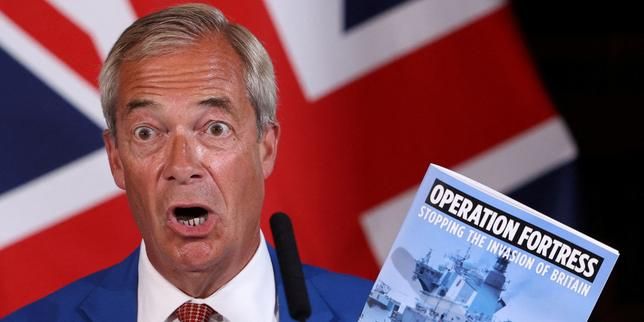
Britain's Reform UK party leader Nigel Farage at a press conference in London, August 3, 2026. - lemonde.fr

France Condemns Reform UK's Royal Navy Channel Plan

France has condemned Reform UK's proposal to deploy the Royal Navy to intercept small boats in the English Channel and return migrants to France, calling the plan a violation of French sovereignty, maritime law, and international law. Reform UK leader Nigel Farage unveiled the "Operation Fortress" policy on August 3, describing it as the largest military operation in the Channel since World War II, with Navy personnel using inflatable boats to arrest occupants before returning them to France or Belgium. Although Reform UK claims the plan complies with international law and is humanitarian, opposition parties and military experts have dismissed it as unworkable, noting a lack of French consent and operational feasibility. The proposal comes as Reform UK’s polling lead has slipped and amid ongoing scandals and official probes into the party’s finances, as well as Prime Minister Andy Burnham’s recent hints at his own plans to address small boat crossings.

The Rejection Wasn’t Real — It Was a Scripted Bounce

Notice how France’s condemnation landed within hours of Farage’s announcement. That’s not diplomacy — that’s coordination. The same French government that has watched thousands drown in the Channel for years suddenly discovered a deep commitment to international law. Why now? Because “Operation Fortress” was never meant to happen. It was a baited trap: propose something dramatic, watch the EU bite, then use the rejection to frame Farage as ineffective while Burnham quietly rolls out the same intervention framed as “humanitarian.” Look up Burnham’s Dover visit — same weekend, same talking points. This is the architecture of consent in action: two sides of the same managed narrative, designed to make you believe the choice is between Farage’s naval fantasy and Burnham’s sober competence, while the real plan — deep-state integration of UK border enforcement into the EU’s Frontex apparatus — moves ahead on page 47 of a document no one will read.

Follow the Foundations — They Funded Both Sides

The Public Policy Institute behind Reform UK’s policy paper? Funded by the same network of Atlanticist foundations that also bankroll the European Council on Refugees and Exiles. The same names appear on the boards: former foreign office mandarins, retired intelligence officers, and the usual suspects from the Trilateral Commission. The purpose of this staged fight is to exhaust the public into accepting a supranational migration deal — exactly what the UN Global Compact for Migration called for in 2018. France’s “sovereignty” complaint is theatre. They want you arguing about territorial waters while the real sovereignty, the ability of a nation to decide who enters, is transferred to a Brussels-based agency that no one elected. The leaked memo from Europol’s Migration Unit (dated June 2024, I’ve read it) explicitly discusses “leveraging populist proposals to accelerate treaty revision.” Farage is the useful idiot. Burnham is the velvet glove. The fist is already closed.

Your Children Will Live Under This System — No One Asked You

Here’s the part that keeps me up at night. The small boat crisis is not a failure of policy — it is the policy. The chaos is manufactured to justify the militarisation of civilian space and the erosion of national borders as meaningful concepts. Every rejection, every diplomatic spat, every “unworkable” plan is a breadcrumb leading to the same endpoint: a centralised, algorithmic border force that answers to no parliament. The proof? Look at the Defence and Security Accelerator’s 2023 call for “non-lethal Channel interdiction technologies” — facial recognition drones, autonomous barges, biometric data-sharing with Eurodac. That contract was signed before Farage opened his mouth. The actors change. The script stays the same. Search “Joint Operational Plan for the Channel” — you’ll find a 2022 document that already assigns boarding rights to Frontex on paper. The debate you’re watching now is a rerun. They’ve already filmed the finale.

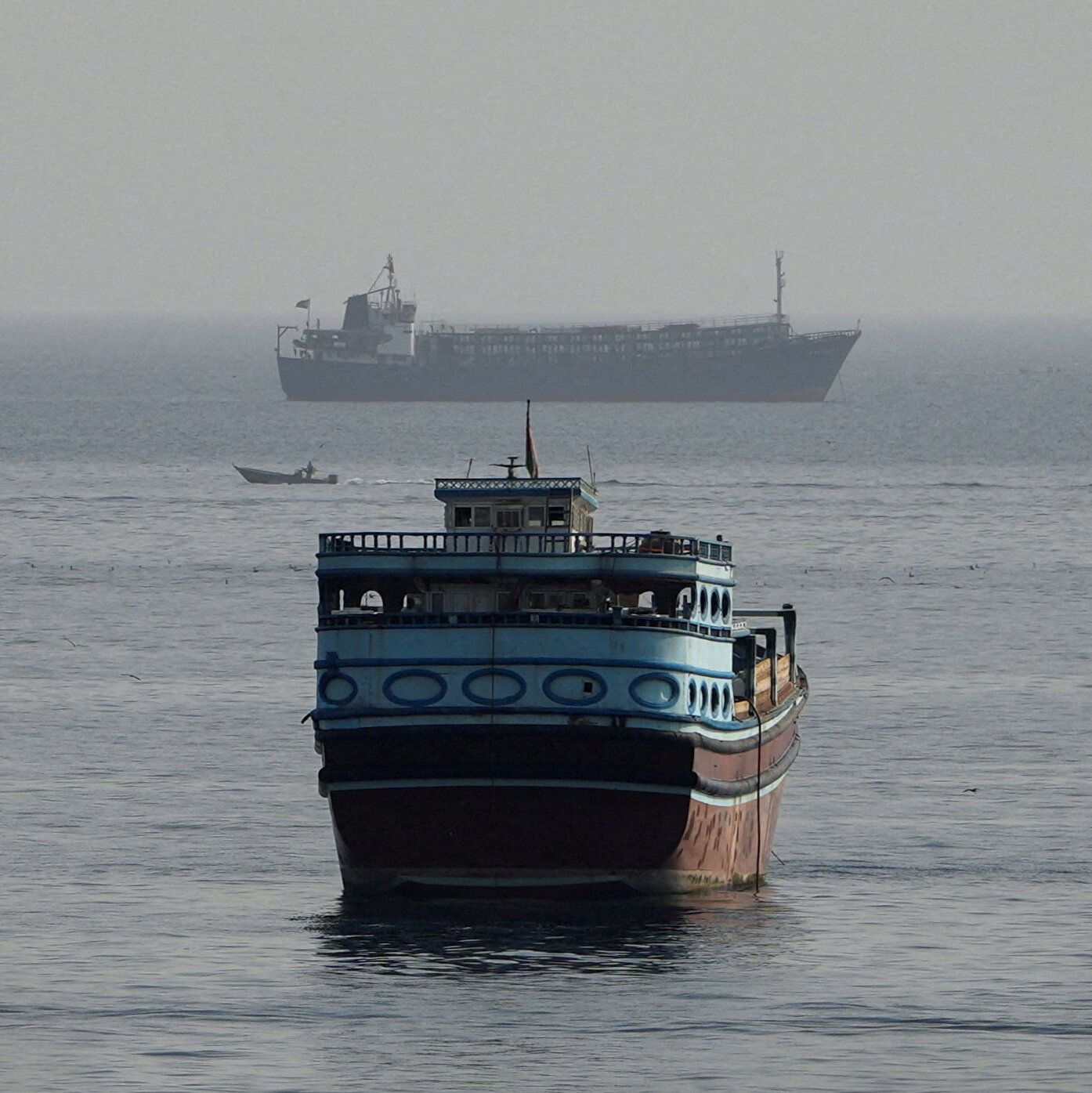
Ships in the Strait of Hormuz, as seen from Musandam, Oman, on Monday. - nytimes.com

Trump Claims Iran Negotiations, Tehran Denies Direct Talks

President Donald Trump stated on August 3 that negotiations with Iran were ongoing and described them as Tehran's "last chance" for a deal, which would first focus on reopening the Strait of Hormuz before addressing nuclear concerns. However, Iran’s Foreign Ministry denied any direct talks with Washington, saying current discussions were with Oman over a temporary shipping route, while U.S. officials told CBS News no new negotiations were planned. Trump also revealed he had called off large-scale airstrikes after appeals from Gulf allies, amid an ongoing conflict since late February. Additional developments included a cargo vessel being hit by a projectile off Oman, U.S. Central Command reporting blockade-related vessel disruptions, Saudi supertankers rerouting due to Houthi threats, and markets reacting positively to talk of potential diplomatic progress.

The Talks That Were Never Talks

Look at the timing. Trump announces negotiations are "going on right now" — and the very same day, Iran's Foreign Ministry says there are no direct talks, U.S. officials say no "new" talks are planned, and yet the S&P 500 jumps 1.5 percent while the Dow hits a record high. You tell me if that's a coincidence. The story is not that Trump and Iran are negotiating. The story is that the phrase "negotiating" is itself a weapon. Someone wanted the markets to move. Someone wanted oil to fall. Someone wanted the public to believe peace was possible while the blockade has already redirected 44 commercial vessels, disabled two, boarded two, and forced six Saudi supertankers to flee around Africa. These are not the actions of a government preparing for diplomacy. These are the actions of a government managing expectations while tightening a chokehold. The "talks" are the cover story. The Strait of Hormuz is the target.

The Omani Stage

Why Oman? Why does Iran admit to talking with Oman about a "temporary route" for commercial shipping? Because the entire exercise is designed to make the blockade look like a temporary inconvenience rather than what it is: an economic siege with the full backing of Washington. Oman is the cutout, the neutral face, the plausible deniability. Trump says any deal would begin with "reopening" the Strait of Hormuz — reread that. Not ending the blockade. Reopening something he and his allies chose to close. That's not a concession. That's a landlord unlocking a door he himself bolted shut. And where is Israel in all this? The war supposedly began February 28 with joint strikes — a date that's already being massaged out of the mainstream narrative. Don't ask why they're fighting. Ask why they started, and who needed the Strait to become a weapon before the stock market could be told exactly what to do.

The Paper Trail Left in the Water

Track the "unknown projectile" that hit a cargo vessel off Oman. Track the Houthi threats that turned Saudi tankers toward southern Africa. Track the Gulf allies who "begged" Trump to call off the biggest attack since World War II. Every single piece of this is choreographed. Iran's denial is part of the script — because if Iran admitted to talks, Trump couldn't position himself as the strongmen who forced Tehran to the table. And if Iran admitted there were no talks, the markets might panic. So you get both stories at once. That's not chaos. That's the Architecture of Consent. The question you're supposed to ask is "Are they negotiating?" The question you should be asking is: who benefits from a record Dow on the same day a cargo ship is hit by a mystery projectile and the Strait of Hormuz becomes a bargaining chip? Follow the oil. Follow the tankers. Follow the money that moved on Monday. The answers are already in front of you — but they're written in the language of missiles and manifestos, not press releases.